However, as in past years, some states will add LIS qualifying plan options, whereas some other states will be losing a few LIS $0 premium qualifying Medicare Part D plan options.
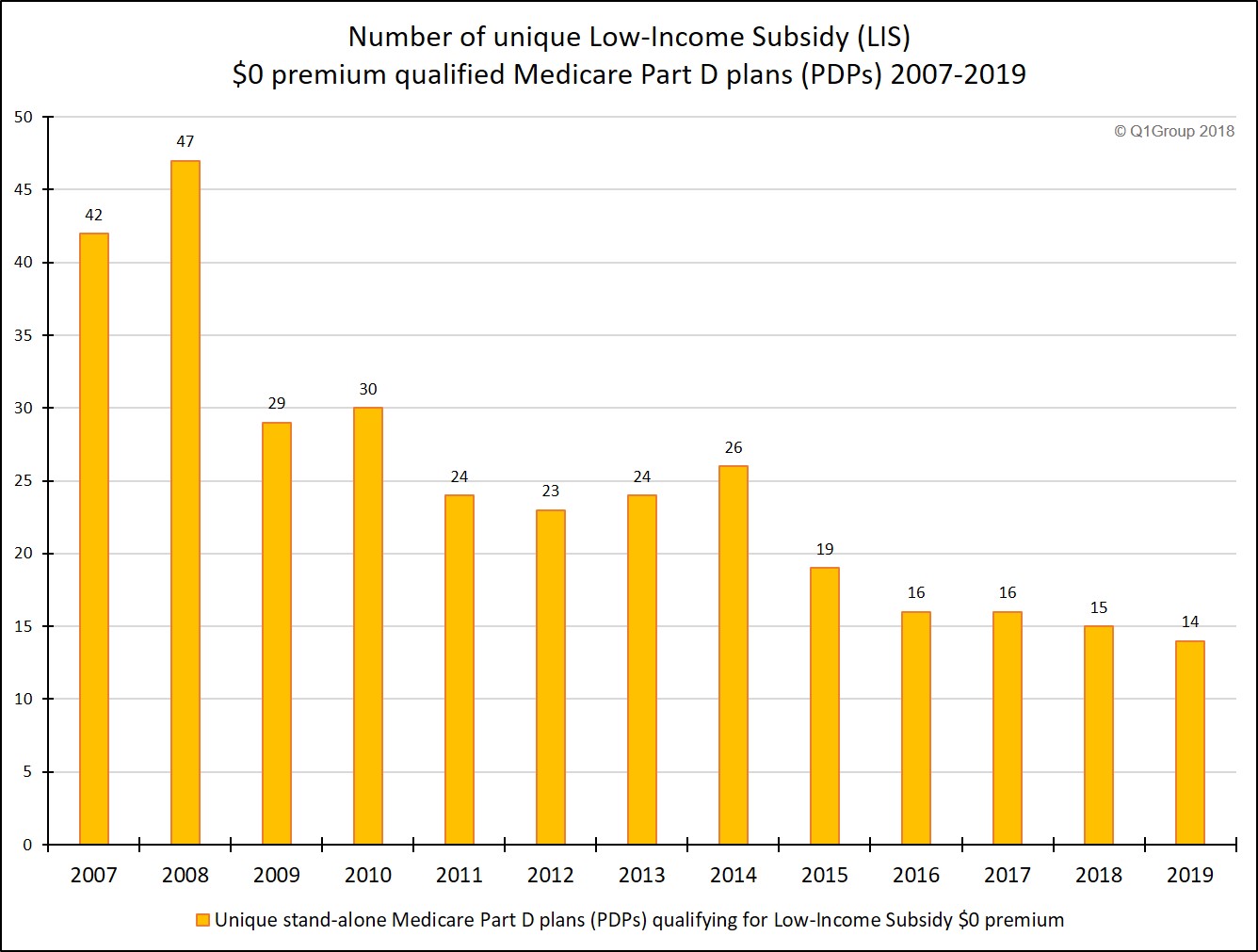
As an example of state plan changes, Louisiana will offer eight (8) LIS $0 premium qualifying 2019 Medicare Part D plans as compared to the six (6) LIS-qualifying plans in 2018.
Alternatively, Texas will be losing two LIS $0 qualifying Medicare Part D plan in 2019 and lower-income Texas residents will have access to five 2019 Medicare Part D plans qualifying for the state’s Low-Income Subsidy (LIS) $0 premium benchmark.
The state with the smallest selection of $0-premium LIS Medicare Part D plans is...
As is also true in 2018, the state offering the smallest selection of 2019 Medicare Part D plans qualifying for the LIS $0 premium continues to be Florida, offering only two (2) LIS $0-premium qualifying Medicare Part D plans.
The states with the largest selection of LIS-qualifying $0 premium Medicare Part D plans is...
The state offering the largest selection of ten (10) $0 premium LIS plans in 2019 continue to be Arizona. In 2018, Delaware, Maryland, and Washington, DC also offered 10 LIS plans, however in 2019, they will lose one (1) LIS plan and only have a selection of nine (9) full-LIS plans.
In comparison to 2019, in 2015, the states with the largest selection of LIS $0 premium plans were Alabama, Arizona, Idaho, Tennessee, and Utah, all with 12 Medicare Part D plans qualifying for the 2015 LIS $0 premium.
The state with the largest number of LIS recipients is...
The state with the most Medicare beneficiaries qualifying for the low-income subsidy (LIS or Extra Help Program) is California (almost 1.4 million “Extra Help” recipients). In 2019, California LIS recipients will have seven (7) Medicare Part D plan choices qualifying for the $0 premium (up from five LIS $0 premium Part D plans in 2018).
What Medicare Part D plan providers are offering 2019 LIS-qualifying plans?
From our national stand-alone PDP-Facts page, here is a table showing a comparison of the 2018 and 2019 Medicare Part D plans qualifying for the $0 premium Low-Income Subsidy.
$0 Premium LIS Qualified stand-alone Medicare Part D Plans
|
|
||||||||||||||||||||||||||||||||||||||||||||||||||||||||||||||||||
Please note, not all plans are available in every state.
Historical changes in the number of LIS-Qualifying Medicare Part D plans
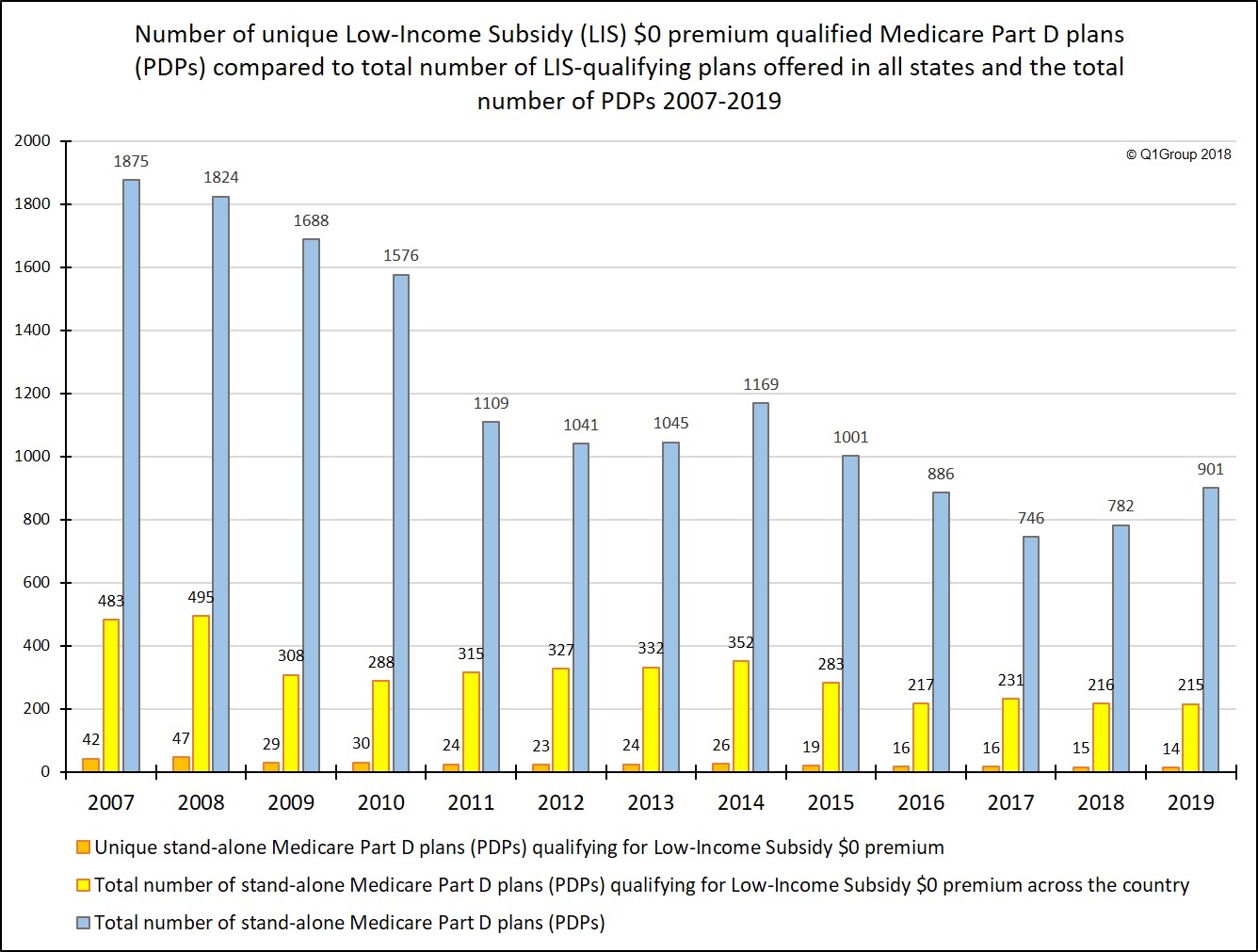
A few more 2019 LIS $0 premium facts:
- Texas is losing two (2) LIS $0 premium plans
- Eight (8) states are losing one LIS $0 premium plan
- Thirty-one (31) states have no change in the number of LIS $0 premium plans being offered
- Nine (9) states are gaining one LIS $0 premium plan
- California and Louisiana are gaining two LIS $0 premium plans
Which Medicare Part D plans qualify for the full Low-Income Subsidy $0 premium in your state?
Each year, insurance companies adjust their Medicare Part D plan premiums, and some Medicare Part D plans raise their premiums and move their prescription drug plans above the state low-income subsidy (LIS) benchmark limits, while other Part D plan sponsors lower their monthly premiums so that their plans can qualify for a state’s $0 premium.
This means that the number of Medicare Part D plans qualifying for the LIS $0 premium can change each year. Click on the 2019 premium for your state in our state low-income subsidy (LIS) benchmark limits article to see qualifying plans in your state.
More on Medicare Part D Extra Help
The Medicare Part D Extra Help or the Low-Income Subsidy (LIS) is a federal program helping low-income Medicare beneficiaries pay a portion of their Medicare Part D prescription drug costs. Based on a person’s income and financial resources, the Extra Help or LIS program pays all or part of a person’s monthly Medicare Part D plan premiums and a significant portion of the beneficiary’s medication costs.
If you qualify for the full-LIS program, you can choose a Medicare Part D plan that qualifies for your state’s $0 monthly premium or allow yourself to be automatically enrolled in a plan that qualifies for the $0 premium. If you enroll in a Medicare Part D plan that does not qualify for the $0 premium, you will pay a portion of the premium. The monthly premium amount you will pay is shown under the "Benefit Details" button on our Medicare Part D plan finder.
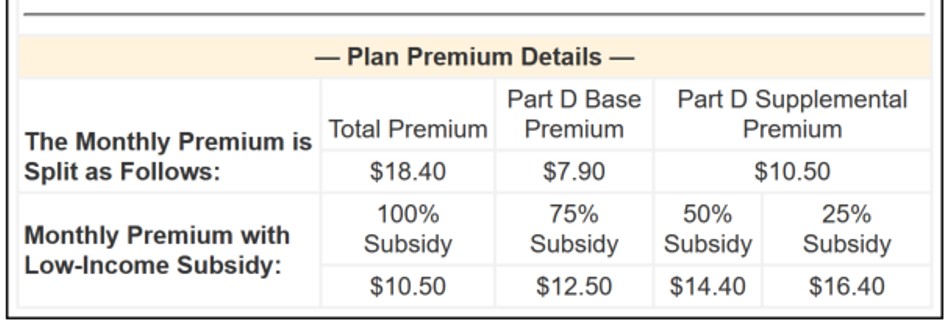
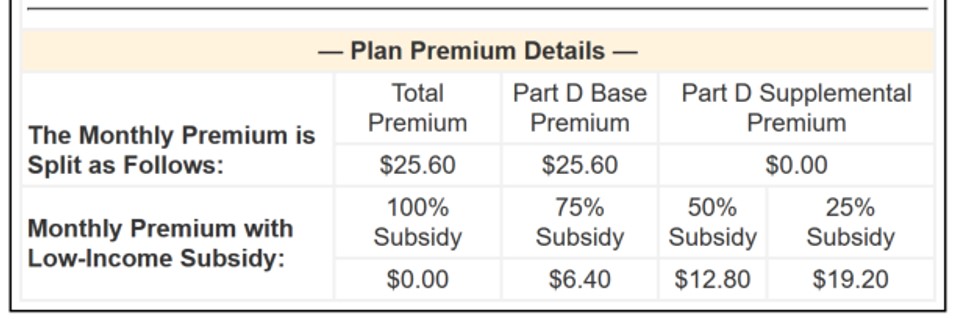
; As can be seen in the above graphic, if you qualify for only "partial-LIS benefits" (such as 50% LIS), you will also only pay a portion of the plan's monthly premium.
Please note, our Medicare Part D plan finder allows you to view the premiums of a Medicare Part D plan based on whether you receive full - or partial-LIS benefits.
The PDP-Finder.com feature looks like this:
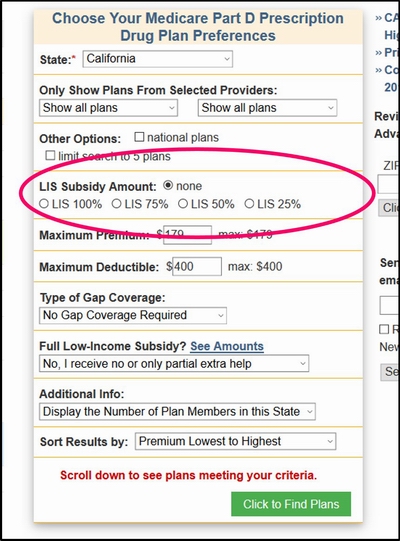
The applicable monthly premium will be shown in the search results and can be found on our "Benefit Details" page, for example:
A Brief note about automatic plan reassignment and people who are "choosers"
Because of changes in the annual Medicare Part D plan premiums and state LIS benchmarks, some full low-income subsidy qualifying Medicare beneficiaries (such as people who are Medicare / Medicaid dual-eligible beneficiaries) may be automatically reassigned to new 2018 Medicare Part D plans that will still qualify for the $0 monthly premium.
However, Extra Help recipients who "chose" their own plan in the past (or "choosers") may notbe auto-reassigned to a new 2018 LIS qualifying plan and may need to select a new 2019 Medicare Part D plan or Medicare Advantage plan that includes drug coverage that still meets the $0 monthly premium threshold (or pay the small monthly premium). As reference, you can use our PDP-Finder to see LIS qualifying plans in your state. Be sure to select “Yes, show only plans that qualify for $0 premium". Click here to see an example for Texas.
Not sure where to begin?
For more information on Medicare Part D plans that qualify for your state's low-income $0 premium benchmark, please call Medicare toll-free at 1-800-633-4227 and speak with a Medicare representative to learn more about your Medicare Part D and Medicare Advantage plan options.