Not always. If you are "Dual Eligible", qualifying for
both Medicare and Medicaid, you will automatically qualify for the Medicare Part
D Low-Income Subsidy (LIS) or Extra Help program.
If you have LIS benefits and enroll in a "basic" Medicare Part D plan (designated as DS, AE, or BA plans) with a monthly premium at or below your state’s LIS premium benchmark, you should have a $0 monthly premium for your Part D drug coverage.
The LIS benchmark premiums are released every year and establish the maximum premium subsidy that would complete pay the monthly Medicare Part D premiums for people who qualify to receive LIS benefits. The LIS $0 benchmark premium is usually slightly different for every CMS Part D region.
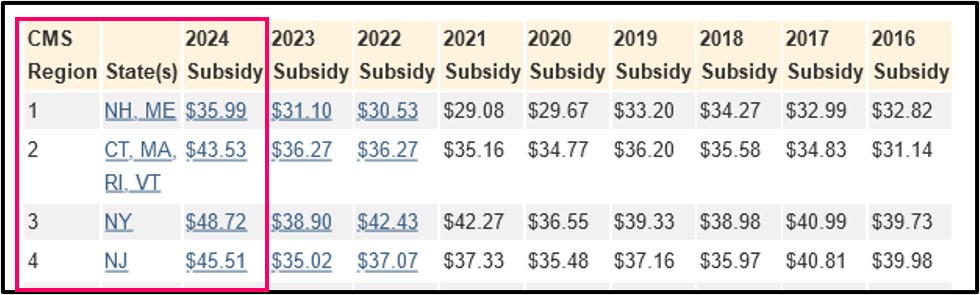
For example, the 2024 California $0 LIS Benchmark Premium is $40.98 and if you qualify for Extra Help and enrolled in a "basic" Medicare Part D plan with a premium below (or slightly over) the benchmark, you would pay a $0 premium. So if you chose the 2024 Wellcare Classic (PDP) Medicare Part D plan that has a $35.90 premium, you would pay a $0 premium.

See the 2025 Wellcare Classic (PDP)
If you qualify for LIS benefits, but choose a Part D plan with a premium higher than the state benchmark, you may pay a portion of your premium that exceeds your state’s benchmark.
In this situation, if you enrolled in the 2024 AARP MedicareRx Saver Plus (PDP) that has a $89.80 premium, you would pay $48.80 per month premium (roughly the $89.80 premium - the $40.98 benchmark premium).

See the 2025 AARP MedicareRx Saver Plus (PDP)
Important: If you qualify for LIS benefits and enroll in a Medicare Part D plan that does not qualify for your state's $0 LIS premium, you will pay a monthly premium that is roughly calculated as the difference between your state's benchmark premium and the Medicare plan's premium.
The good news is that, if you qualify for Medicare Part D Extra Help, you may be able to use the Dual-Eligible Special Enrollment Period to change Medicare Part D plans throughout the year. Beginning with plan year 2025, the ability for Extra Help beneficiaries to change plans during the plan year depends on whether your Medicare plan is a stand-alone Part D plan or a Medicare Advantage plan. Learn more about the timing for the Dual-Eligible SEP.
Your newly chosen plan becoming effective the first day of the month after enrollment.
If you have LIS benefits and enroll in a "basic" Medicare Part D plan (designated as DS, AE, or BA plans) with a monthly premium at or below your state’s LIS premium benchmark, you should have a $0 monthly premium for your Part D drug coverage.
The LIS benchmark premiums are released every year and establish the maximum premium subsidy that would complete pay the monthly Medicare Part D premiums for people who qualify to receive LIS benefits. The LIS $0 benchmark premium is usually slightly different for every CMS Part D region.
For example, the 2024 California $0 LIS Benchmark Premium is $40.98 and if you qualify for Extra Help and enrolled in a "basic" Medicare Part D plan with a premium below (or slightly over) the benchmark, you would pay a $0 premium. So if you chose the 2024 Wellcare Classic (PDP) Medicare Part D plan that has a $35.90 premium, you would pay a $0 premium.
See the 2025 Wellcare Classic (PDP)
If you qualify for LIS benefits, but choose a Part D plan with a premium higher than the state benchmark, you may pay a portion of your premium that exceeds your state’s benchmark.
In this situation, if you enrolled in the 2024 AARP MedicareRx Saver Plus (PDP) that has a $89.80 premium, you would pay $48.80 per month premium (roughly the $89.80 premium - the $40.98 benchmark premium).
See the 2025 AARP MedicareRx Saver Plus (PDP)
Important: If you qualify for LIS benefits and enroll in a Medicare Part D plan that does not qualify for your state's $0 LIS premium, you will pay a monthly premium that is roughly calculated as the difference between your state's benchmark premium and the Medicare plan's premium.
The good news is that, if you qualify for Medicare Part D Extra Help, you may be able to use the Dual-Eligible Special Enrollment Period to change Medicare Part D plans throughout the year. Beginning with plan year 2025, the ability for Extra Help beneficiaries to change plans during the plan year depends on whether your Medicare plan is a stand-alone Part D plan or a Medicare Advantage plan. Learn more about the timing for the Dual-Eligible SEP.
Your newly chosen plan becoming effective the first day of the month after enrollment.
Question: Which Medicare Part D plans qualify for the $0 premium?
You can quickly see the Medicare Part D plans (PDPs) in your state that qualify for the $0 premium (that is, the PDPs that meet your state's $0 LIS benchmark premium and offering a basic or standard Medicare Part D plan design (DS, AE, BA)) at PDP-Finder.com/FL.
Please note: you will notice that a low-costing Medicare Part D plan in the example graphic below (see current plans here) does not qualify for the $0 premium -- even though its premium is less than the Florida (2023) $0 benchmark premium ($35.92) -- because the plan offers enhanced (EA) Medicare Part D coverage rather than basic coverage. You will also notice that a Medicare Part D plan may meet the state $0 benchmark premium in one state and not qualify for the $0 premium in another state.
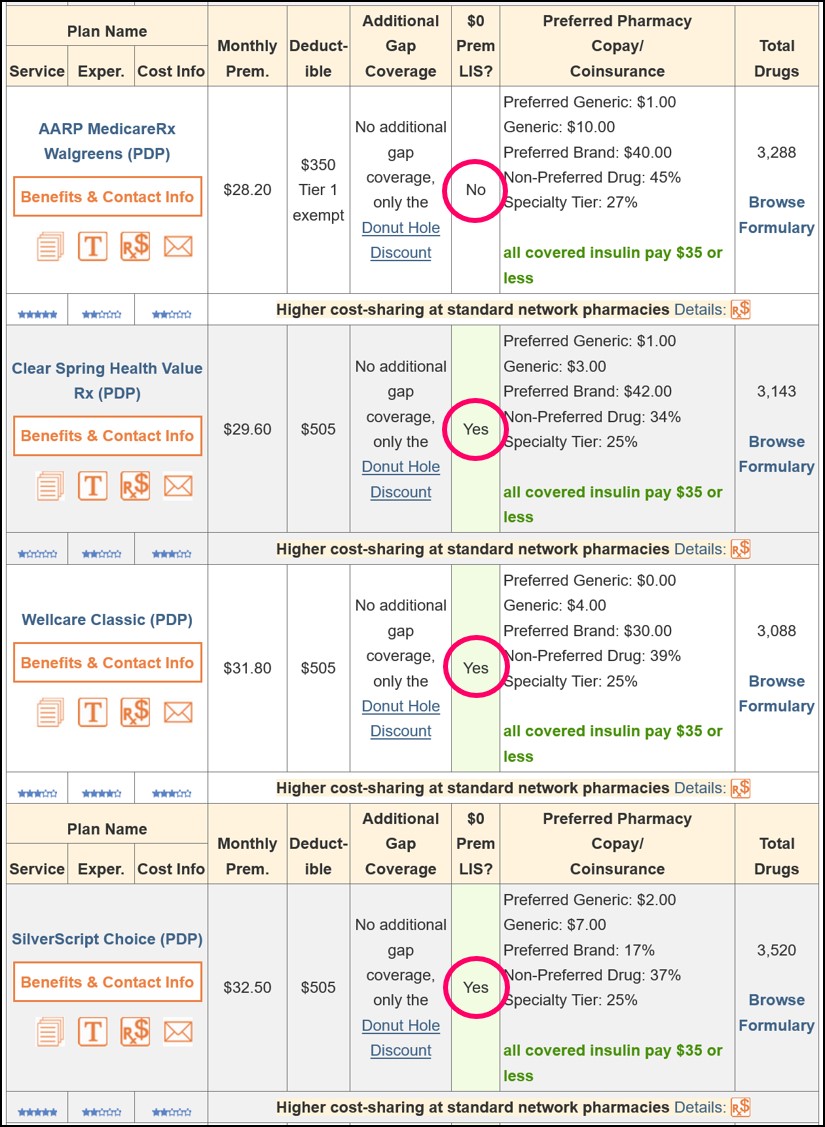
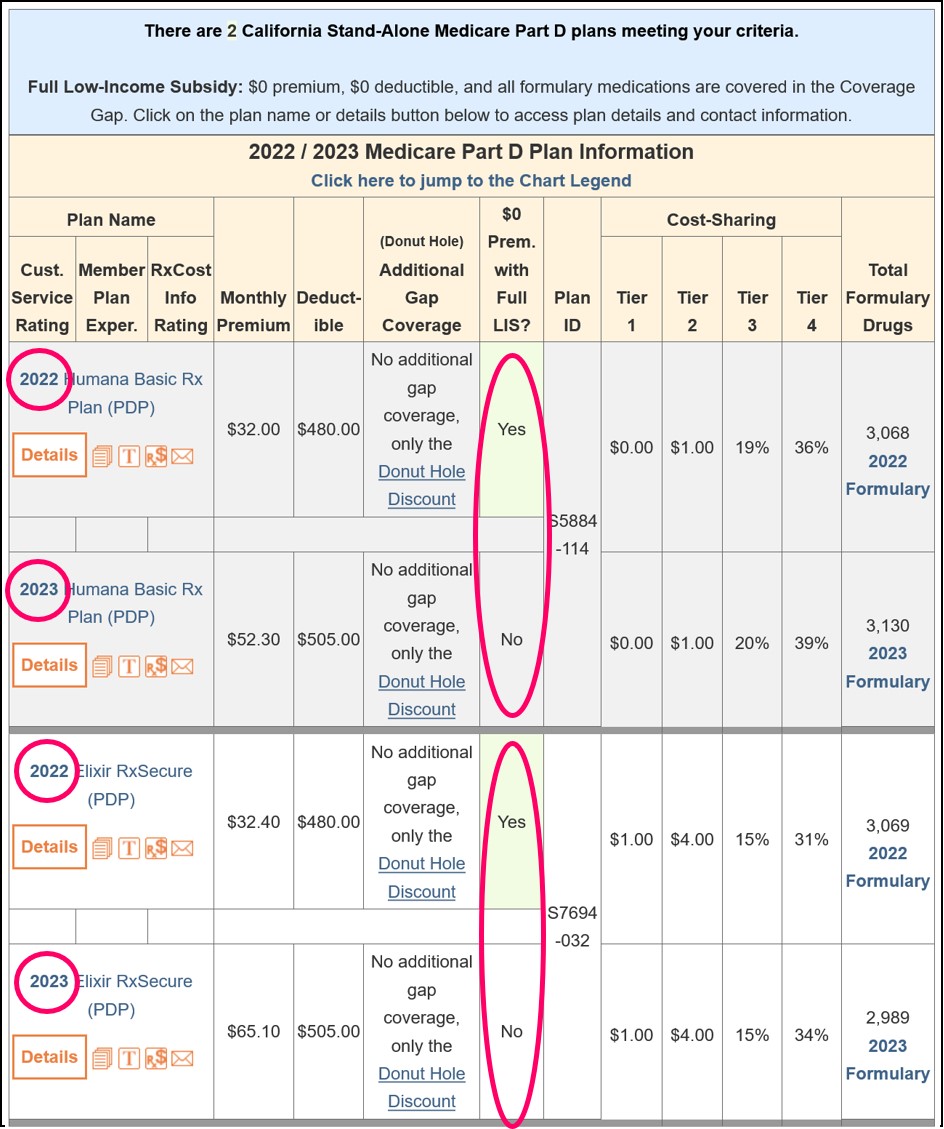
But, state LIS benchmark premiums and Medicare Part D plans change each year - and the Medicare plans that qualify for the state's $0 benchmark premium also change each year. You can see how Medicare Part D plans change each year using our Medicare Part D compare tool (PDP-Compare.com/CA).
So as you can see in this older 2022/2023 example below using PDP-Compare, it is possible that your Medicare Part D plan might qualify as a $0 premium plan one year and then next year the same Medicare plan does not qualify for the $0 premium.
A bit of pre-2024 Medicare Part D history...
Plan year 2023 was the last year for partial-LIS benefits. Starting with plan year 2024, the Inflation Reduction Act (IRA) increased full-Extra Help benefits to people at or below 150% of FPL and consequently, the current partial Extra Help (135% to 150% of FPL) designation will be eliminated.
Question: Where can I see the 2023 plan premium if I had partial-LIS benefits?
In the past, you may have only qualified for partial-LIS benefits (instead of full-LIS benefits); however, beginning in plan year 2024, full-LIS benefits have been expanded to 150% of FPL and therefore full-LIS benefits are extended to beneficiaries who formerly received only partial-LIS benefits. See more about Medicare Part D changes made through the Inflation Reduction Act (IRA).
For plan years prior to 2024, if you click on the Medicare Part D plan name while using PDP-Finder or PDP-Compare, and scroll through the plan's coverage details to the premium details section, you can see the premium paid with full-LIS status or partial-LIS status (see 2023 example below).
For More Information:
Please see our FAQ: "I am qualified for Medicaid and Medicare, so why am I still paying a premium for my Medicare Part D prescription drug plan?"
To learn more and apply for Extra Help, you can call Social Security at 1-800-772-1213 (TTY 1-800-325-0778) or visiting www.socialsecurity.gov or contact your local state Medicaid office. For more assistance with choosing a Medicare Part D or Medicare Advantage plan call 1-800-MEDICARE (1-800-633-4227). TTY users should call 1-877-486-2048.
Or you can visit the Medicare.gov Medicare Prescription Drug Plan Finder for a list of the Medicare drug plans available in your area.
Again, to help with your plan search, we also offer our Medicare Part D Plan Finder and Plan Overview by State.
(Primary source: U.S. Department of Health & Human Services)
Plan year 2023 was the last year for partial-LIS benefits. Starting with plan year 2024, the Inflation Reduction Act (IRA) increased full-Extra Help benefits to people at or below 150% of FPL and consequently, the current partial Extra Help (135% to 150% of FPL) designation will be eliminated.
Question: Where can I see the 2023 plan premium if I had partial-LIS benefits?
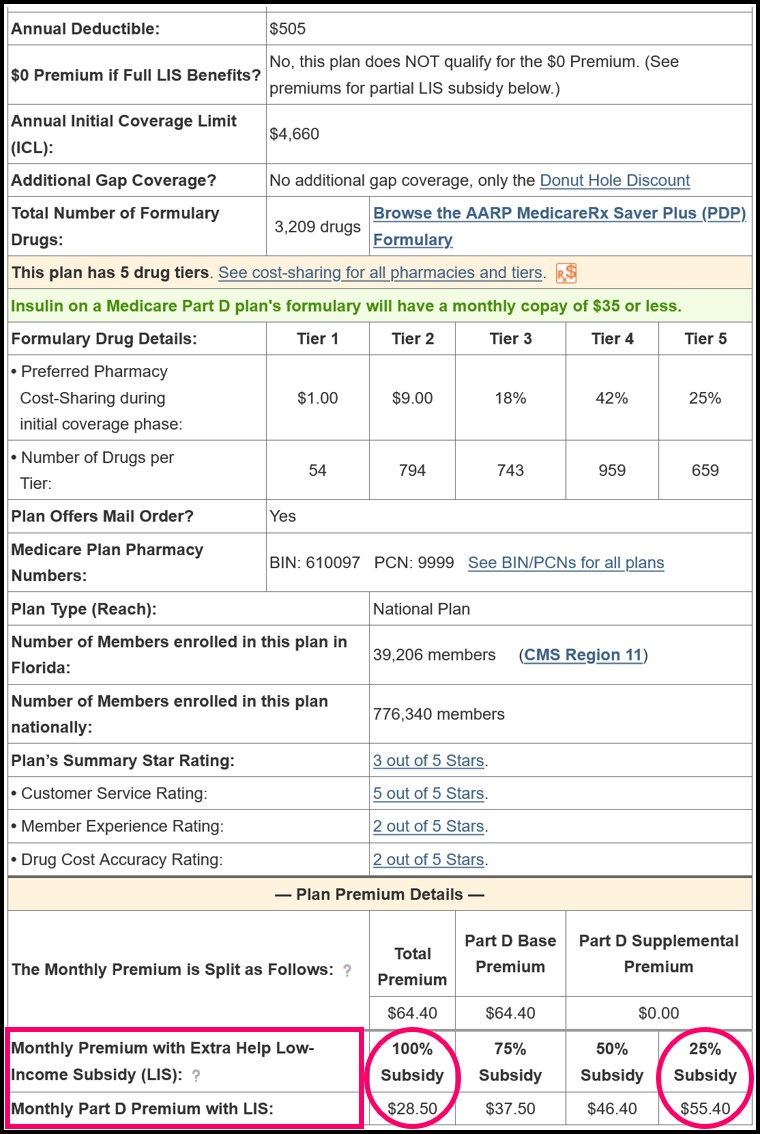
In the past, you may have only qualified for partial-LIS benefits (instead of full-LIS benefits); however, beginning in plan year 2024, full-LIS benefits have been expanded to 150% of FPL and therefore full-LIS benefits are extended to beneficiaries who formerly received only partial-LIS benefits. See more about Medicare Part D changes made through the Inflation Reduction Act (IRA).
For plan years prior to 2024, if you click on the Medicare Part D plan name while using PDP-Finder or PDP-Compare, and scroll through the plan's coverage details to the premium details section, you can see the premium paid with full-LIS status or partial-LIS status (see 2023 example below).
For More Information:
Please see our FAQ: "I am qualified for Medicaid and Medicare, so why am I still paying a premium for my Medicare Part D prescription drug plan?"
To learn more and apply for Extra Help, you can call Social Security at 1-800-772-1213 (TTY 1-800-325-0778) or visiting www.socialsecurity.gov or contact your local state Medicaid office. For more assistance with choosing a Medicare Part D or Medicare Advantage plan call 1-800-MEDICARE (1-800-633-4227). TTY users should call 1-877-486-2048.
Or you can visit the Medicare.gov Medicare Prescription Drug Plan Finder for a list of the Medicare drug plans available in your area.
Again, to help with your plan search, we also offer our Medicare Part D Plan Finder and Plan Overview by State.
(Primary source: U.S. Department of Health & Human Services)
- Browse Medicare Part D prescription drug plans
- Browse Medicare Advantage plans (MAPD)
- Sign-up for our Medicare Part D Newsletter.
- Still have a question? Click here to let us know.