Remember: We show the average negotiated retail drug prices - and you will find that the actual retail prices can vary pharmacy-to-pharmacy (so CVS retail prices may not be the same as prices at WalMart or Walgreens) and prices can change week-to-week. Also, please note that the average negotiated retail drug price can vary state-to-state as you travel with your Medicare Part D plan.
Here is an example of our on this site Drug Finder showing how the retail price of a popular generic medication can vary between Medicare Part D plans (the estimated cost using a Drug Discount Card is shown at the top of the the drug finder® table).
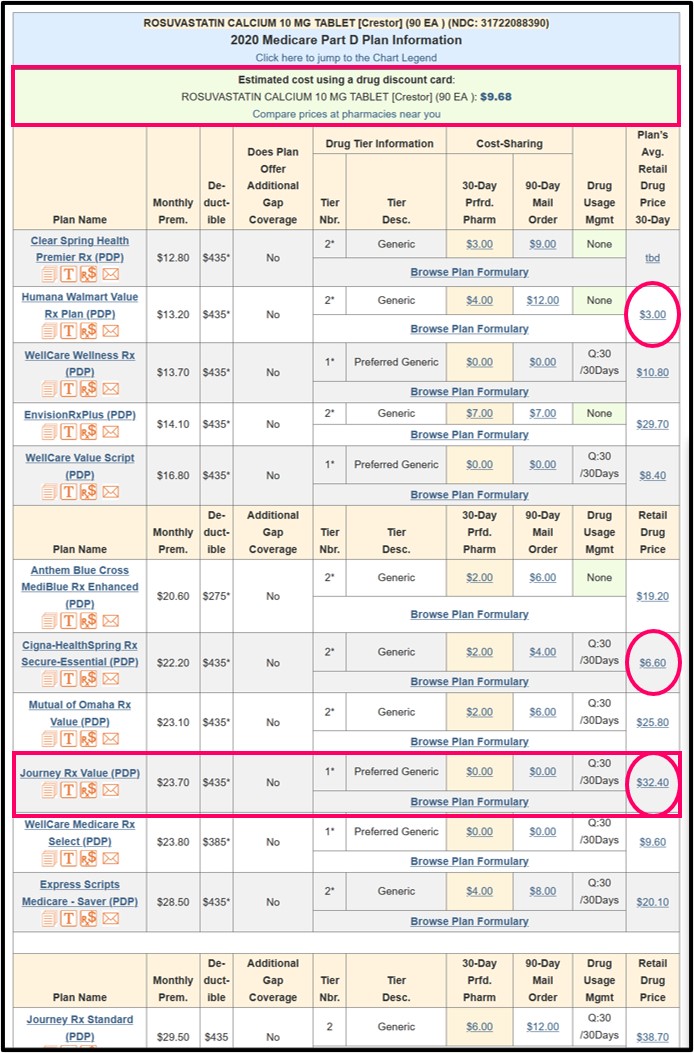
To see how a retail price can change with a certain Medicare Part D plan, you can click on the average negotiated retail drug price (in this example, the Cigna-HealthSpring price of $6.60) to view the pricing history for a particular plan and drug.
The same average retail drug pricing information is also available when using our Formulary Browser and clicking on the 30-day supply or 90-day supply cost-sharing figures.
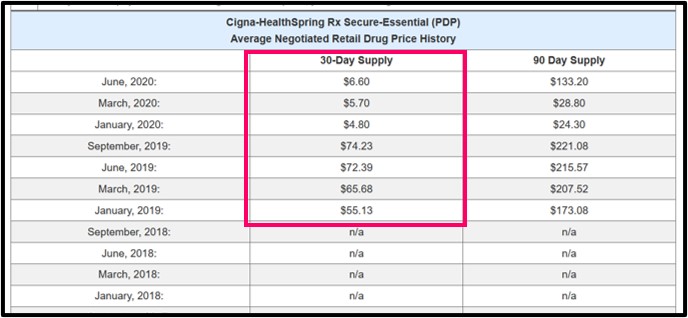
See the 2021 Rosuvastatin data and see the current Rosuvastatin data.
Question: Why are retail drug prices important when you have Medicare drug coverage?
Higher retail drug costs can mean that you pay more for your drug coverage - and move faster through the phases of your Medicare drug coverage.
- Retail drug costs determine the time you spend in the Initial Deductible.
If your Medicare prescription drug plan has an initial deductible, retail drug prices will affect how long you stay in the
deductible.
- Retail drug costs can determine what you will pay in the Initial Coverage phase.
If your Medicare prescription drug plan uses coinsurance cost sharing, then you will pay a percentage of the retail drug costs for your formulary drugs. For example, if you pay a 25% coinsurance for a medication that has a negotiated retail drug price of $100, your cost-sharing is $25. If the retail drug price increases to $200 during the plan year, you will pay $50 for the same medication - even though the coverage cost was $25 for the same drug back when you enrolled in the plan.
- Retail drug prices can influence on which drug tier your drug will be placed.
Your Part D plan may place drugs will higher retail drug costs on formulary drug tiers with higher cost-sharing.
Still, the bottom line is: With higher retail drug price your out-of-pocket cost can be different than what you predicted when you chose your Medicare Part D drug plan last fall - meaning, you may no longer be enrolled in the most economic Medicare prescription drug plan.