If you are a Medicare beneficiary with higher annual earnings, you may be assessed an Income-Related Monthly Adjustment Amount (or IRMAA) which is an additional amount that you pay together with your monthly Medicare Part D prescription drug plan premiums and your monthly Medicare Part B premiums (for out-patient or doctor visit coverage).
Medicare beneficiaries are assessed Medicare Part D IRMAA and Medicare Part B IRMAA based on their modified adjusted gross income (or MAGI) - specifically when MAGI exceeds certain threshold amounts that can change each year.
As noted by the Centers for Medicare and Medicaid Services (CMS):
Medicare beneficiaries are assessed Medicare Part D IRMAA and Medicare Part B IRMAA based on their modified adjusted gross income (or MAGI) - specifically when MAGI exceeds certain threshold amounts that can change each year.
As noted by the Centers for Medicare and Medicaid Services (CMS):
"Changes in the law affect how Medicare prescription drug coverage premiums are calculated for those with higher incomes. Beginning January 1, 2011, if you have a higher income, you will pay a higher premium for your Medicare prescription drug coverage (Part D). If your income is $85,000 or above (individual) or $170,000 or above (married filing jointly), you must pay an extra premium amount for your Medicare Part B and Medicare prescription drug coverage [Medicare Part D]. This extra premium amount is called the income-related monthly adjustment amount (IRMAA). This amount is based on your modified adjusted gross income as reported on your IRS tax return from 2 years ago (your most recent tax return)."And as noted by Medicare:
"Under §1839(i)(5) [of the Social Security Act], the dollar amount for the income tiers will be adjusted annually based on the Consumer Price Index. However, in accordance with §3204 of the Affordable Care Act, these income threshold amounts will remain at the 2010 levels for calendar years 2011-2019."
"Approximately 8% of people with Medicare Part D pay the income-related monthly adjustment amount in addition to their Part D premium."
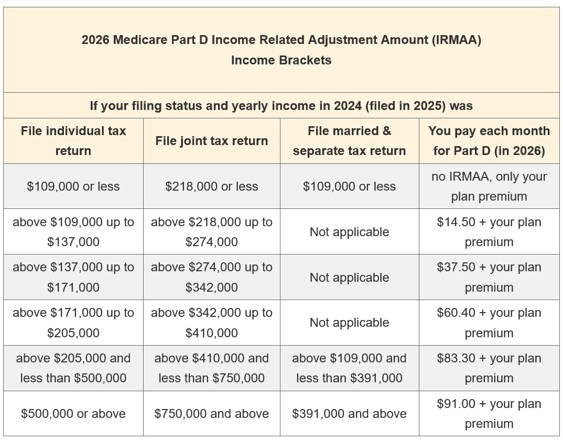
The Income Brackets for the 2026 Medicare Part D Income Related Adjustment Amount (IRMAA) are as follows:
Read more in our article:
2026 IRMAA: Slight increase in Medicare Part D IRMAA payments for some. at on this site
Question: How will I know if I have been assessed IRMAA?
If you are assessed Medicare Part D IRMAA, the Social Security Administration (SSA) will provide you with a written notice that will include:
(1) the amount of your Medicare Part D IRMAA (or PartD-IRMAA);
(2) what information was used by SSA to make the IRMAA determination; and
(3) how to request a review of the your Medicare Part D IRMAA determination.
Question: How will I pay my Part D IRMAA?
If you are assessed a Medicare Part D IRMAA, you will pay through premium withholding from your monthly Social Security benefits. If your monthly SSA benefit is not sufficient to pay the your IRMAA (or you do not receiving Social Security benefits, you will receive a bill for your IRMAA from another government office such as the Centers for Medicare and Medicaid Services (CMS) or the Office of Personnel Management (OPM) or the Railroad Retirement Board (RRB).
As noted by CMS:
Section 3308 of the Affordable Care Act amended §1860D-13(a)(7) of the Social Security Act and created the Medicare Part D Income Related Monthly Adjustment Amount that went into effect January 1, 2011.
As reference, review articles in our on this site section on the Income-Related Monthly Adjustment Amount (or IRMAA), where you will find articles specific to each plan year.
You can click on the following link and send us an email on this site
Sources include:
Part D-Income Related Monthly Adjustment Amount—Frequently Asked Questions & Answers, from Anthony Culotta, Director Medicare Enrollment & Appeals Group, December 10, 2010
If you are assessed Medicare Part D IRMAA, the Social Security Administration (SSA) will provide you with a written notice that will include:
(1) the amount of your Medicare Part D IRMAA (or PartD-IRMAA);
(2) what information was used by SSA to make the IRMAA determination; and
(3) how to request a review of the your Medicare Part D IRMAA determination.
Question: How will I pay my Part D IRMAA?
If you are assessed a Medicare Part D IRMAA, you will pay through premium withholding from your monthly Social Security benefits. If your monthly SSA benefit is not sufficient to pay the your IRMAA (or you do not receiving Social Security benefits, you will receive a bill for your IRMAA from another government office such as the Centers for Medicare and Medicaid Services (CMS) or the Office of Personnel Management (OPM) or the Railroad Retirement Board (RRB).
As noted by CMS:
"By law, income-related monthly adjustment amount (IRMAA) for prescription drug coverage must be withheld from Social Security [SSA], Railroad Retirement Board [RRB], or Office of Personnel Management [OPM] benefit checks unless the monthly payment isn’t enough to cover the entire amount owed. If your check isn’t enough to cover the entire amount, you will get a bill from Medicare."Question: What law established Medicare Part D IRMAA?
Section 3308 of the Affordable Care Act amended §1860D-13(a)(7) of the Social Security Act and created the Medicare Part D Income Related Monthly Adjustment Amount that went into effect January 1, 2011.
As reference, review articles in our on this site section on the Income-Related Monthly Adjustment Amount (or IRMAA), where you will find articles specific to each plan year.
You can click on the following link and send us an email on this site
Sources include:
Part D-Income Related Monthly Adjustment Amount—Frequently Asked Questions & Answers, from Anthony Culotta, Director Medicare Enrollment & Appeals Group, December 10, 2010
- Browse Medicare Part D prescription drug plans
- Browse Medicare Advantage plans (MAPD)
- Sign-up for our Medicare Part D Newsletter.
- Still have a question? Click here to let us know.