Question: But isn't the Donut Hole now closed?
Not exactly. Although we say that the Donut Hole "closed" in 2020 since you receive a 75% discount on all formulary drugs, you will still leave your Medicare Part D plan's Initial Coverage Phase once your retail drug costs exceed the Initial Coverage Limit. And when you leave your Initial Coverage Phase, you will enter the Coverage Gap (Donut Hole) where the cost of your formulary medications can increase, decrease, or stay the same - depending on your Medicare drug plan, your cost-sharing, and the drug's retail price.
You can click on our FAQ "Did the Coverage Gap or Donut Hole just close up and go away?" to read more.
Spoiler Alert: The Donut Hole or Coverage Gap phase is actually eliminated from your Medicare Part D coverage in 2025 (see more below).
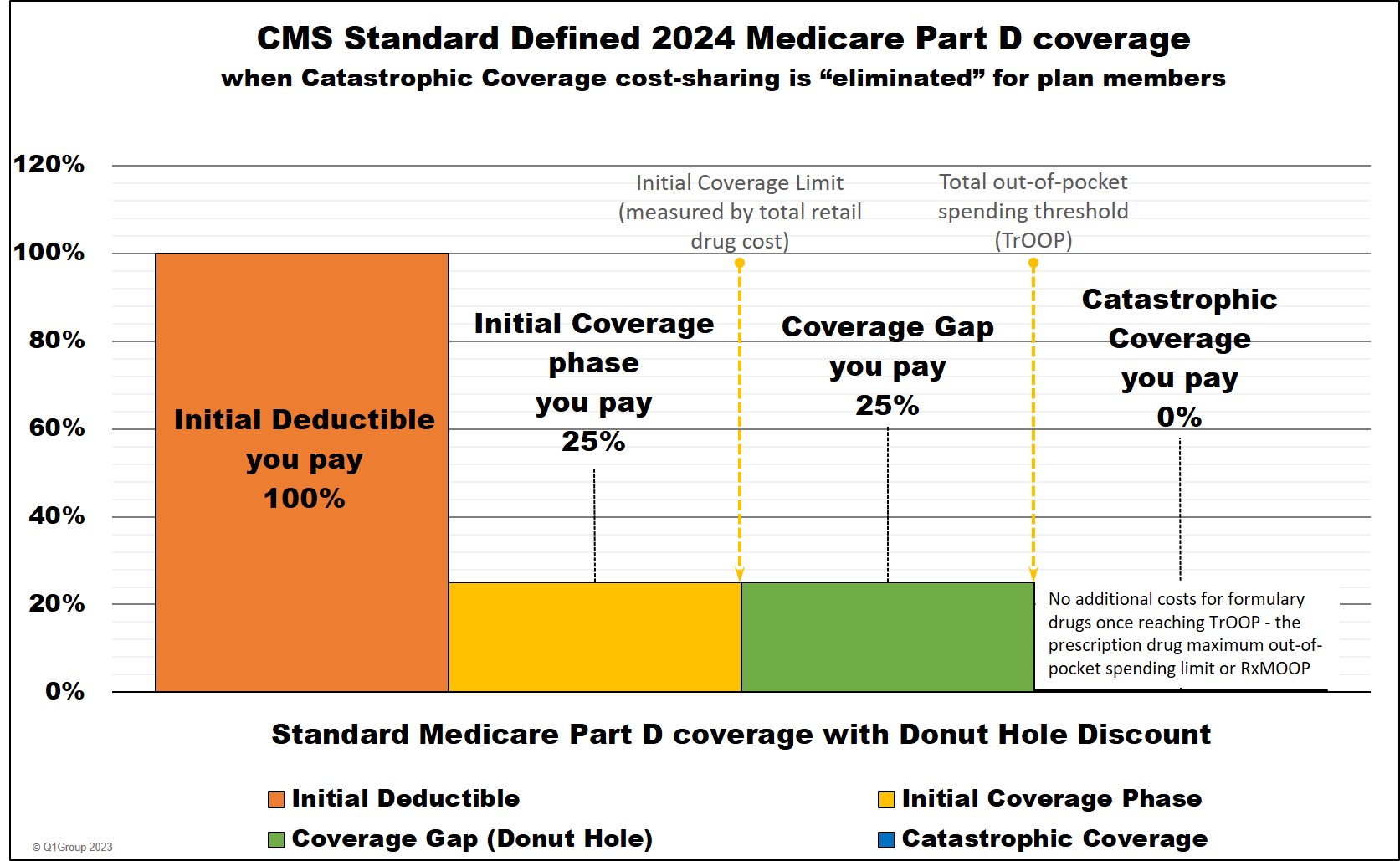
The 2024 Medicare Part D Donut Hole
Starting in 2024, the Inflation Reduction Act (IRA) of 2022 eliminates cost-sharing for formulary drugs in the Catastrophic Coverage phase. This means, if you exit the 2024 Donut Hole and enter the Catastrophic Coverage phase, you will pay nothing more (cost-sharing will be $0) for all formulary Medicare Part D drugs through the remainder of the year.
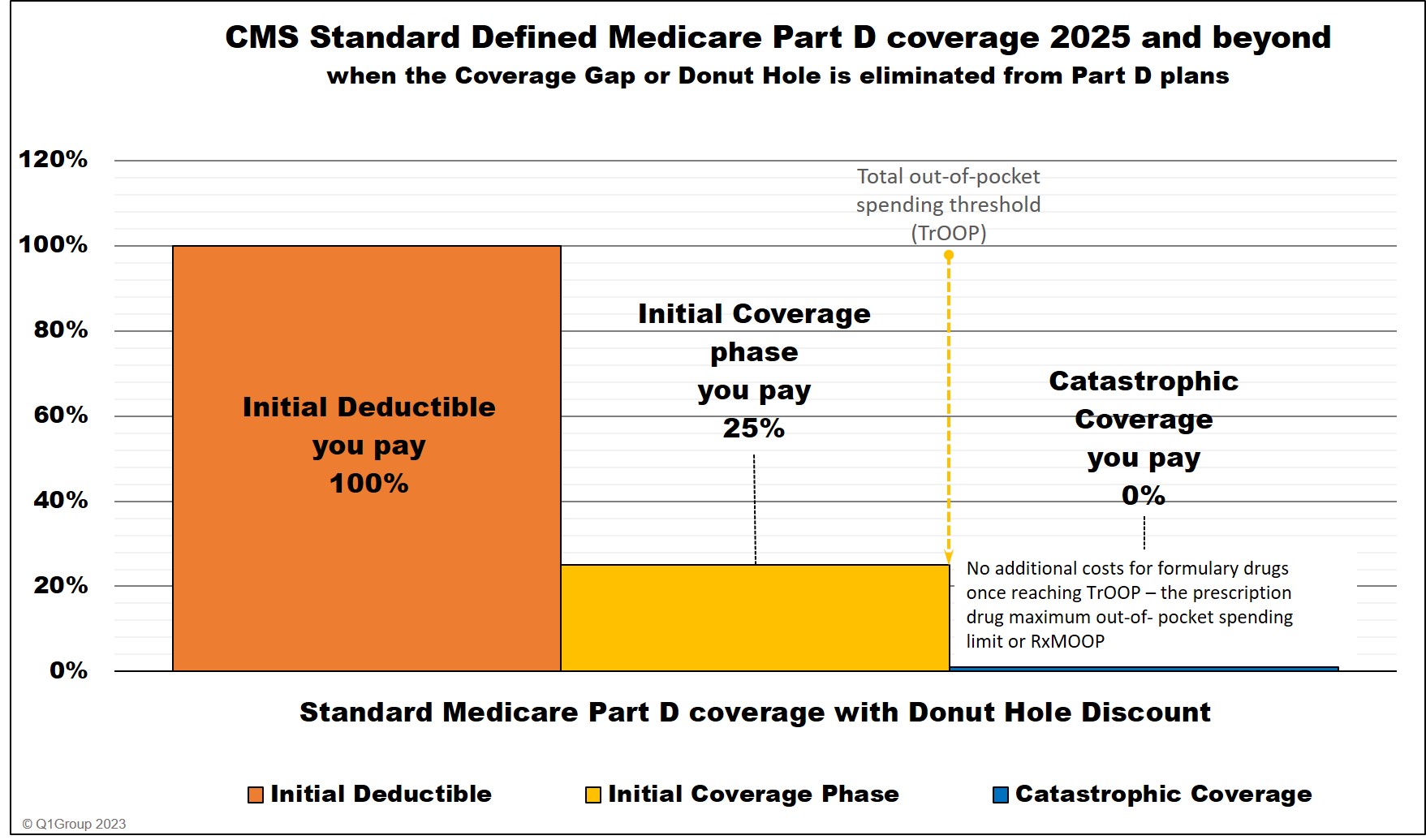
Important Update: 2024 is the last year for the Coverage Gap or Donut Hole. Starting in 2025, the Donut Hole will be eliminated from Medicare Part D coverage.
Starting in 2025, the Inflation Reduction Act (IRA) eliminates the Coverage Gap (Donut Hole). In 2025 and beyond, Medicare Part D beneficiaries will stay in the Initial Coverage phase until their out-of-pocket spending for Part D formulary drugs (TrOOP) reaches the maximum out-of-pocket spending limit for Part D formulary drugs (RxMOOP) - which is set at $2,000 for 2025. After reaching RxMOOP, Medicare Part D beneficiaries will enter Catastrophic Coverage and have a $0 copay (no additional costs) for all formulary Medicare Part D drugs through the remainder of the year.
2025 Medicare Part D coverage
You will enter the Donut Hole based on the total negotiated retail value of your medication purchases. For example, when the total retail cost of your drug purchases exceeds the standard Initial Coverage Limit $5,030 in 2024, you will leave your Medicare plan's Initial Coverage Phase (where you share the cost of your prescriptions with your Medicare plan) and enter into the Donut Hole.
See Will I enter the Medicare Part D Coverage Gap or Donut Hole this year? for upcoming changes to the Donut Hole.
(2) Exiting the Donut Hole or Coverage Gap
You will exit the Donut Hole based on your total out-of-pocket spending (or TrOOP) threshold. For example, in 2024, the TrOOP limit or Donut Hole exit point is reached after your actual out-of-pocket spending for covered medications has reached $8,000.
As noted, 2023 was the last year that Medicare Part D beneficiaries paid cost-sharing in the Catastrophic Coverage phase. For plan year 2024, the Inflation Reduction Act (IRA) eliminated beneficiary cost-sharing in the Catastrophic Coverage phase. This means, if you exit the 2024 Donut Hole and enter the Catastrophic Coverage phase, you will pay nothing more (cost-sharing will be $0) for all
formulary Medicare Part D drugs through the remainder of the year.
Your discount on drugs in while in the Donut Hole
Remember, while you are in the Donut Hole, 70% of the brand-name drug discount that is paid by the drug manufacturers counts toward meeting this total out-of-pocket spending amount.
Here is how this works: If you are in your Medicare Advantage plan's 2024 Initial Coverage Phase (before reaching the Donut Hole), and you purchase a medication with a $100 retail cost, and pay your Medicare plan's co-payment (for example, $30) out of your own pocket, and the Medicare plan pays the other $70, you get $30 credit toward the $8,000 Donut Hole exit point (or TrOOP) and $100 toward your $5,030 Initial Coverage Limit.
If you exceed the 2024 Initial Coverage Limit of $5,030 and enter the Donut Hole, and if you buy the same $100 medication, and your Medicare plan does not provide any additional Donut Hole coverage, you will get a 75% Donut Hole discount on all formulary drugs bought in the Donut Hole (you pay 25% of retail).
Brand-name drug example - Going back to our previous example, if your $100 medication was a brand-name drug, then you will pay only $25 (25% of $100) in the Donut Hole - but since you purchased a brand-name drug, you will get credit for $95 toward meeting your $8,000 out-of-pocket threshold (TrOOP) or 2024 Donut Hole exit point. This $95 credit represents the $25 that you paid for the brand-name formulary drug and the $70 that was paid on your behalf by the brand-name drug (pharmaceutical) manufacturer. You do not get credit for the $5 portion of the retail cost paid toward the brand-name discount by your Medicare plan.
Generic drug example - If you purchase a generic drug in the Donut Hole with a $100 retail value, you will get the 75% generic Donut Hole discount, pay $25 and the $25 you spent will count toward meeting your $7,400 TrOOP limit or 2024 Donut Hole exit point.
Reminder: Your Medicare Advantage plans Part A and Part B MOOP vs. Part D TrOOP
As another reminder: Your Medicare Advantage plan (MAPD) has two maximum limits:
- one limit for Medicare Part A and Medicare Part B spending (MOOP) and
- one limit for drug spending (TrOOP):
(2) Your total out-of-pocket (TrOOP) limit (or RxMOOP) for your Medicare Part D prescription drug purchases. When you exceed the 2024 TrOOP limit of $8,000, you enter the Catastrophic Coverage portion of your Medicare prescription drug coverage and pay nothing ($0) for the remainder of the year for your formulary Part D drugs.
Read about the new RxMOOP in: What is the Medicare Part D RxMOOP?