The prescription drug coverage is provided by insurance companies that contract with the U.S. government's Centers for Medicare and Medicaid Services (CMS). These private companies then negotiate with drug suppliers or pharmacies for the retail price of the medications.
With ongoing price negotiations, the retail prices of your Medicare Part D drugs can (and usually do) change throughout the year. We update our the drug finder® Drug Finder ( on this site) and Formulary Browser (Formulary-Browser.com) with new retail drug pricing as the pricing information is released by Medicare. But, retail drug prices vary, not only plan-to-plan, but also pharmacy-to-pharmacy for a given Medicare plan. The data we show is always the average negotiated retail price across all pharmacies for a specific Medicare plan.
Each Medicare prescription drug plan will have a formulary or drug list including all prescription drugs that are covered by the Part D plan - and the formulary will show the price you will pay for coverage (for instance $60 for all Tier 3 Brand Name drugs or 25% coinsurance for all specialty drugs) - and the formulary will include usage restrictions (for instance, Quantity Limits such as only 30 tablets per 30-days, Prior Authorization, required Step Therapy ).
You can use our this site PDP-Finder to get started with an overview of Medicare Part D plans in your area (just choose your state to view all Medicare Part D plans in your area: PDP-Finder.com.
You will see a place on our Medicare Part D plan finder that will allow you to email the result to yourself or someone else. Please note that, as part of our Privacy Policy, we never share your personal information with anyone,
Who pays for Medicare Part D coverage?
Depending on the stage of your Medicare Part D coverage, a portion of your medication cost is paid by one or more of the following:
- You,
- Your Medicare drug plan,
- The brand-name drug manufacturer,
- and the federal government (Medicare)
Who pays in 2025 and beyond?
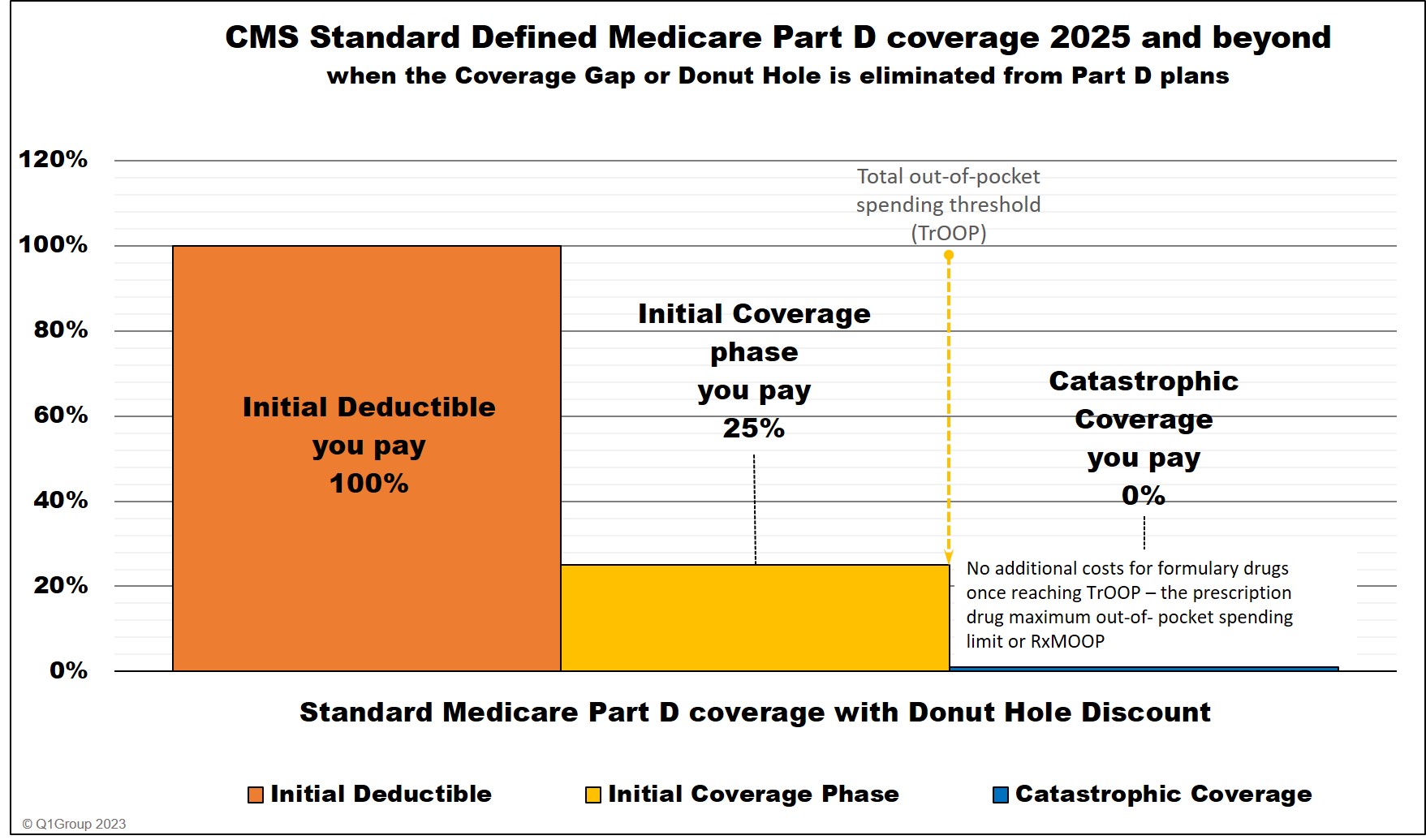
Starting with plan year 2025, the Inflation Reduction Act changed the percentage of the drug costs allocated to the brand-name drug manufacturer, Medicare Part D plan, and the federal government.
| Beginning January 1, 2025 When you purchase a Part D formulary medication with a $100 retail cost |
||||||
| Brand-name Drug Retail Cost |
You Pay | Your Medicare drug plan pays |
Pharma Mfgr. pays |
Federal Govern. pays |
Amount counting toward your RxMOOP Threshold |
|
| Initial Deductible (if any) |
$100 | $100 | $0 | $0 | $0 | $100 |
| Initial Coverage phase - brand-drugs * | $100 | $25 | $65 | $10** | $0 | $25 |
| Initial Coverage phase - generic-drugs * | $100 | $25 | $75 | $0 | $0 | $25 |
| Catastrophic Coverage (brand drug) **** | $100 | $0 | $60 | $20 | $20 | n/a |
| Catastrophic Coverage (generic drug) **** | $100 | $0 | $60 | $0 | $40 | n/a |
* 25% coinsurance or cost-sharing until you reach the $2,000 RxMOOP, then your Part D formulary drug costs are $0 for the remainder of the year.
** The 10% brand-name drug manufacturer discount applied in the 2025 Initial Coverage Phase (after the standard deductible) does not apply toward the $2,000 TrOOP threshold (https://www.cms.gov/files/document/manufacturer-discount-program-final-guidance.pdf).
**** Starting with plan year 2025, the Coverage Gap (or Donut Hole) no longer exists. A plan member stays in the Initial Coverage phase until reaching the plan's $2,000 out-of-pocket spending threshold (RxMOOP) and enters Catastrophic Coverage where for the remainder of the year, the person has no out-of-pocket costs for formulary drugs. Enrolling into a Medicare Part D drug plan
Based on regular changes in drug prices or the availability of drugs, Medicare Part D plan providers will re-examine their plan designs (cost and coverage) each year and then submit the new plans for CMS approval. Once approved, the Medicare plans are offered to the public during the annual Open Enrollment Period (Medicare OEP or AEP starting October 15th and continuing through December 7th).
If you are enrolled in a Medicare Part D plan, and the plan is offered next year, and you make no choice during the annual Open Enrollment Period, you will be automatically, re-enrolled into the plan for another year - but your plan may have made changes to cost and coverage. So, every year, you should be prepared to reevaluate your prescription needs and check to see if you are still enrolled in the most economical and convenient plan. We have an online Medicare Part D plan comparison tool to help you see how your plan is changing each year: PDP-Compare.com.
You can enroll in a Medicare Part D plan by calling the plan, working with an agent that represents the plan, or calling Medicare at 1-800-633-4227. You can also enroll online at Medicare.gov, the Medicare plan's website or with a few agents that provide an online enrollment option.
Paying for your coverage - Qualifying for financial assistance - Being assessed a higher premium based on your income
When you enroll in a Medicare Part D plan, you would be responsible for the cost of your Medicare Part D plan (premiums, deductibles, and cost-sharing) just like any insurance, unless you qualify for the Medicare Part D financial extra help program. (If you qualify for Medicaid, then you automatically qualify for Extra Help or the Low-Income Subsidy). Here is a link to more information on the Extra Help program on this site
As noted, without some form of Financial Extra Help, your costs for a Medicare Part D plan would include a monthly premium, possibly an initial deductible (unless you join a Medicare Part D plan with a $0 deductible), and then you would pay a certain price for your covered medications.
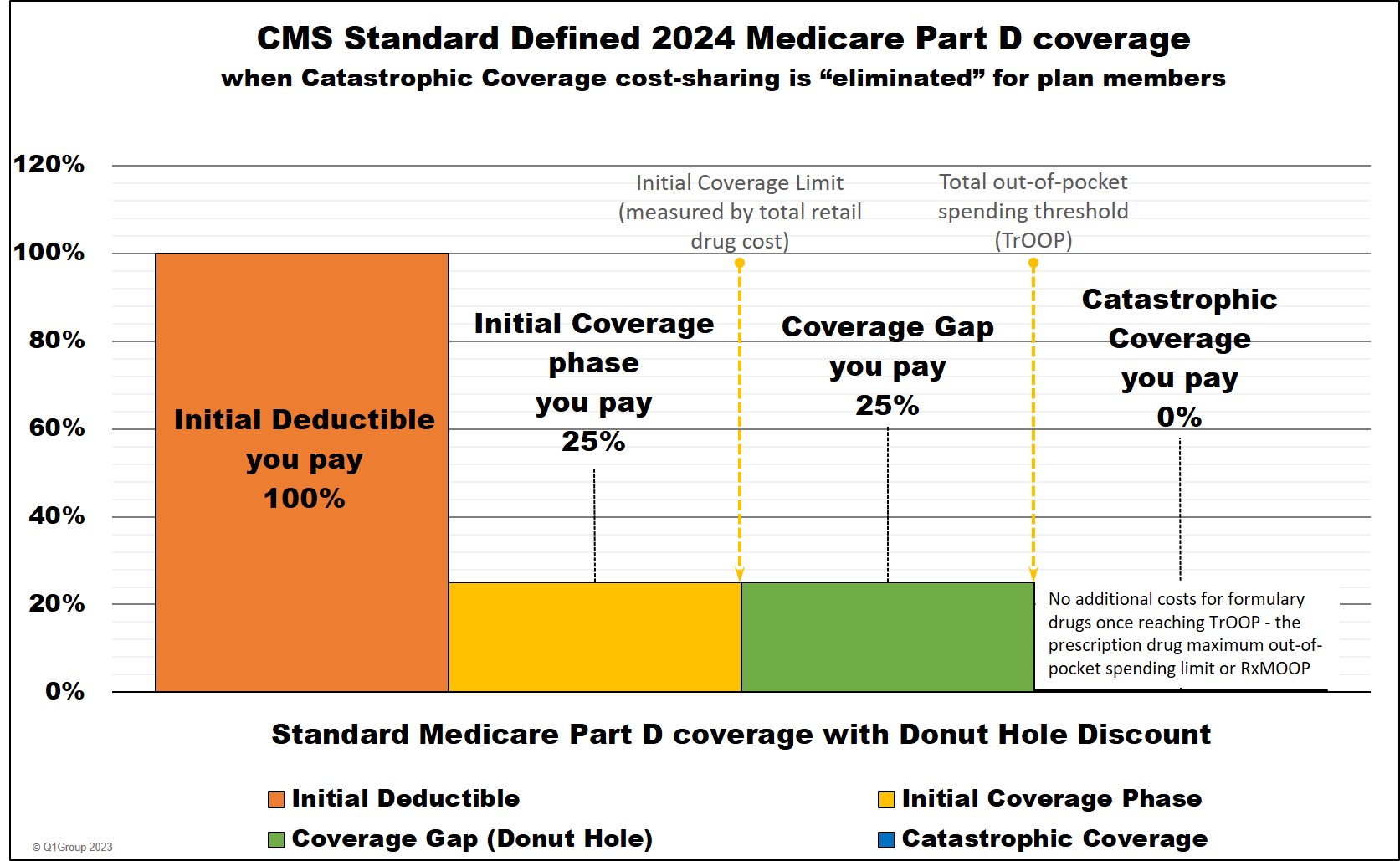
If you have a higher income, you may be subject to IRMAA or the Income Related Monthly Adjustment Amount that means you will pay more for your monthly premiums based on your income level. You can read more about IRMAA on this site Your Medicare Part D plan has up to three phases:
- The Initial Deductible (unless you have a Medicare plan with a $0 deductible)
- The Initial Coverage phase (based on the retail prices of your medications)
- The Catastrophic Coverage phase
-- Starting with plan year 2024, the Inflation Reduction Act eliminated beneficiary cost-sharing in the Catastrophic Coverage phase.

2024 Medicare Part D coverage
2025 Medicare Part D coverage
Still not sure about all of this information?
If you are new to the Medicare Part D program, you may wish to start here: Help! Where Do I Start?