Cost-sharing is the portion of your prescriptions or healthcare that is paid by you or your insurance company (or other payer). For example, if you purchase a Tier 3 formulary medication that has a retail cost of $100, your cost-sharing or copay could be $45 and the Medicare Part D plan will pay $55 - or you may purchase a $500 Tier 5 specialty drug that has 25% cost-sharing so your portion in $125 and your Medicare Part D plan pays $375.
The Centers for Medicare and Medicaid Services (CMS) defines "Cost-Sharing" as the portion of the total healthcare or prescription drug cost that you pay yourself. Cost-sharing can include copayments ($10 for a doctor visit), coinsurance (25% of retail for a Tier 4 drug), and/or deductibles ($480 you pay before drug coverage begins).
The key point is: Your prescription and healthcare cost-sharing is an important consideration when choosing a Medicare plan.
Accordingly, your Medicare plan must tell you what you will pay for cost-sharing and cost-sharing information can be found:
Your Medicare plan's cost-sharing can vary depending on whether you are in-network - or out-of-network (for Medicare Advantage plans) or whether you are using a standard or preferred network pharmacy (for Medicare drug plans).
As an example, in your Medicare plan documents you may see cost-sharing information such as:
Cost-sharing can be further defined as:
Copayments or the fixed cost you pay for healthcare or prescription drug coverage. For example, you pay $40 for each visit to your Primary Care Physician (PCP) or $2 for a 30-day supply of a Tier 1 generic drug.
Coinsurance or the fixed percentage of the total cost that you will pay of the drug or healthcare coverage. For example, you may 25% of the retail price for any Tier 3 brand-name medications - so if the retail price is $100, you will pay $25 coinsurance. Important: As the retail prices of your formulary medications change throughout the plan year, your cost-sharing or coinsurance can also change as retail drug prices change.
Your deductible is the amount of money you pay toward your healthcare or drug cost before your Medicare plan begins to provide some coverage. Sometimes you will hear people saying that you are responsible for 100% of the healthcare or drug cost until you spend a certain amount of money - and then you "share" the cost with your Medicare plan. For example, if your Medicare Part D plan has a $480 deductible, you will pay the first $480 of any drug purchases before you and your Medicare plan begin to "share" the cost of drugs (either through copayment or coinsurance).
The Centers for Medicare and Medicaid Services (CMS) defines "Cost-Sharing" as the portion of the total healthcare or prescription drug cost that you pay yourself. Cost-sharing can include copayments ($10 for a doctor visit), coinsurance (25% of retail for a Tier 4 drug), and/or deductibles ($480 you pay before drug coverage begins).
The key point is: Your prescription and healthcare cost-sharing is an important consideration when choosing a Medicare plan.
Accordingly, your Medicare plan must tell you what you will pay for cost-sharing and cost-sharing information can be found:
- in your plan's Summary of Benefits document (that you receive when enrolling in a Medicare plan)
- or the
Annual Notice of Change letter (ANOC) (that you plan sends you each October)
- or Explanation of Benefits document that you will receive every year from your existing Medicare plan (you may receive this when enrolling or with your ANOC or you can download the EOC from the plan's website).
- You can also find basic cost-sharing information on your Medicare plan's annual marketing information
- or the information is prominently displayed on your plan's website
- or you can call your plan's Member Services department (using the toll-free number found on your Member ID card) to learn more about the plan's cost sharing.
Your Medicare plan's cost-sharing can vary depending on whether you are in-network - or out-of-network (for Medicare Advantage plans) or whether you are using a standard or preferred network pharmacy (for Medicare drug plans).
As an example, in your Medicare plan documents you may see cost-sharing information such as:
Benefits |
In-Network | Out-of-Network |
| Doctor Visits - Specialist |
$25 | $40 |
| Emergency Care (worldwide) |
$75 | $75 |
| Diagnostic Tests and Radiology Services |
20% of costs |
30% of costs |
Cost-sharing can be further defined as:
Copayments or the fixed cost you pay for healthcare or prescription drug coverage. For example, you pay $40 for each visit to your Primary Care Physician (PCP) or $2 for a 30-day supply of a Tier 1 generic drug.
Coinsurance or the fixed percentage of the total cost that you will pay of the drug or healthcare coverage. For example, you may 25% of the retail price for any Tier 3 brand-name medications - so if the retail price is $100, you will pay $25 coinsurance. Important: As the retail prices of your formulary medications change throughout the plan year, your cost-sharing or coinsurance can also change as retail drug prices change.
Your deductible is the amount of money you pay toward your healthcare or drug cost before your Medicare plan begins to provide some coverage. Sometimes you will hear people saying that you are responsible for 100% of the healthcare or drug cost until you spend a certain amount of money - and then you "share" the cost with your Medicare plan. For example, if your Medicare Part D plan has a $480 deductible, you will pay the first $480 of any drug purchases before you and your Medicare plan begin to "share" the cost of drugs (either through copayment or coinsurance).
Cost-Sharing Information on this site
We have the cost-sharing details for all Medicare prescription drug plans online and they can be viewed in our this site® Medicare Part D Plan Finder (PDP-Finder.com/FL) and Medicare Advantage Plan Finder (MA-Finder.com/44319). You can see the example below for the formulary drug cost-sharing for different formulary tiers (for example, you pay $1 for a prescription of a Tier 1 "Preferred Generic" when filled at a preferred network pharmacy).
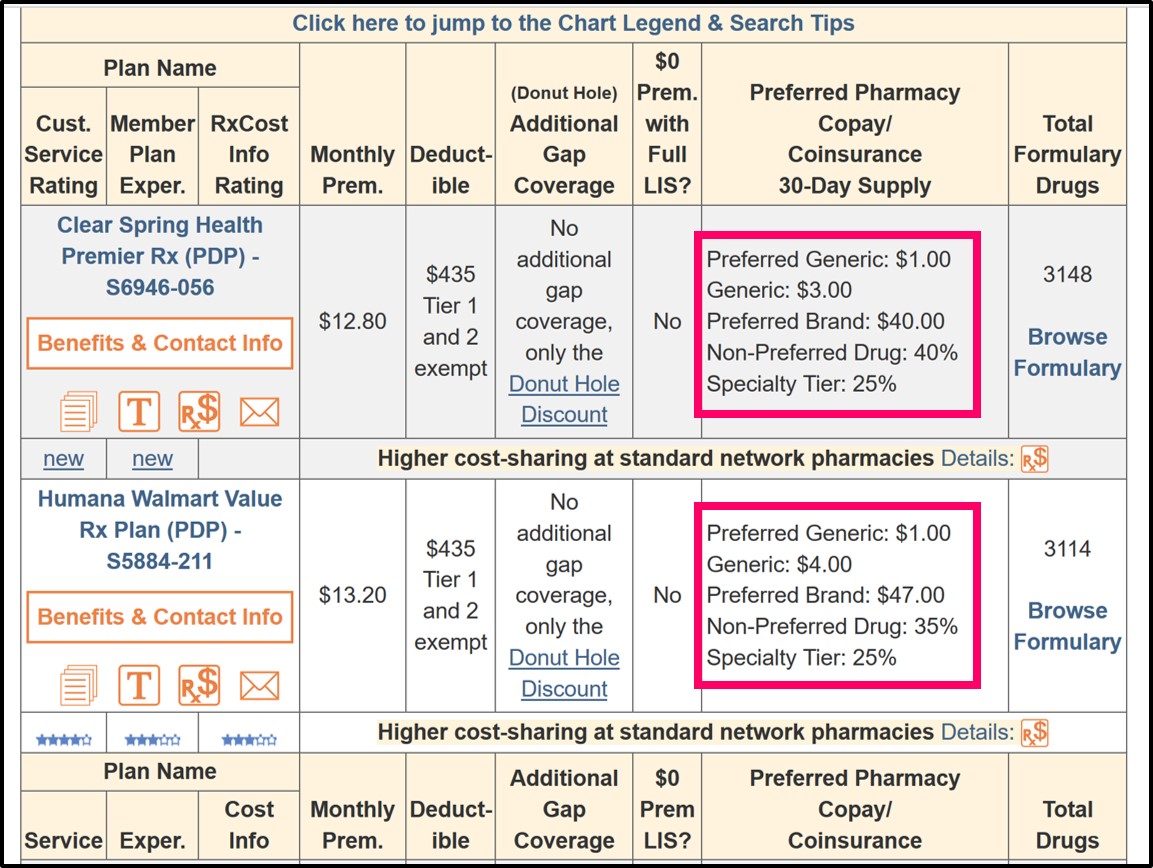
We also provide a portion of the healthcare cost-sharing information for Medicare Advantage plans (when available) in our Medicare Advantage Plan Finder. you can click on the plan name or Benefits & Contact Info button to see the plan benefit details.
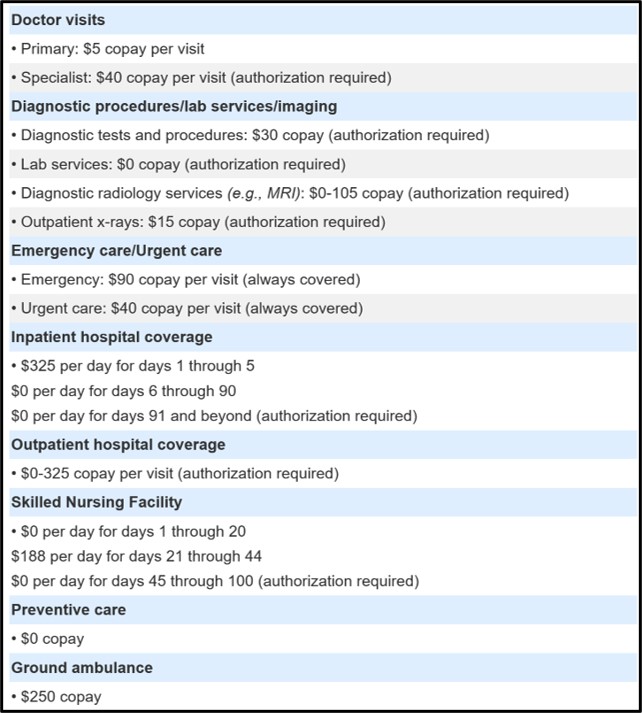
For more information, you can also telephone the Medicare plan's Member Services department for a complete and up-to-list of all cost-sharing information.
Sources include:
Medicare.gov [with additions and formatting])
- Browse Medicare Part D prescription drug plans
- Browse Medicare Advantage plans (MAPD)
- Sign-up for our Medicare Part D Newsletter.
- Still have a question? Click here to let us know.