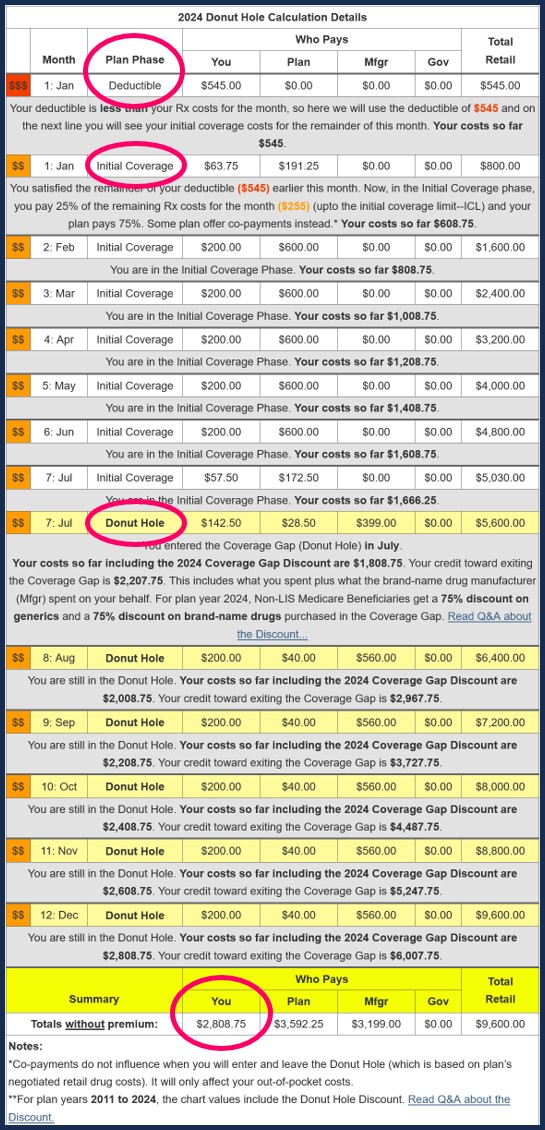
So between 2006 and 2010, the Medicare Part D Coverage Gap or Donut Hole was actually similar to a second deductible in an insurance policy where, after receiving a certain level of drug coverage (your Initial Coverage Phase), you were, once again, responsible for paying your own drug coverage until you reached the Catastrophic Coverage portion of your Medicare Part D prescription drug plan (PDP) or Medicare Advantage plan that included drug coverage (MAPD).
In other words, you had a "hole" in the center of your Medicare Part D drug coverage as is shown in the following chart.
The Donut Hole 2006 to 2010
2020 and beyond: Closing the Donut Hole
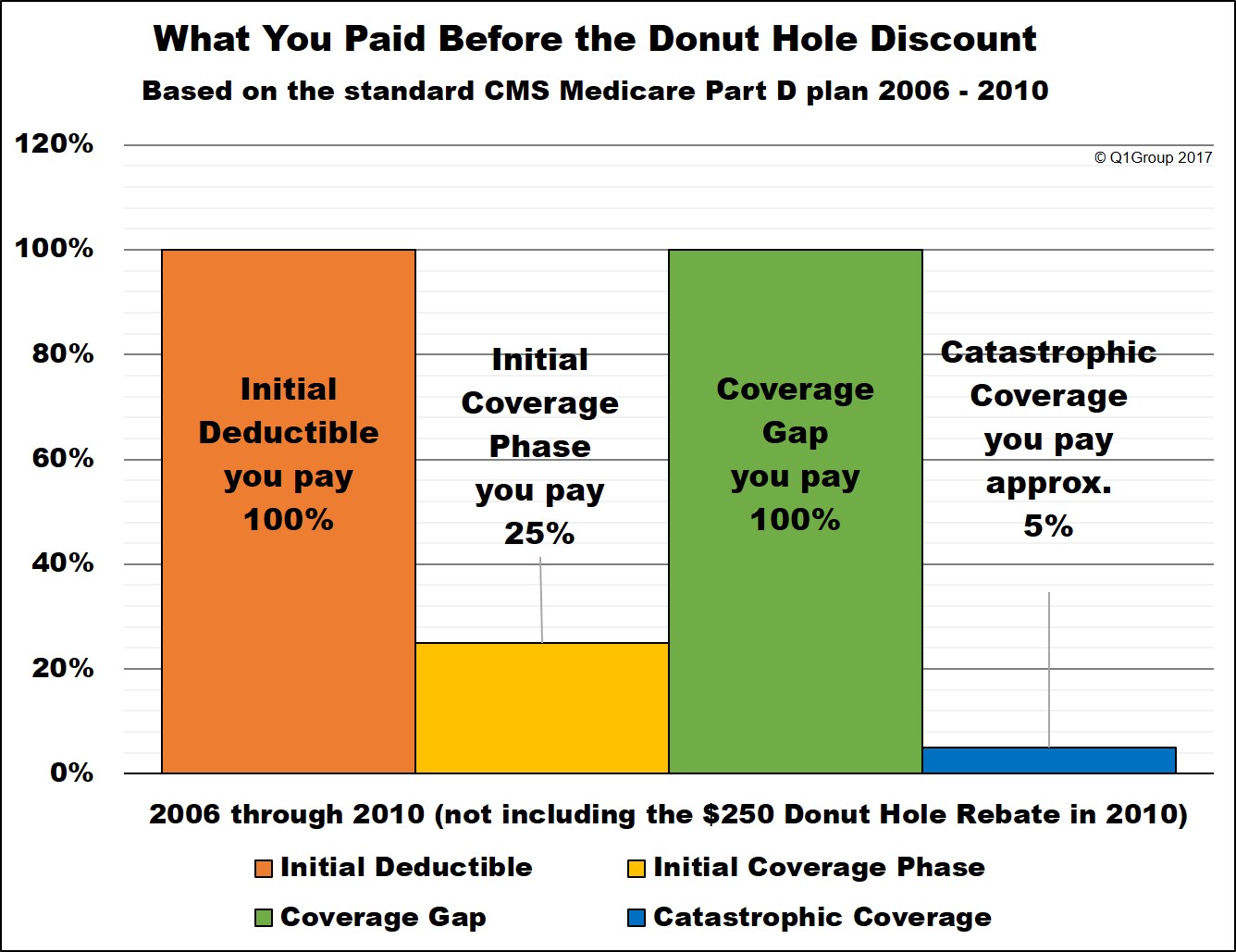
In 2020, the Coverage Gap was considered "closed" when both formulary generic and brand-name drugs cost Medicare Part D plan members 25% of the retail drug price (so you will pay $250 for a medication with a $1,000 retail cost) until reaching Catastrophic Coverage where you will pay around 5% of retail.
For example, if your Medicare Part D plan follows the standard Medicare Part D prescription drug plan, you will pay a fixed 25% cost-sharing in the Initial Coverage phase and then, if you enter the Donut Hole, you will continue to pay the same 25% co-insurance for all formulary drugs purchased - and since there is no change in coverage between being your Initial Coverage phase and Coverage Gap - the Donut Hole appears to be closed (see the diagram below).
In fact, the Donut Hole actually "closed" a little earlier than planned.
In 2018, President Trump signed the Bipartisan Budget Act of 2019 (Pub.L. 115-123) that effectively "closes" the Coverage Gap for brand-name drugs, with the brand-name Donut Hole discount increasing to 75% in 2019 (one year earlier than planned). The Coverage Gap for generic drugs was not affected by the Act and "closed" as planned in 2020 when all generic formulary drugs also receive a 75% discount.
The Donut Hole 2020 to 2023
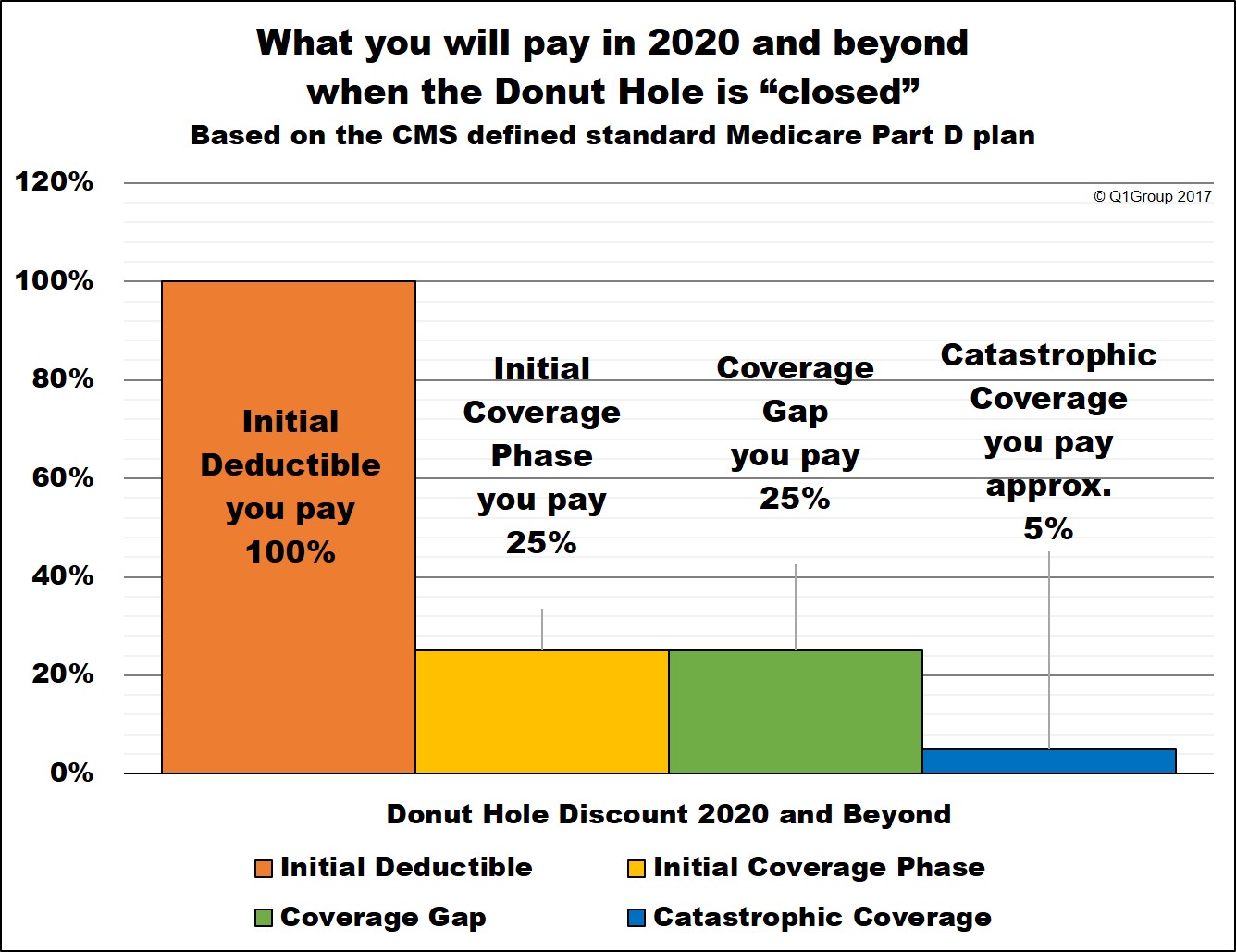
The 2024 Medicare Part D Donut Hole
Starting in 2024, the Inflation Reduction Act (IRA) of 2022 eliminates cost-sharing for formulary drugs in the Catastrophic Coverage phase. This means, if you exit the 2024 Donut Hole and enter the Catastrophic Coverage phase, you will pay nothing more (cost-sharing will be $0) for all formulary Medicare Part D drugs through the remainder of the year.
Question: So did the Donut Hole just go away from our Medicare Part D plans?
Not exactly - but it will in 2025. Although we say that the Donut Hole is now "closed" since you receive a 75% discount on all formulary drugs if you enter the Donut Hole - it is possible that the cost of your formulary medications can increase, decrease, or stay the same once you are in the Donut Hole (Coverage Gap) - depending on your Medicare drug plan, your initial cost-sharing, and the drug's retail price.
For example, if you usually pay a fixed co-pay for your drugs (for example, $47 for a $300 drug) during your Initial Coverage phase, you will pay 25% of $300 if you enter the Donut Hole or $75. So, you would pay more in the Donut Hole ($75) than you did in your Initial Coverage phase ($47).
You can click on our FAQ "Did the Coverage Gap or Donut Hole just close up and go away?" to read more.
Important Update: 2024 is the last year for the Coverage Gap or Donut Hole.
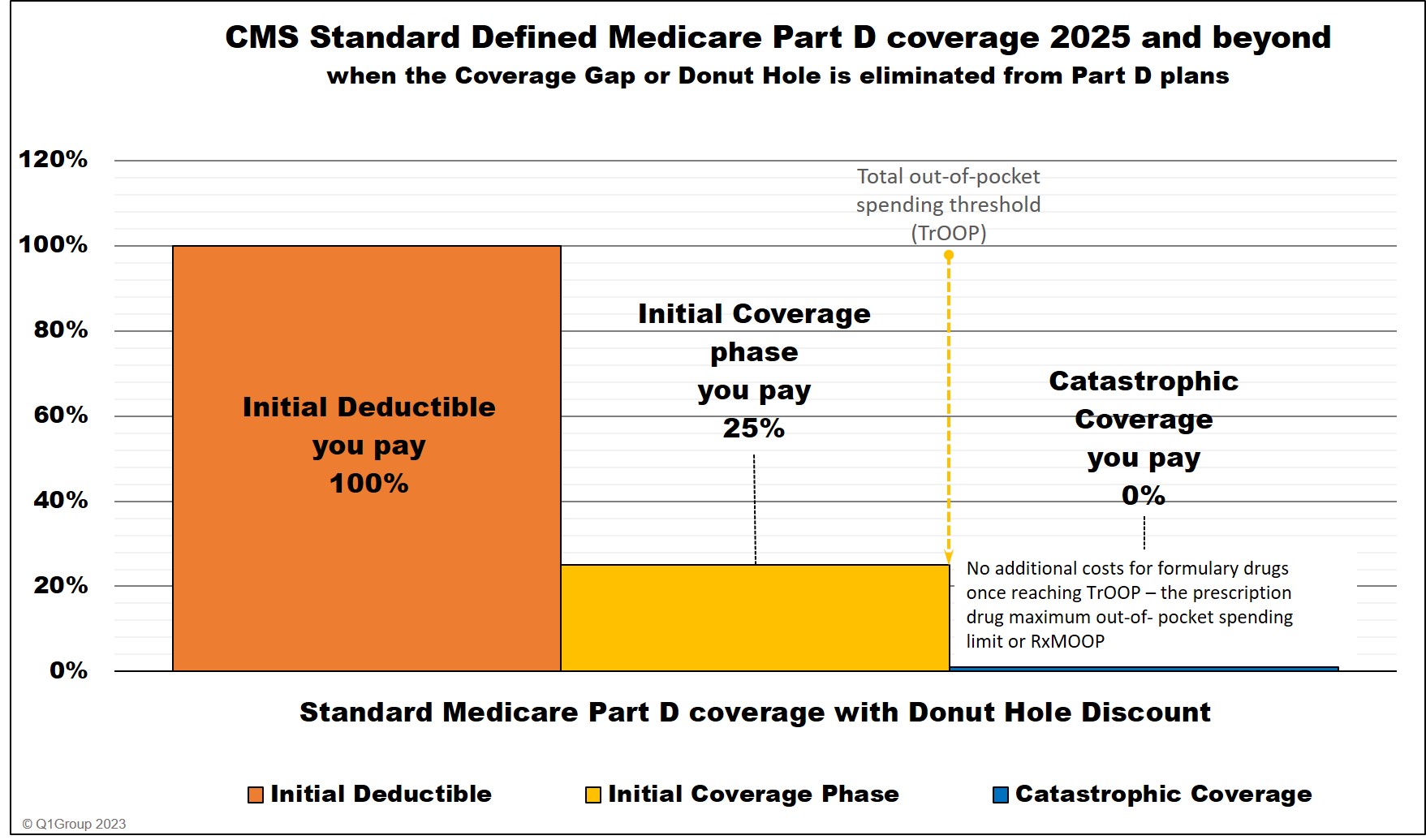
Starting in 2025, the Donut Hole will be eliminated from Medicare Part D coverage.
Starting in 2025, the Inflation Reduction Act (IRA) eliminates the Coverage Gap (Donut Hole). In 2025 and beyond, Medicare Part D beneficiaries will stay in the Initial Coverage phase until their out-of-pocket spending for Part D formulary drugs (TrOOP) reaches the maximum out-of-pocket spending limit for Part D formulary drugs (RxMOOP) - which is set at $2,000 for 2025. After reaching RxMOOP, Medicare Part D beneficiaries will enter Catastrophic Coverage and have a $0 copay (no additional costs) for all formulary Medicare Part D drugs through the remainder of the year.
2025 Medicare Part D coverage
To help you visualize the phases of your Medicare Part D prescription drug plan coverage, we have a Donut Hole Calculator or PDP-Planner online illustrating the changes in your monthly estimated costs based on the established standard Medicare Part D plan limits mentioned above.
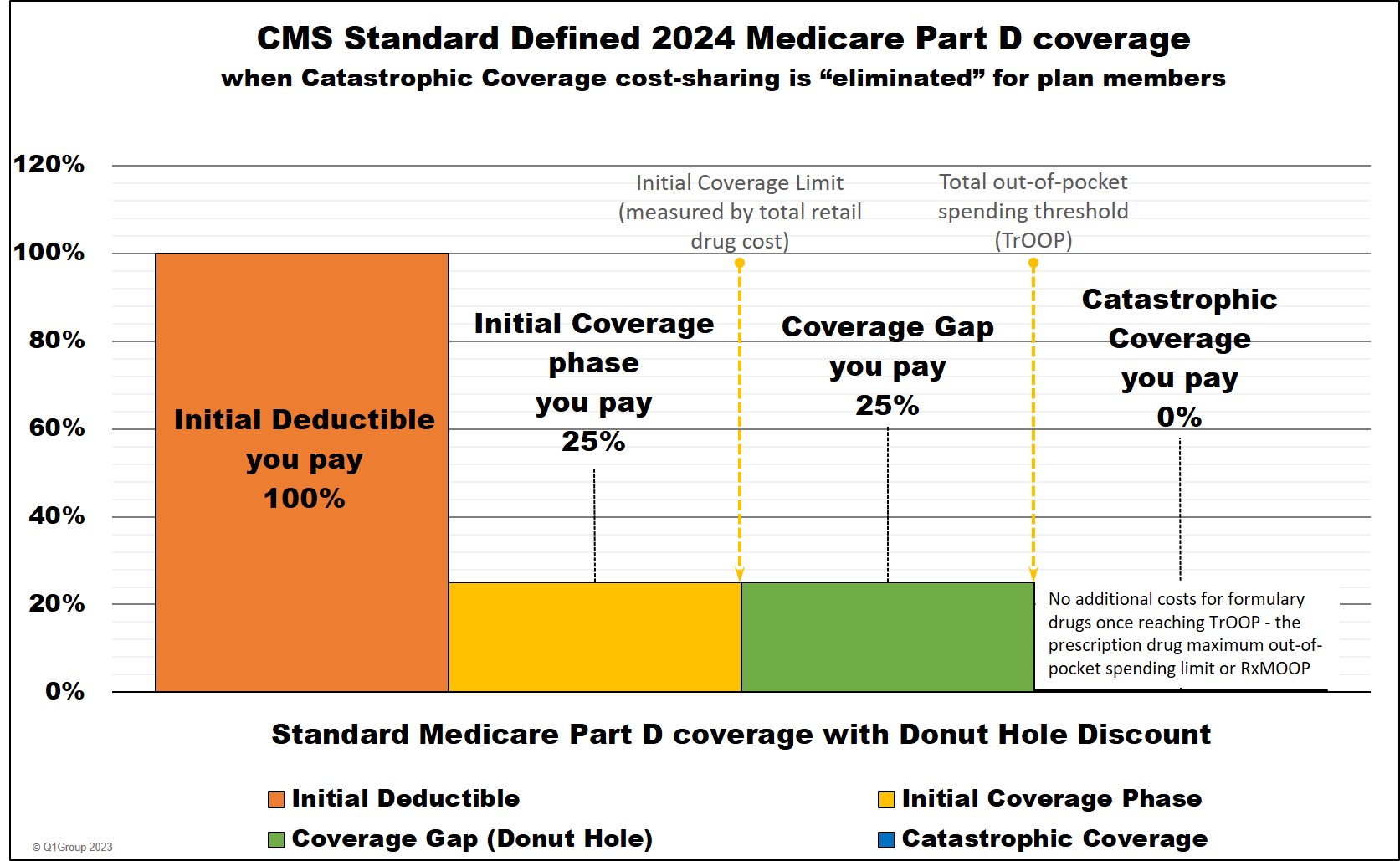
We also have several examples online to help you get started with PDP-Planner. You can click here for a 2024 example of a Medicare beneficiary with relatively high monthly prescription drug costs of $800 per month resulting in estimated annual out-of-pocket costs of $2,809 - you can then change the monthly drug cost to whatever you wish to estimate your annual out-of-pocket cost.
Below is an example graphic of the this site PDP-Planner or Donut Hole calculator showing the possible spending throughout the phases of your Medicare Part D plan - and how your drug costs can change before, during, and after the Donut Hole.