The Big Picture: Changes in the national SNP landscape result in slightly more 2026 SNP options.
First, based on our analysis, the bad news is that about 27% of the 2025 Medicare Advantage Special Needs Plans (SNPs) will be discontinued in 2026 – this is compared to 29% in 2025.
However, the good news is there are 719 new 2026 Medicare Advantage SNPs that will be introduced – and with these new SNPs, we will actually see a net 19% increase in the total nationwide 2026 SNP offerings (see section 1 below). The vast majority of SNPs remains Dual-Eligible – D-SNPs (59%). More good news, when analyzing the service area size for each 2026 SNP, a net 10% increase in plan accessibility is noted (see section 2 below).
Across the country, we will see an increase in the total number of 2026 Medicare Advantage Special Needs Plans (SNPs); and SNP gains in some counties will more than offset SNP losses in other areas (or even the same counties). You can see plan year 2025 to 2026 SNP gains and losses with our Medicare Advantage plan comparison tool MA-Compare found at MA-Compare.com.
(1) The types of 2026 Special Needs Plans
SNPs are divided into three major types of special need:
- Chronic Care SNPs or C-SNPs (like diabetes, heart disease, or ESRD) (more details in section 3 below),
- Dual-Eligible Medicare/Medicaid SNPs or D-SNPs (for Medicare and Medicaid beneficiaries), and
- Institutional SNPs or I-SNPs (for Nursing and Long-Term Care (LTC) residents).
| 2026 Special Needs Medicare Advantage Plans by Type of Special Need |
||||||||
| SNP Type | 2026 Plans | 2025 Plans | Net Change* | % Net Change | Dropped Plans* | % of '25 SNPs Dropped | 2024 Plans | 2023 Plans |
| Chronic Illness | 548 | 376 | 172 | 46% | 78 | 21% | 309 | 306 |
| Dual Eligible | 1,019 | 906 | 113 | 12% | 278 | 31% | 851 | 789 |
| Institutional | 154 | 160 | -6 | -4% | 35 | 22% | 173 | 189 |
| Total | 1,721 | 1,442 | 279 | 19% | 391 | 27% | 1,333 | 1,284 |
The chart below summarizes the 2026 Special Needs Plan landscape and how the SNP landscape has changed over the past few years.
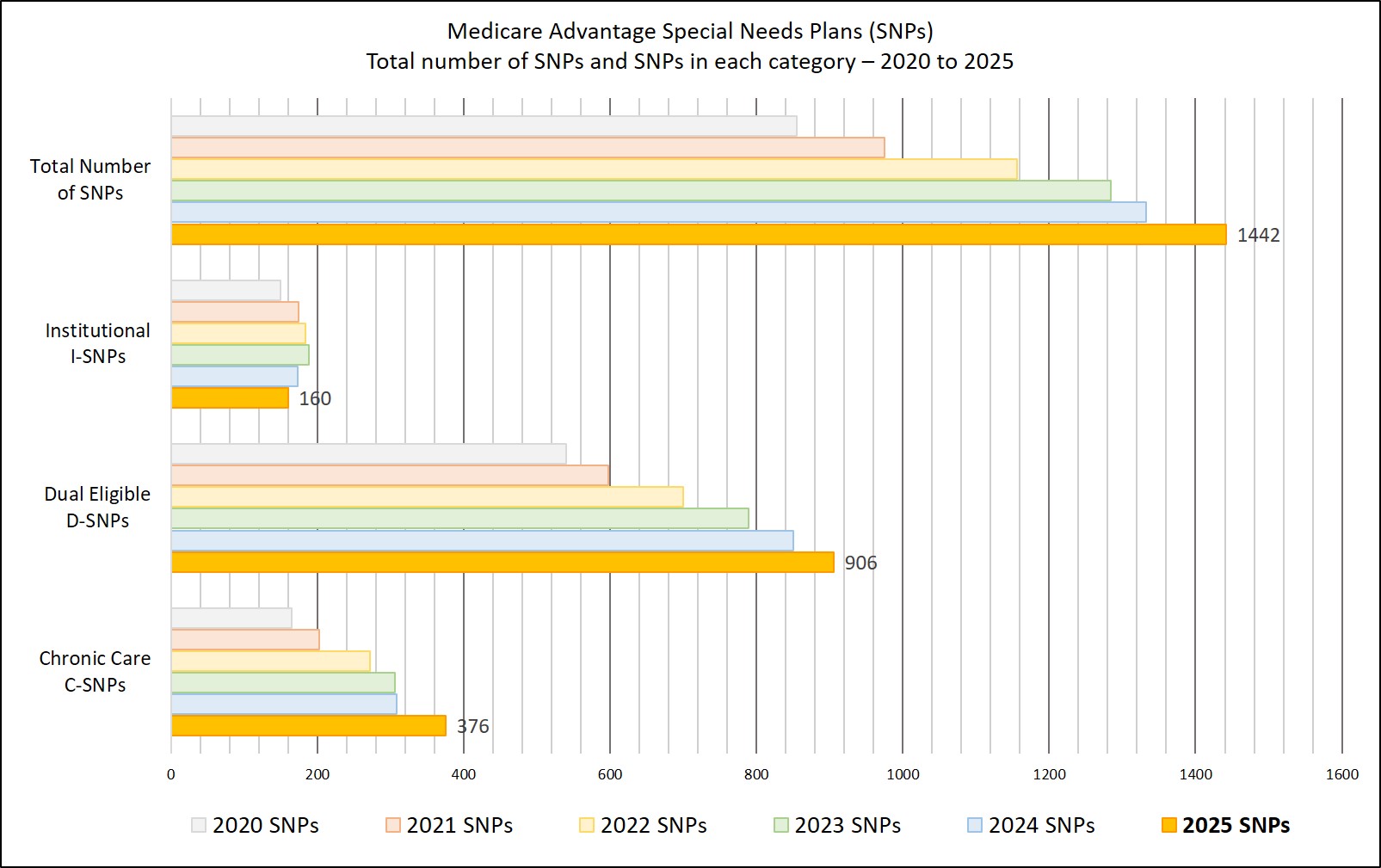
You can learn more about the 2026 SNPs available in your area by using our Medicare Advantage plan finder (MA-Finder.com/2026) or add your ZIP code to the MA-Finder.com link to see plans in your area (MA-Finder.com/2026/90001).
To get you started, here is an example of all 2026 Special Needs Plans available in Allegheny County, PA.
Please note, if you are using our MA-Finder and looking for a Dual-Eligible Medicare/Medicaid SNP (D-SNP), be sure to select "Yes" for the "Show Premium with LIS Subsidy?" to see the actual D-SNP monthly premiums for dual-eligible Medicare/Medicaid beneficiaries.
Designation of 2026 D-SNP Medicare/Medicaid integration
Included within our Medicare Advantage plan finder are the details about whether a Dual-Eligible Medicare Advantage Special Needs Plan (D-SNP) is a Fully-Integrated Dual-Eligible (FIDE) SNP, Highly-Integrated Dual-Eligible (HIDE) SNP, or Coordination-only D-SNPs – and whether the D-SNP is also designated as an Applicable Integrated Plan (AIP).
(2) Changes within the SNP county-specific landscape
When comparing SNP reach (SNP plan multiplied by counties in the plan’s service area) we see an overall increase in plan reach. There is a notable increase in the availability of chronic care SNPs.
| 2026 Special Needs Plan Reach (plan/county combinations) by Type of Need |
|||||||
| SNP Type | 2026 | 2025 | Change '25 to '26 | Percent Change'25 to '26 | 2024 | 2023 | 2013 |
| Chronic Care | 9,972 | 7,715 | 2,257 | 29% | 5,499 | 4,566 | 6,402 |
| Dual Eligible | 36,078 | 34,134 | 1,944 | 6% | 30,073 | 24,789 | 5,284 |
| Institutional | 5,868 | 5,183 | 685 | 13% | 4,137 | 3,410 | 537 |
| Total | 51,918 | 47,032 | 4,886 | 10% | 39,709 | 32,765 | 12,223 |
As noted, the vast majority (59%) of SNPs remain dual-eligible Medicare/Medicaid plans (D-SNPs). However, the number of counties across the country offering a Medicare Advantage Chronic Care C-SNP will increase by 29% and the number of counties offering an Institutional I-SNP will increase13%.
| 2026 Special Needs Plan Reach (Number of unique counties where SNP type is offered) by Type of Need |
||||
| SNP Type | 2026 | 2025 | Change '25 to '26 | Percent Change'25 to '26 |
| Chronic Care | 2,416 | 2,378 | 38 | 1.60% |
| Dual Eligible | 3,027 | 2,932 | 95 | 3.24% |
| Institutional | 2,080 | 2,086 | -6 | -0.29% |
In 2026, 3,058 counties will offer one or more SNP of any type as compared to 3,083 counties in 2025 – a decrease of 25 counties.
Question: In which counties can we find the most SNPs?
As in past years, the most Special Needs Plans are available within densely populated counties located in Florida, California, and Texas with the highest 2026 SNP plan counts concentrated in Florida.
| Counties with the Largest Number of 2026 Special Needs Plans |
||||||||
| Locations | SNPs | |||||||
| Hillsborough County, FL | 75 | |||||||
| Pinellas County, FL | 72 | |||||||
| Pasco County, FL | 71 | |||||||
| Broward County, FL | 69 | |||||||
| Miami-Dade County, FL | 69 | |||||||
| Osceola County, FL | 69 | |||||||
| Seminole County, FL | 69 | |||||||
| Palm Beach County, FL | 66 | |||||||
| Polk County, FL | 65 | |||||||
| Orange County, FL | 64 | |||||||
| Hernando County, FL | 55 | |||||||
| Sumter County, FL | 55 | |||||||
(3) A closer look at the types of 2026 Chronic Care SNPs (C-SNPs)
Medicare Advantage Chronic Care Special Needs Plans can be further divided into the type of chronic care that the plan is designed to address – and the specific types of chronic conditions addressed by the SNPs varies slightly year-to-year, with a notable increase in "Cardiovascular Disorders, Chronic Heart Failure and Diabetes" SNPs.
| 2026 Special Needs – Chronic Care Plans Compared to the 2025 Plan Year |
|||||
| Chronic Care | Number of SNPs | ||||
| 2026 Plans | 2025 Plans | Net Change | 2024 Plans | 2023 Plans | |
| Cardiovascular Disorders | 0 | 1 | -1 | 0 | 1 |
| Cardiovascular Disorders and Chronic Heart Failure | 0 | 1 | -1 | 14 | 22 |
| Cardiovascular Disorders, Diabetes Mellitus | 5 | 6 | -1 | 6 | 5 |
| Cardiovascular Disorders, Chronic Heart Failure, Diabetes Mellitus | 468 | 278 | 190 | 194 | 164 |
| Chronic Mental Health | 0 | 0 | 0 | 0 | 2 |
| Cardiovascular Disorders or Chronic Heart Failure or Diabetes Mellitus | 0 | 0 | 0 | 3 | 5 |
| Chronic Heart Failure | 1 | 1 | 0 | 2 | 3 |
| Chronic Heart Failure and Diabetes | 0 | 2 | -2 | 2 | 2 |
| Chronic Lung Disorders | 30 | 31 | -1 | 29 | 35 |
| Dementia | 1 | 1 | 0 | 4 | 6 |
| Diabetes Mellitus | 1 | 11 | -10 | 21 | 36 |
| End-stage Renal Disease Requiring Dialysis | 0 | 41 | -41 | 32 | 23 |
| End-stage Renal Disease Requiring Dialysis or HIV/AIDS | 0 | 0 | 0 | 0 | 3 |
| Chronic Kidney Disease | 34 | 0 | 34 | 0 | 0 |
| Chronic Kidney Disease, Post Renal Organ Transplantation | 2 | 0 | 2 | 0 | 0 |
| Chronic Mental Health, Substance Use Disorders | 1 | 0 | 1 | 0 | 0 |
| Obesity Overweight Metabolic Syndrome | 1 | 0 | 1 | 0 | 0 |
| HIV/AIDS | 1 | 1 | 0 | 1 | 3 |
| Total Chronic Illness SNPs | 545 | 374 | 171 | 308 | 310 |
Important Reminder: A Medicare Advantage Special Needs Plan (SNP) is not for everyone.
Often you will find a Medicare Advantage SNP in your area that is very well-priced with feature-rich benefits and an extensive drug formulary – making the plan a very appealing coverage option.
But, please remember that you cannot join (or remain in) a Medicare Advantage SNP unless you qualify for the plan’s “Special Need” – that is, SNPs are designed for people with specific conditions, diseases, or characteristics – and you must meet (and continue to meet) the plan's "Special Need" to be eligible for enrollment.
For example, if you do not qualify for your state's Medicaid program, you will not be eligible to join a Dual-Eligible (Medicare/Medicaid) SNP. For more information about qualifying for a SNP, please contact a local SHIP volunteer or telephone a Medicare representative at 1-800-Medicare.