Here are highlights of the 2026 stand-alone Medicare Part D PDP landscape (excluding U.S. teritories) from our PDP-Facts.com analysis:
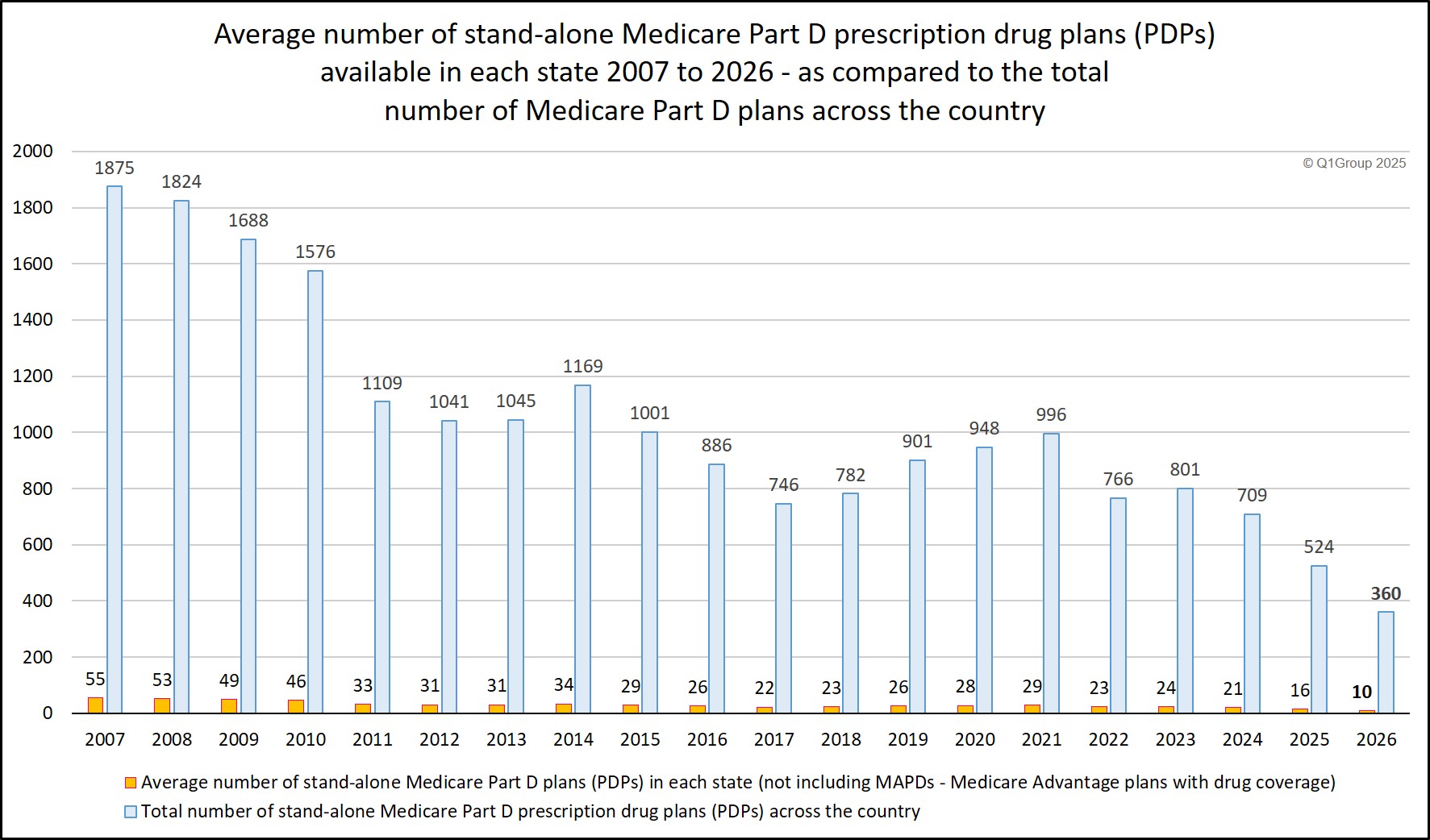
(1) There will be 31% fewer 2026 stand-alone Medicare Part D PDP options.
The total number of stand-alone 2026 Medicare Part D prescription drug plans across the country will decrease 31% to 360 Part D plans from 524 PDPs currently offered in 2025 -- a loss of 164 plans. The average number of stand-alone 2026 Part D plans offered in each state is decreasing to 10 plans down from 16 PDPs per state in 2025.
12 states will offer twelve (12) stand-alone 2026 Medicare Part D plan choices (As an example, California will offer 12 PDPs down from 18 stand-alone Part D plans offered in 2025.
Hawaii will offer the smallest number of 2026 PDPs at 8 PDPs, down from 12 Medicare Part D plans in 2025.
Maine, New Hampshire and Virginia will see the largest PDP decrease – losing seven (7) PDP options in 2026.
(2) The average 2026 stand-alone Medicare Part D premium will increase 2%, and will increase 16% when weighted by current plan enrollment.
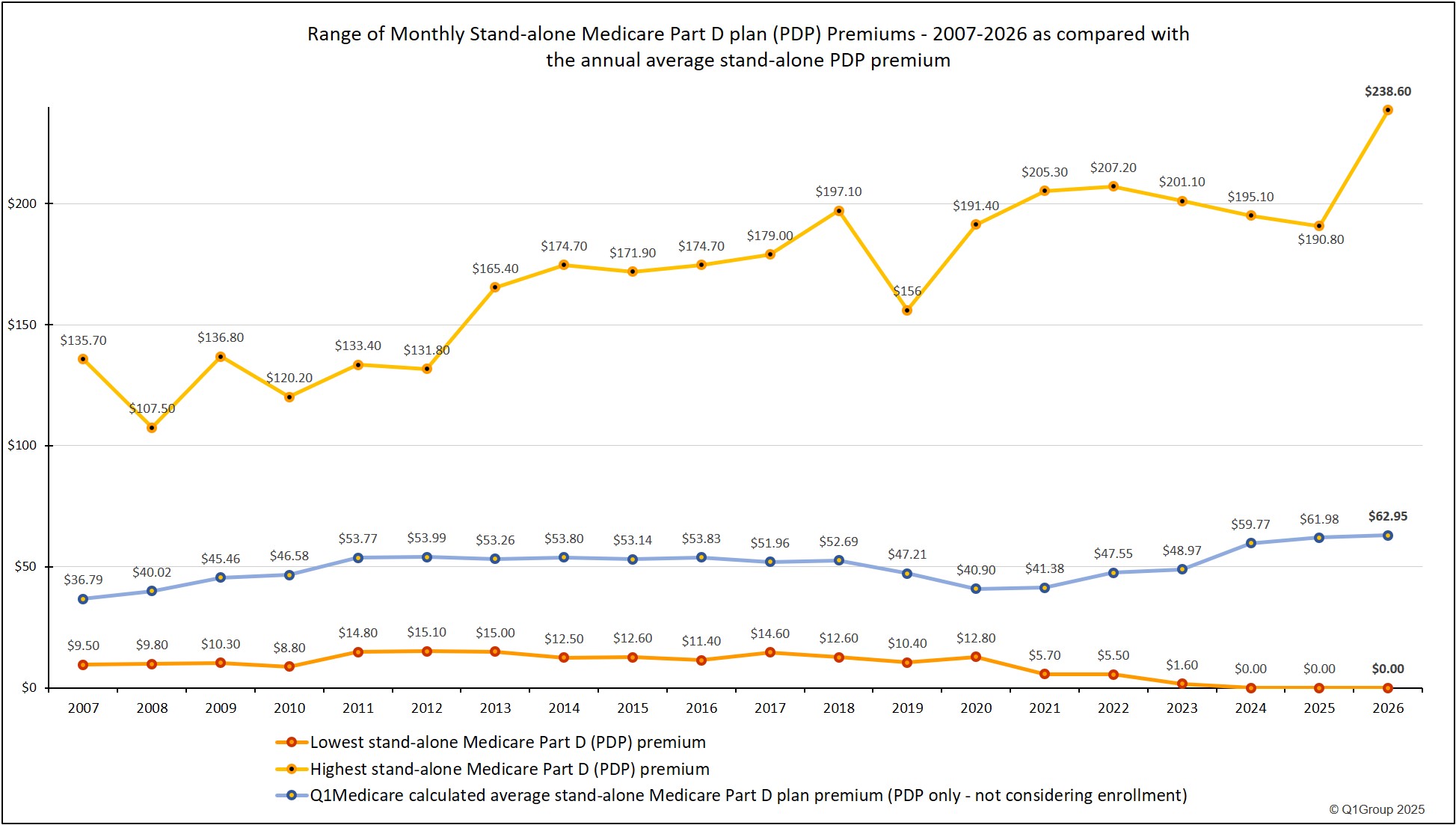
Our preliminary analysis of only the stand-alone 2026 Medicare Part D PDPs indicates a 2% premium increase across all PDPs to an average premium of $62.95*. When considering current 2025 Medicare Part D plan enrollment, the average weighted 2026 Part D premium will increase 16% to $43.49*. The this site weighted average premium does not reflect a similar premium ($34.50) calculated by CMS. This could be because we do not include the U.S. territories in our PDP Landscape analysis.
* Medicare plan average premiums are calculated on a Regional (and not state-by-state) basis where multiple states can include the same Medicare Part D plans.
For the first time since 2006, the Centers for Medicare and Medicaid Services (CMS) did not release the projected Medicare Part D premium for 2026 in late-July or early-August. Instead, CMS introduced the new Part D Premium Stabilization Demonstration whereby stand-alone Medicare Part D PDPs (not MAPDs) were encouraged to voluntarily lower 2026 premiums with Medicare providing additional financial support against plan losses possibly incurred with the Inflation Reductions Act’s expanded drug plan benefits.
In their September 27, 2025 Fact Sheet, CMS noted:
"Based on the voluntary elections of Part D plan sponsors, approximately 99% of people with Medicare enrolled in a stand-alone Part D plan in 2025 are currently enrolled in a stand-alone Part D plan offered by a plan sponsor that opted into the demonstration for 2026. The voluntary demonstration for stand-alone Part D plans includes three elements: a $15 uniform reduction in the base beneficiary premium, a year-over-year premium increase limit of $35 on a plan’s total Part D premium, and a change to the risk corridors."CMS estimates that this Demonstration will cost taxpayers about $5 billion (other sources are estimating that the cost of the Premium Stabilization Demonstration may be closer to over $7 billion).
(3) As many as 47% of current 2025 Medicare Part D plan members (not considering LIS eligibility) may have increases in 2026 monthly premiums.
When the 2026 Part D PDP premiums are weighted by current 2025 Part D plan enrollment, we estimate that up to 47% of all Medicare Part D beneficiaries currently enrolled in a stand-alone 2025 Medicare Part D plan will see an average premium increase of $28.76 in 2026 -- unless these people change drug coverage to a more affordable 2026 Medicare Part D or Medicare Advantage plan that includes prescription drug coverage (MAPD).
Important Extra Help reminder: If you are eligible for the Medicare Part D Low-Income Subsidy (LIS) and chose your own Part D plan in the past, you will receive a tan-colored notice from Medicare in early-November, informing you about your upcoming premium increase.
(4) Low-premium 2026 Medicare Part D plan options remain available everywhere except New York.
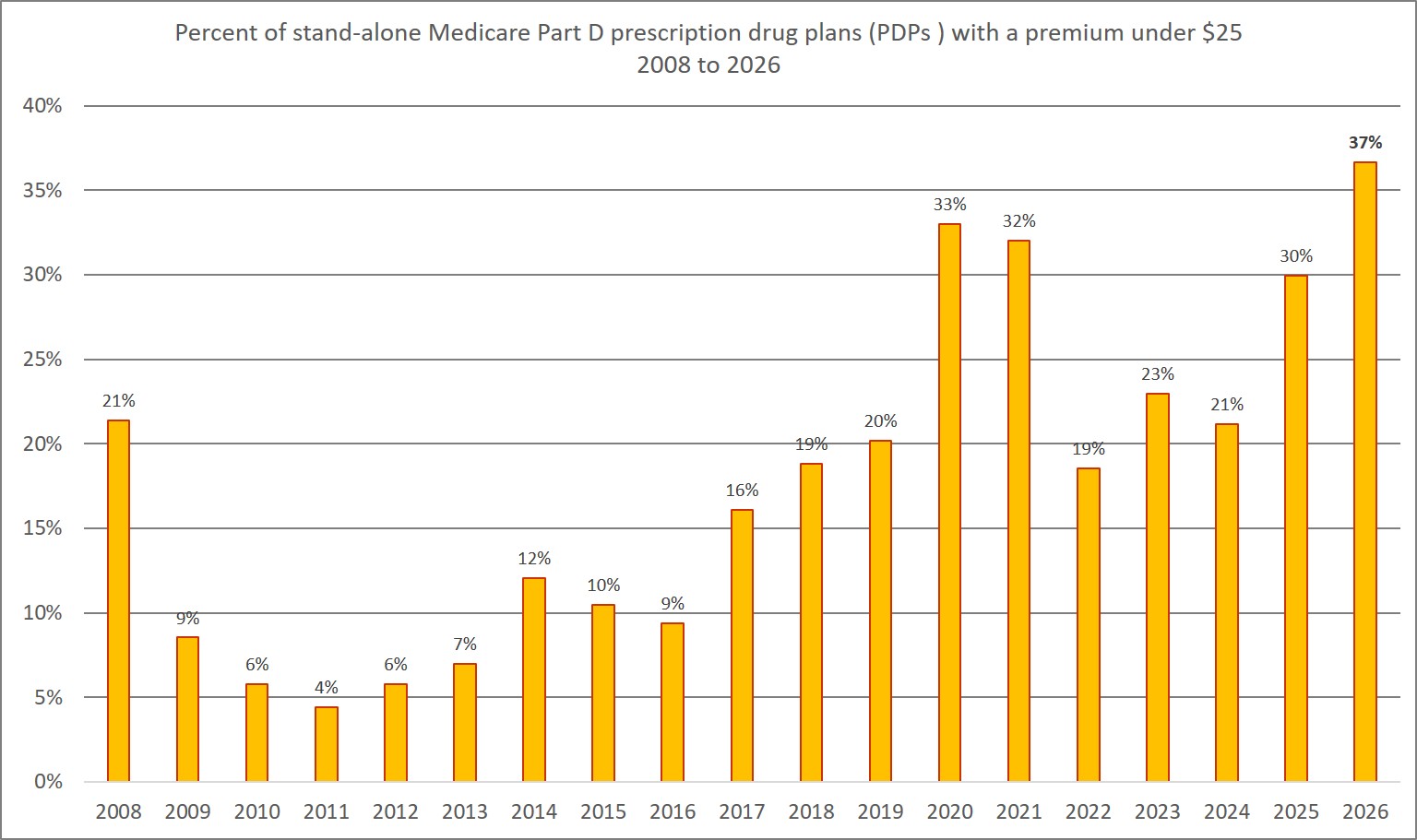
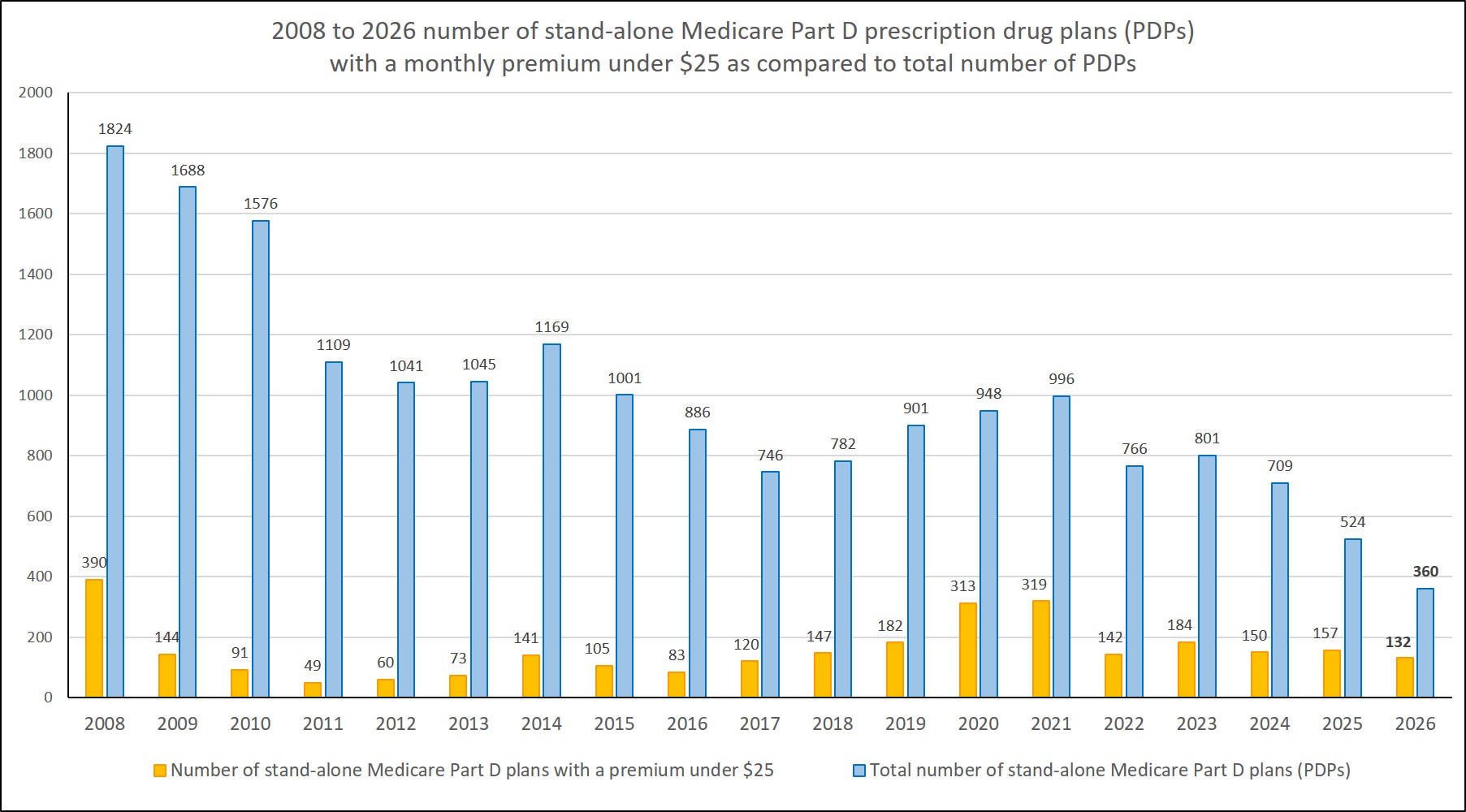
The this site analysis of the 2026 PDP landscape found a decrease in the total number of PDPs with a premium under $25. In 2026, there will be 25 fewer PDPs with a premium under $25; however, when viewed as a percentage of the total number of plans, there is a 7% increase low-premium plans.
As an example, Medicare beneficiaries in Indiana, and Kentucky will find that 40% of the 2026 Medicare Part D plans available have premiums under $25. The chart below shows the total number of stand-alone Medicare Part D plans as compared to the number of PDPs across the country with a premium under $25.
When viewed state-by-state: twenty-six (26) states will have fewer Part D plans with a premium under $25, eight (8) states will continue to have the same number of low-premium plans, and seventeen (17) states will have an increase in low-premium PDPs.
As an example of premium increases, Medicare beneficiaries in Arkansas, Colorado and New Jersey will have three (3) fewer 2026 Medicare Part D plans with premiums under $25 as compared to 2025. However, as we highlight in the next section, a $0 premium 2026 stand-alone Medicare Part D plan is available in all but seven (7) states (and many areas across the country will have access to $0 premium Medicare Advantage plans that include drug coverage (MAPDs)).
The following chart shows the number of low-cost ($25 per month or less) premium Medicare Part D plans as compared to the total number of stand-alone Part D plans offered across the country.
(5) Lows and Highs: The lowest premium and highest premium stand-alone 2026 Medicare Part D plans.
In 21 states the lowest 2026 Part D premium will be the Humana Basic Rx Plan (PDP) with a premium of $0.00. A total of 33 states will offer one or more stand-alone Prescription drug plans with a $0 premium. And those states that do not offer a $0 premium plan will have a premium under $10 except for New York where the lowest premium is $35.70.
The 2026 Medicare Part D plan with the lowest monthly premium - and a $0 initial deductible - continues to be the Kansas Blue MedicareRx Plus (PDP) plan, with a premium of $67.40. The Humana Premier Rx Plan (PDP) is the lowest priced $0 deductible plan in most other states with a premium of about $75.60 to $173.60.
The 2026 Medicare Part D
plan with the most expensive premium is the Blue MedicareRx Premier (PDP) in
Connecticut (and MA, RI, VT) at
$238.60 per month.
(6) Fewer 2026 Medicare Part D plans qualify for the LIS $0 premium.
There will be 23% fewer 2026 Medicare Part D plans qualifying for the state’s Low-Income Subsidy (LIS) $0 benchmark premium across the country.
The states offering the smallest selection of $0 premium LIS plans are Florida, and Texas, each with only one (1) $0 premium LIS plans in 2026. All other states will be offering two (2) to four (4) $0 premium LIS plans in 2026.
Learn more about $0 premium LIS plan availability.

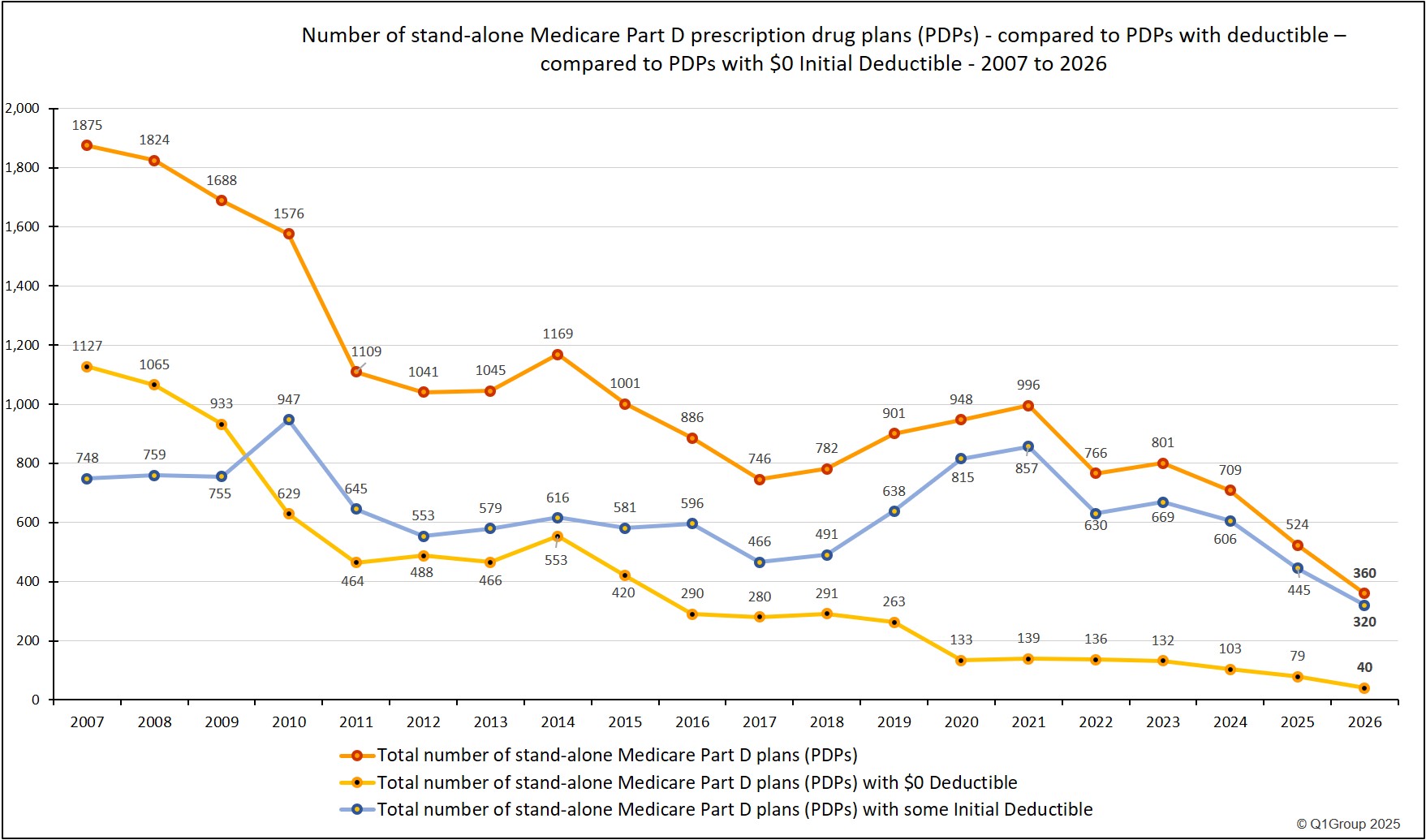
(7) 89% of stand-alone 2026 Medicare Part D plans have an initial deductible.
As was true in 2025, most 2026 Medicare Part D plans will have an initial deductible ranging from $130 to the 2026 standard initial deductible of $615.
In fact, about 89% of all 2026 stand-alone Medicare Part D PDPs will have some initial deductible - with the vast majority of these plans (69%) having a $615 initial deductible.
As an example, of the 10 plans available in Florida, only one (1) 2026 stand-alone Medicare Part D plans will have a $0 initial deductible.
On a positive note, almost 40% of 2026 Medicare Part D PDPs with an initial deductible will exclude some low-costing drug tiers from the deductible (meaning possible first-dollar coverage of your low-cost formulary drugs).
(8) More about the $2,100 out-of-pocket spending limit.
What counts toward the $2,100?
What you actually spend out-of-pocket on Medicare Part D drugs found on your plan’s formulary (and in some cases, what other organizations spend) will count toward the $2,100 maximum prescription drug out-of-pocket spending limit for the entire year (RxMOOP).
For example, as in the past, some third party arrangements that help pay for your Part D drugs will count toward your true out-of-pocket (TrOOP) spending, such as:
- Supplemental commercial health insurance
- Qualified State Pharmacy Assistance Programs (SPAPs)
- Indian Health Service and certain other Native American organizations;
- AIDS Drug Assistance Programs; and
- Legitimate charities
In this simple example, assume your Medicare Part D drug plan has a standard $615 deductible and then 25% cost-sharing after the deductible for all formulary Part D drugs (following the Defined Standard (DS) Part D plan) – and we will also assume your first purchase of the year is a $1,000 Tier 3 drug with 25% cost-sharing.
You will first spend $615 to meet the 2026 deductible, and in addition you will pay 25% of the remaining retail balance (($1,000 - $615) * 25% = $96.25). After this first $1,000 drug purchase your total out-of-pocket spending would be $615 + $96.25 = $711.25.
You will then have $2,100 - $711.25 = $1,388.75 remaining to spend before reaching your annual $2,100 spending limit.
If you use the same $1,000 Tier 3 drug each month you will have only the 25% coinsurance or pay $250 a month (since you met the $615 deductible with the first purchase). This means that in just over 6 months, you will meet the $2,100 RxMOOP and have no additional costs for Part D formulary drugs through the remainder of the year.
Important: You may spend much less than $2,100 to meet your 2026 RxMOOP - depending on your 2026 Part D plan.
There are actually four different types of Medicare Part D drug plans that vary depending on how close the drug plan coverage is to the annual Medicare Defined Standard benefit plan (having a $615 deductible and 25% cost-sharing for all formulary tiers in 2026). The four types of drug plans you can join are:
- Defined Standard (DS) - used in the simple example above,
- Basic Alternative (BA),
- Actuarial Equivalent (AE), and
- Enhanced Alternative (EA).
If you are enrolled in an "Enhanced Alternative" (EA) Medicare Part D plan, you will get credit for what you spend on Part D formulary drugs plus what the EA Medicare plan spends on your Part D drugs, up to the amount you would have spent if you were covered by a Defined Standard Part D plan.
A more complex RxMOOP example using a 2026 Enhanced Alternative (EA) Medicare Part D plan.
In this example, assume you enroll into a Medicare Part D plan with a $0 deductible (instead of the standard 2026 deductible of $615) and your plan has a Tier 3 fixed copay of $30 (instead of the standard 25% of retail cost-sharing) - and your first purchase of the year is a $200 Tier 3 drug, you would pay a $30 copay and get TrOOP credit for the $200 retail price.
This is calculated by first determining what the person would have paid if this was a Defined Standard (DS) plan where the $615 deductible was not met (since this is the first purchase of the year). In the case of a DS plan, the person would pay the full $200 drug price (toward the standard $615 deductible).
Next, the person is granted "the greater of" the EA cost or the DS cost as TrOOP credit: The Enhanced Alternative drug plan copay cost is $30 as compared to Defined Standard drug plan cost of $200. So in this case, the TrOOP credit is $200 - even though the person only spent $30 out-of-pocket.
After the first $200 drug purchase the person would have ($2,100 - $200) $1,800 remaining before reaching RxMOOP, entering Catastrophic Coverage and having $0 cost-sharing for any formulary Part D drugs through the remainder of the year.
What does NOT count toward your $2,100 spending limit?
-- Your monthly Medicare plan premiums will not count toward the $2,100 RxMOOP. (Important: You need to keep paying your monthly premium even after reaching your $2,100 spending limit or you could lose coverage of formulary drugs.)
-- If you buy a drug that is not covered by the Medicare Part D program, the cost of the non-Part D drug will not count toward the $2,100 RxMOOP.
-- If you buy a non-formulary Part D drug (a Part D drug not covered on your plan’s formulary), the cost will not count toward your $2,100 RxMOOP. (However, you have the right to ask your plan for a formulary exception whereby, if granted, your non-formulary Part D drug will be covered by your Medicare drug plan - and counted toward your $2,100 spending limit).
(9) You can spread your 2026 Medicare drug spending over the entire year.
Using the simple DS example above, you will also have the option in 2026 to shift the continued cost of the expensive $1,000 drug purchase over the entire year. So, you would not need to pay a lot of money in the first 6 months and then have $0 cost for the remainder of the year. Instead, you can opt into your plan’s payment smoothing program (called: the "Medicare prescription payment plan" or MPPP or M3P) and the optional-MPPP would then take your $2,100 out-of-pocket spending and spread it across the whole year instead of paying everything in the first 6 to 7 months.
(10) All 2026 Medicare Part D plans will continue to offer insulin at a 30-day $35 or less copay - and cover ACIP vaccines at a $0 copay.
All 2026 stand-alone Medicare Part D prescription drug plans and Medicare Advantage plans with drug coverage (MAPDs) will continue to offer a 30-day supply of insulins found on the plan’s formulary for a copay of $35 (or less) - through the deductible and Initial coverage phases. In Catastrophic Coverage, all formulary drugs will have a $0 copay.
In addition, all 2026 stand-alone Medicare Part D prescription drug plans and Medicare Advantage plans with drug coverage (MAPDs) will continue to offer $0 cost-sharing for vaccines recommended by the Advisory Committee on Immunization Practices (ACIP), such as Shingles and Pneumonia vaccines.
(11) Remember, all Medicare plans change each year.
You can review changes in Medicare plan features from 2025 to 2026 using our PDP-Compare.com/2026 or MA-Compare.com/2026.
- Your formulary (drug list) will change year-to-year, see
FormularyBrowser.com/2026 (updated as data is available)
- The 2026 standard deductible is increasing to $615, see PDP-Finder.com/2026 or MA-Finder.com/2026
- The 2026 Total Out-of-Pocket (TrOOP) threshold (RxMOOP) is $2,100
- There continues to be no beneficiary cost-sharing in the Catastrophic Coverage phase.
If you would like to see an overview of your state’s Medicare Part D plan landscape, please use the following links to our interactive 2026 PDP-Facts: AK AL AR AZ CA CO CT DC DE FL GA HI IA ID IL IN KS KY LA MA MD ME MI MN MO MS MT NC ND NE NH NJ NM NV NY OH OK OR PA RI SC SD TN TX UT VA VT WA WI WV WY National Statistics.
Please note: The above information is from our Medicare Part D plan landscape summaries and based on stand-alone Medicare Part D prescription drug plans – and does not include the U.S. territories.
Question: Can we skip the numbers and just read about our state’s Medicare Part D plan changes?
Yes you can. We provide a written summary of how 2025 Medicare Part D plans are changing in 2026 for each state, just look for the "Summarized in Plan Text" link on our PDP-Facts.com state pages. For example, you can click here to read more about drug plan changes in Arizona, such as:
"Arizona 2026 Medicare Part D premium increases and decreases:
Of the 14 Medicare Part D plans available in Arizona for 2026, 6 plan(s) will lower their premiums and 6 will increase their premiums. Currently, 32.2% of Arizona residents enrolled in a stand-alone Medicare Part D plan are enrolled in one of the 6 plans with a premium increase. The average premium increase for members of these plans will be $22.46 per month...."
What about 2026 Medicare Advantage plans?
The 2026 Medicare Advantage plan landscape summary will be presented in our next newsletter. A number of 2026 Medicare Advantage plans (MA/MAPD / MSA / SNP) may be available in your area and may include prescription drug coverage, along with Medicare Part A (hospitalization coverage), Medicare Part B (out-patient and physician coverage), and additional healthcare (and non-health-related) benefits.
You can use our Medicare Advantage plan finder (MA-Finder.com) for an overview of plans in your area (enter your ZIP to get started).
this site®, the drug finder®, and this site® are registered Service Marks of this site and may not be used for any commercial purposes without the express authorization of this site.
Copyright this site, Saint Augustine, Florida (2026)
Sources include:
CMS Press Release, "Medicare Advantage and Medicare Prescription Drug Programs Expected to Remain Stable in 2026" https://www.cms.gov/newsroom/press-releases/medicare-advantage-medicare-prescription-drug-programs-expected-remain-stable-2026
CMS Fact Sheet: "CMS Releases 2025 Medicare Part D Bid Information and Announces Premium Stabilization Demonstration"
https://www.cms.gov/newsroom/fact-sheets/cms-releases-2025-medicare-part-d-bid-information-and- announces-premium-stabilization-demonstration
CMS Press Release, "Medicare Advantage and Medicare Prescription Drug Programs to Remain Stable as CMS Implements Improvements to the Programs in 2025" https://www.cms.gov/newsroom/press-releases/medicare-advantage-and-medicare-prescription- drug-programs-remain-stable-cms-implements-improvements
CMS Fact Sheet, "Medicare Advantage and Medicare Prescription Drug Programs to Remain Stable as CMS Implements Improvements to the Programs in 2025" https://www.cms.gov/newsroom/fact-sheets/medicare-advantage-and-medicare-prescription-drug- programs-remain-stable-cms-implements-improvements
"Final CY 2025 Part D Redesign Program Instructions Fact Sheet "
https://www.cms.gov/newsroom/fact-sheets/final-cy-2025-part-d-redesign-program-instructions-fact-sheet
"Final CY 2025 Part D Redesign Program Instructions"
https://www.cms.gov/files/document/final-cy-2025-part-d-redesign-program-instructions.pdf
"Prescription Drug Event Record Reporting Instructions for the Implementation of the Inflation Reduction Act for Contract Year 2025"
https://www.hhs.gov/guidance/sites/default/files/hhs-guidance-documents/PDE_Record_Reporting_ Instructions_for_the_Implementation_of_the_IRA_for_Contract_Year_2025_508_G.pdf