In early April, hurricane researchers from the Colorado State University (CSU) predicted that the 2025 hurricane season will include:
- 17 named storms,
- 9 storms developing into becoming hurricanes, and
- four (4) of these hurricanes developing into major hurricanes.
The April CSU press release stressed the “high levels of uncertainty” surrounding the 2025 hurricane forecast as similar past hurricane seasons have ranged from “slightly below-average Atlantic hurricane activity to being hyperactive [like 2024].” The June 11th CSU 2025 forecast-update maintained the April prediction.
Researchers from the National Oceanic and Atmospheric Administration (NOAA) confirmed the CSU forecast, with NOAA also predicting a high probability of an “above-normal” 2025 Atlantic Hurricane Season having a range of
Researchers from the National Oceanic and Atmospheric Administration (NOAA) confirmed the CSU forecast, with NOAA also predicting a high probability of an “above-normal” 2025 Atlantic Hurricane Season having a range of
- 13 to 19 named storms,
- 6 to 10 storms becoming hurricanes, and
- 3 to 5 hurricanes developing into major hurricanes.
NOAA noted that, based on data from 1991 to 2020, an average hurricane season produces 14 named storms of which 7 become hurricanes, including 3 major hurricanes. Colorado State University forecasters found the same 14.4 average numbers of named storms from 1991 to 2020 with 7.2 hurricanes and 3.2 major hurricanes. For 2025, CSU researchers also noted that the probability of "major hurricanes making landfall" as compared to the averages from 1880 to 2020:
- 51% for the entire U.S. coastline (average from 1880–2020 is 43%).
- 26% for the U.S. East Coast, including the Florida peninsula (average from 1880–2020 is 21%).
- 33% for the Gulf Coast from the Florida panhandle westward to Brownsville, Texas (average from 1880–2020 is 27%).
- 56% for the Caribbean (average from 1880-2020 is 47%)
Question: How accurate are the recent NOAA Atlantic hurricane forecasts?
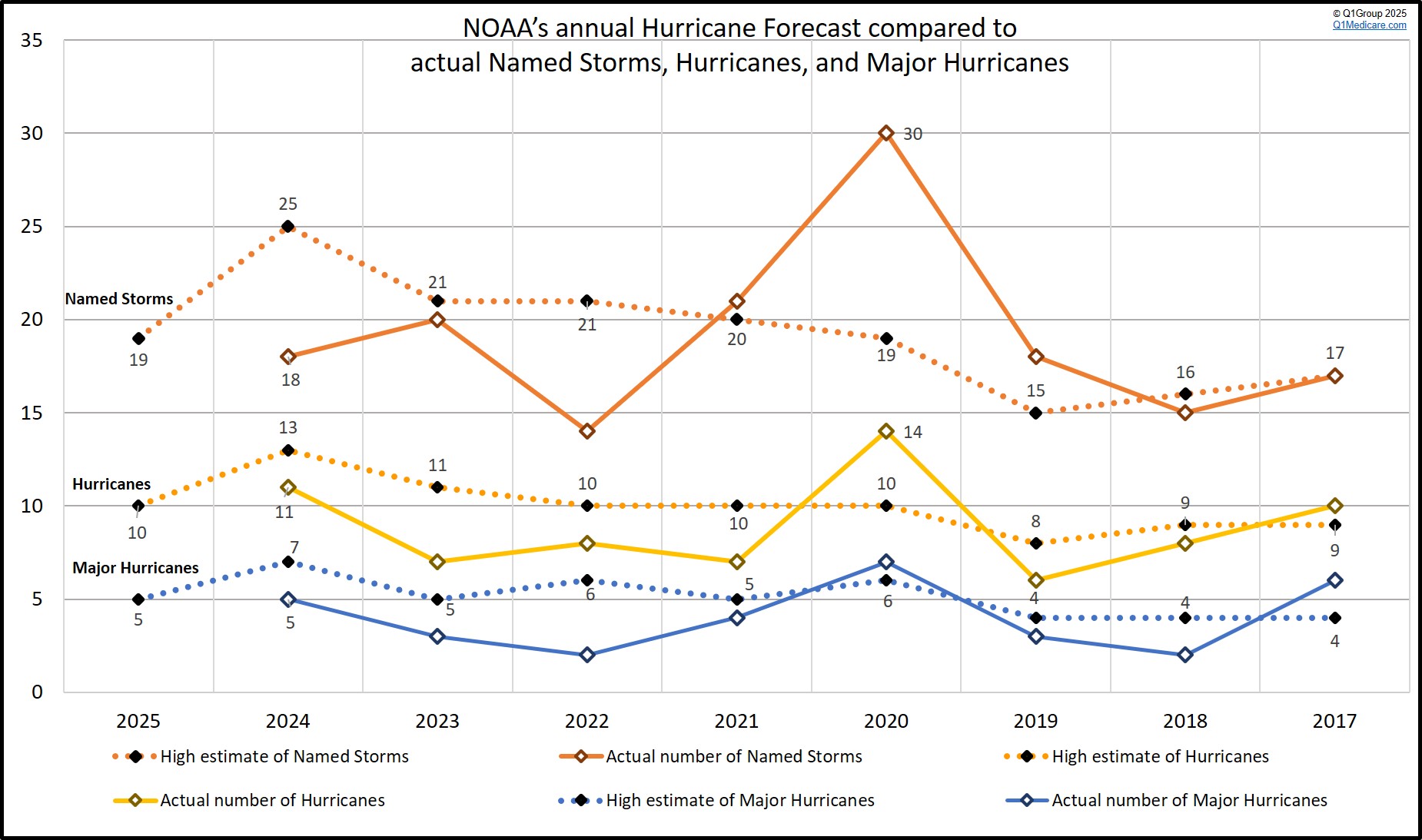
Quite accurate. As shown when comparing past predictions with actual storm activity below, the NOAA forecasters are usually quite accurate when predicting hurricane season (with 2020 being an exceptional year with a record-breaking 30 named storms).
Last May, the National Oceanic and Atmospheric Administration (NOAA) predicted a "very active" 2024 Atlantic Hurricane season with 17 to 25 named storms, 8 to 13 storms becoming hurricanes, and 4 to 7 hurricanes developing into major hurricanes.
At the end of the 2024 Atlantic Hurricane Season there were 18 name storms recorded with 11 storms reaching hurricane strength and 5 of those hurricanes becoming major hurricanes. However, although the actual number of 2024 storms were fewer than expected, CSU researchers remind people that the combination of just Hurricanes Helene and Milton caused “over 250 fatalities and more than $120 billion dollars in damage in the southeastern United States”.
The chart below shows how the upper limit of NOAA Named Storm, Hurricane, and Major Hurricane predictions (dotted lines) compare to the actual number of Named Storms. Hurricanes, and Major Hurricanes (solid lines).
Question: What is the difference between a named storm - a hurricane - and a major hurricane?
A "named storm" has winds reaching 39 mph or higher. A storm is then
classified as a hurricane when winds reach 74 mph or higher, and a
hurricane becomes a major hurricane (Category 3, 4 or 5) when winds
reach 111 mph or higher.
Important: With the number of storms predicted by NOAA increasing well beyond past years, the public is cautioned to never underestimate a named storm and to begin preparing early for the possibility of hurricanes. As noted by NOAA:
"Hurricane disasters can occur whether the season is active or relatively quiet.... Therefore, residents, businesses, and government agencies of coastal and near-coastal regions are urged to prepare for every hurricane season regardless of this, or any other, seasonal outlook. NOAA, the Federal Emergency Management Agency (FEMA), the NHC, the Small Business Administration, and the American Red Cross all provide important hurricane preparedness information on their web sites."As further stressed by 2023 FEMA Administrator Deanne Criswell:
“As we saw with [the 2022] Hurricane Ian, it only takes one hurricane to cause widespread devastation and upend lives. So regardless of the number of storms predicted this season, it is critical that everyone understand their risk and heed the warnings of state and local officials. Whether you live on the coast or further inland, hurricanes can cause serious impacts to everybody in their path.”Bottom Line: Don't wait to see if the annual NOAA Hurricane Forecast is accurate, prepare now for this year's Hurricane season. Both NOAA and CSU recommend preparing early for hurricane season - regardless of how active a season is predicted.
For further information about the current hurricane season, please see:
https://www.nhc.noaa.gov/data/tcr/index.php
Question: How is my Medicare plan coverage affected by a natural disaster.
Medicare has made special provisions to ensure continuous healthcare and drug coverage for Medicare beneficiaries affected by a natural disaster or emergency. (See the FEMA website for more about declared natural disasters: https://www.fema.gov/.)
(1) Finding a doctor or healthcare provider during a natural disaster.
- As noted by Medicare, if you have Original Medicare, you can always visit any healthcare provider that accepts Medicare. You can also contact your Medicare Supplement or Medigap provider for more information.
- People enrolled in a Medicare Advantage plan should check with their Medicare plan (you can call the telephone number on your Member ID card), and you may find that your Medicare Advantage plan allows you to get healthcare from another provider (doctor or hospital without a referral or prior authorization at in-network cost-sharing even when the healthcare is out-of-network).
(2) Using your prescription drug benefit during a natural disaster
- Your Medicare drug plan may suspend restrictions on your refills so that you have an adequate medication supply during evacuations when it is difficult to find a nearby pharmacy. (People living in areas prone to natural disasters are reminded to keep their medications organized and protected in the event of an emergency evacuation order.)
- During an evacuation, your Medicare Part D drug plan may pay for out-of-network pharmacy costs when you no longer have access to an in-network pharmacy.
Note: Even in a natural disaster situation, you may be required to pay the full prescription drug cost at an out-of-network pharmacy and then ask your Medicare drug plan for reimbursement for the excess that you spent above in-network pharmacy costs.
For further information about receiving Medicare coverage during a natural disaster, please see:
https://www.medicare.gov/providers-services/disaster-emergency
https://www.ready.gov/hurricanes
Here are some common terms and tips from Ready.gov that you might hear during the Hurricane Season
-- Hurricane Watch
(hurricane conditions possible within the next 48 hrs).
* Steps to take:
• Review your evacuation route(s) & listen to local officials.
• Review the items in your disaster supply kit; and add items to meet the household needs for children, parents, individuals with disabilities or other access and functional needs or pets.
-- Hurricane Warning
(hurricane conditions are expected within 36 hrs).
* Steps to take:
• Follow evacuation orders from local officials, if given.
• Check-in with family and friends by texting or using social media.
• Follow the hurricane timeline preparedness checklist, depending on when the storm is anticipated to hit and the impact that is projected for your location.
What to do when a hurricane is 36 hours from arriving
• Turn on your TV or radio in order to get the latest weather updates and emergency instructions.
• Build or restock your emergency preparedness kit. Include a flashlight, batteries, cash, and first aid supplies.
• Plan how to communicate with family members if you lose power. For example, you can call, text, email or use social media. Remember that during disasters, sending text messages is usually reliable and faster than making phone calls because phone lines are often overloaded.
• Review your evacuation plan with your family. You may have to leave quickly so plan ahead.
• Keep your car in good working condition, and keep the gas tank full; stock your vehicle with emergency supplies and a change of clothes.
What to do when a hurricane is 18-36 hours from arriving
• Bookmark your city or county website for quick access to storm updates and emergency instructions.
• Bring loose, lightweight objects inside that could become projectiles in high winds (e.g., patio furniture, garbage cans); anchor objects that would be unsafe to bring inside (e.g., propane tanks); and trim or remove trees close enough to fall on the building.
• Cover all of your home’s windows. Permanent storm shutters offer the best protection for windows. A second option is to board up windows with 5/8” exterior grade or marine plywood, cut to fit and ready to install.
What to do when a hurricane is 6-18 hours from arriving
• Turn on your TV/radio, or check your city/county website every 30 minutes in order to get the latest weather updates and emergency instructions.
• Charge your cell phone now so you will have a full battery in case you lose power.
What to do when a hurricane is 6 hours from arriving
• If you’re not in an area that is recommended for evacuation, plan to stay at home or where you are and let friends and family know where you are.
• Close storm shutters, and stay away from windows. Flying glass from broken windows could injure you.
• Turn your refrigerator or freezer to the coldest setting and open only when necessary. If you lose power, food will last longer. Keep a thermometer in the refrigerator to be able to check the food temperature when the power is restored.
• Turn on your TV/radio, or check your city/county website every 30 minutes in order to get the latest weather updates and emergency instructions.
What to do after a Hurricane
• Listen to local officials for updates and instructions.
• Check-in with family and friends by texting or using social media.
• Return home only when authorities indicate it is safe.
• Watch out for debris and downed power lines.
• Avoid walking or driving through flood waters. Just 6 inches of moving water can knock you down, and fast-moving water can sweep your vehicle away.
• Avoid flood water as it may be electrically charged from underground or downed power lines and may hide dangerous debris or places where the ground is washed away.
• Photograph the damage to your property in order to assist in filing an insurance claim.
• Do what you can to prevent further damage to your property, (e.g., putting a tarp on a damaged roof), as insurance may not cover additional damage that occurs after the storm.
More Details about preparing for Hurricane Season
If you would like to learn how to prepare for the hurricane season, take a look at the suggestions provided on the NOAA Hurricane Preparedness site: www.nhc.noaa.gov/ prepare/ready.php and www.weather.gov/wrn/ hurricane-preparedness, and ready.gov.
Also, here are also a few tips from the Florida Disaster Preparedness Guide for Elders (found at: elderaffairs.state.fl.us/ doea/disaster.php): elderaffairs.state.fl.us/ doea/pubs/EU/EUdisaster2015/ Disaster_Guide_2015_English_Web.pdf
- Educate yourself and know where you want to go
Learn about your community’s emergency plans, warning signals, evacuation routes, and location of emergency shelters. For example, during Hurricane Matthew, many of the barriers islands along the eastern coast were evacuated and residents were required to show passes or car tags for readmission onto the islands. Check with your local authorities to see whether your community requires some form of pass or identification after an evacuation.
- Be aware of potential home hazards
Be prepared to turn off electrical power when there is standing water or a fallen power line, or before you evacuate. Turn off gas and water supplies before you evacuate. Secure structurally unstable materials (building material, grills, and propane tanks).
- Own a fire extinguisher (and know how to use it)
Buy a fire extinguisher and make sure your family knows where to find it and how to use it. If you have an older extinguisher (over a year old), be sure that it is still functional and inspected by a professional.
- Secure important documents
Locate and secure your important papers, such as insurance policies, wills, licenses, and stock certificates.
- Collect contact information
Post emergency phone numbers at every telephone or save the number in your mobile phone. Some examples of important numbers include your insurance agent, local hospitals, local utilities, local law enforcement, and fire/rescue.
- Do you or someone in the house have special needs?
Inform local authorities if your household includes someone with special needs (such as, a person who is bed-ridden or disabled and has mobility issues).
- Prepare a disaster supply kit
Stock your home, car, and workplace with supplies that may be needed during the emergency period (such as, food, water, prescriptions, and non-prescription medications). You should stock food and water for a minimum of a three-day period. If you are diabetic, be sure to have a means to keep your medications cool while traveling or during a power outage (such as a well-insulated mini-cooler). If you have a pet, look now for a pet-friendly shelter and have pet supplies ready. Do not forget to have some cash on hand as ATM and credit card readers may not be functional if there is no electricity. The government's site (www.ready.gov/build-a-kit) provides some additional information.
FEMA's Basic Disaster Supply Kit includes:
- Water, one gallon of water per person per day for at least three days, for drinking and sanitation
- Food, at least a three-day supply of non-perishable food
- Battery-powered or hand crank radio and a NOAA Weather Radio with tone alert and extra batteries for both
- Flashlight and extra batteries
- First aid kit
- Whistle to signal for help
- Dust mask to help filter contaminated air and plastic sheeting and duct tape to shelter-in-place
- Moist towelettes, garbage bags and plastic ties for personal sanitation
- Wrench or pliers to turn off utilities
- Manual can opener for food supplies
- Local maps
- Cell phone with chargers, automobile power inverters / adapters or solar charger
- Water, one gallon of water per person per day for at least three days, for drinking and sanitation
Sources Include:
https://tropical.colostate.edu/forecasting.html
https://tropical.colostate.edu/archive.html#list_2020s
https://tropical.colostate.edu/Forecast/2025-04-pressrelease.pdf
https://tropical.colostate.edu/resources.html#realtime or https://tropical.atmos.colostate.edu/Realtime/
https://www.noaa.gov/news-release/noaa-predicts-above-normal-2025-atlantic-hurricane-season
NOAA monthly Atlantic weather summary: https://www.nhc.noaa.gov/data/tcr/index.php
(formerly https://www.nhc.noaa.gov/text/MIATWSAT.shtml)
https://www.nhc.noaa.gov/
https://www.cdc.gov/disasters/hurricanes/covid-19/prepare-for-hurricane.html
https://www.weather.gov/safety/hurricane
https://www.cpc.ncep.noaa.gov/products/Epac_hurr/Epac_hurricane.html
https://www.cpc.ncep.noaa.gov/products/Epac_hurr/Slide1.JPG
NOAA Historical Archives - 2022 example: https://www.nhc.noaa.gov/data/tcr/index.php?season=2022&basin=atl
http://rammb-data.cira.colostate.edu/tc_realtime/storm.asp?storm_identifier=al912023
https://tropical.colostate.edu/archive.html#list_2020s
https://tropical.colostate.edu/Forecast/2025-04-pressrelease.pdf
https://tropical.colostate.edu/resources.html#realtime or https://tropical.atmos.colostate.edu/Realtime/
https://www.noaa.gov/news-release/noaa-predicts-above-normal-2025-atlantic-hurricane-season
NOAA monthly Atlantic weather summary: https://www.nhc.noaa.gov/data/tcr/index.php
(formerly https://www.nhc.noaa.gov/text/MIATWSAT.shtml)
https://www.nhc.noaa.gov/
https://www.cdc.gov/disasters/hurricanes/covid-19/prepare-for-hurricane.html
https://www.weather.gov/safety/hurricane
https://www.cpc.ncep.noaa.gov/products/Epac_hurr/Epac_hurricane.html
https://www.cpc.ncep.noaa.gov/products/Epac_hurr/Slide1.JPG
NOAA Historical Archives - 2022 example: https://www.nhc.noaa.gov/data/tcr/index.php?season=2022&basin=atl
http://rammb-data.cira.colostate.edu/tc_realtime/storm.asp?storm_identifier=al912023