For an overview of annual plan changes, you can click here for a chart comparing Medicare Part D standard benefit parameters from the 2006 start of the Medicare Part D program through 2020. CMS is expected to release the finalized version of the 2020 Medicare Part D standard parameters in early April.
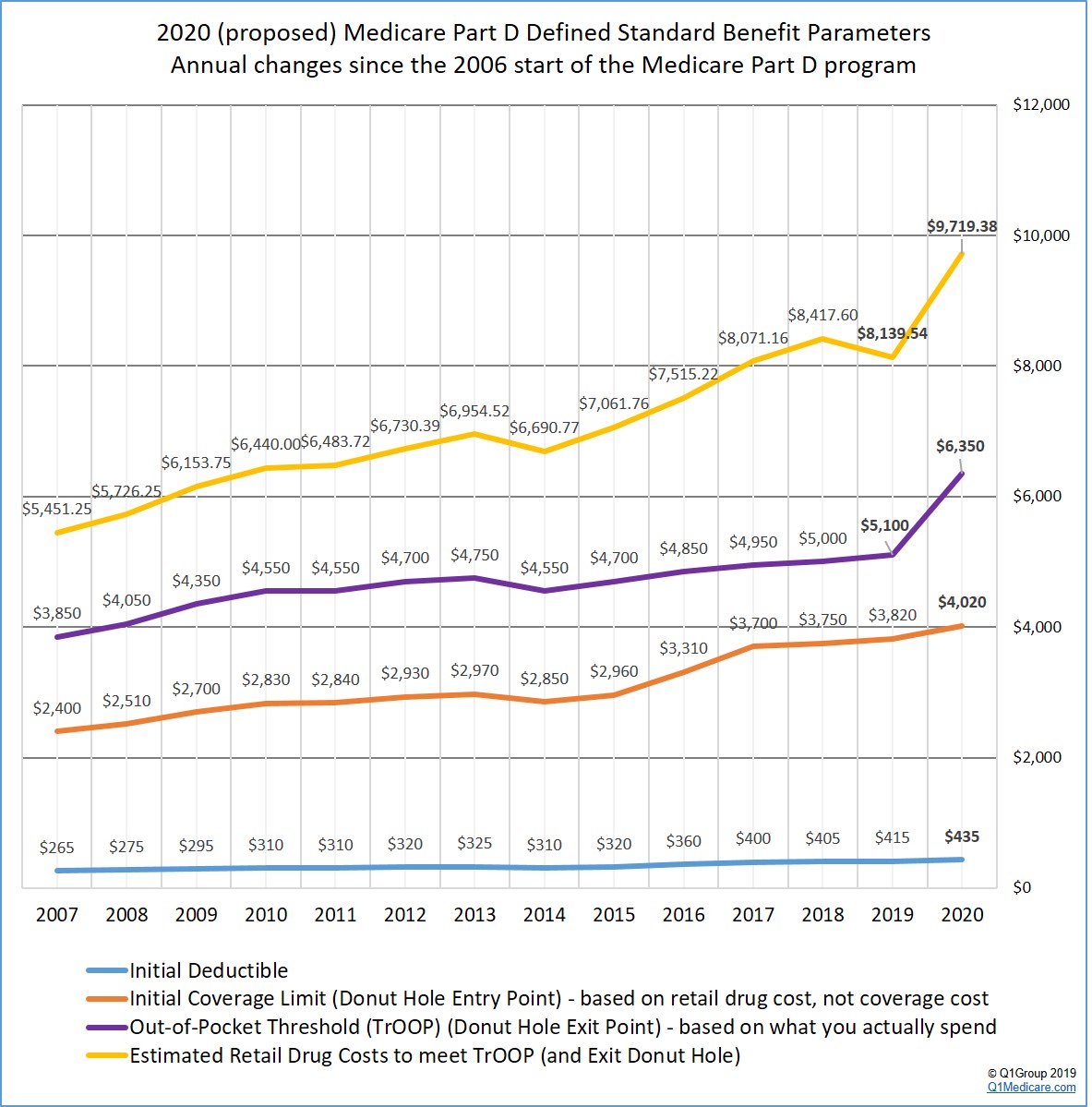
The following graph shows the proposed 2020 Medicare Part D plan parameters and how standard Medicare Part D plan coverage has changed each year since the 2006 beginning of the Medicare Part D program.
Here is more of an explanation of the proposed 2020 Medicare Part D coverage...
Based on the CMS information we have at this time, here are a few proposed changes to the standard Medicare Part D prescription drug coverage:
- The standard 2020 Initial Deductible is proposed to
increase about 5%.
The 2020 standard Initial Deductible is proposed to increase by $20 to $435 from the current 2019 standard Initial Deductible of $415. As reference: the 2018 standard Initial Deductible was $405, the 2017 standard Initial Deductible was $400, the 2016 standard Initial Deductible was $360, and the 2015 Initial Deductible was $320.
Reminder: The Initial Deductible will not affect when you enter the Donut Hole or Coverage Gap, but will impact when you leave the Donut Hole and enter Catastrophic Coverage. In other words, what you spend toward your Initial Deductible is counted toward your out-of-pocket threshold or TrOOP (see below for more about TrOOP).
This means: The Initial Deductible is the amount that you pay yourself before your Medicare Part D plan begins to share in the cost of coverage. If you enroll in a Medicare Part D prescription drug plan with a standard Initial Deductible, you will spend slightly more out-of-pocket in 2020 before your plan coverage begins. As a note, the majority of 2019 Medicare Part D plans have an initial deductible. But, as we see in 2019, many popular Medicare Part D plans exclude lower-costing Tier 1 and Tier 2 drugs from the deductible, providing plan Members with immediate coverage for some lower-costing medications.
- The
Initial Coverage Limit is proposed to increase 5%.
The 2020 Initial Coverage Limit (ICL) is proposed to increase $200 to $4,020 from the current 2019 ICL of $3,820. The Initial Coverage Limit marks the Donut Hole entry point. Medicare beneficiaries enter the Donut Hole or Coverage Gap when the total negotiated retail value of their prescription drug purchases exceeds their plan’s Initial Coverage Limit. As reference, the 2018 ICL was $3,750, the 2017 Initial Coverage Limit was $3,700, the 2016 Initial Coverage Limit was $3,310, and the 2015 Initial Coverage Limit was $2,960.
This means: If CMS approves the proposed standard Medicare Part D parameters in April, you will be able to buy more medications before reaching the 2020 Donut Hole or Coverage Gap (assuming that the retail price of your medications does not increase over time).
- Will you enter the 2020 Donut Hole?
You can estimate now (based on your current retail drug prices remaining stable) that, if you purchase medications with an average retail value of over $335 per month, you will enter the 2020 Donut Hole at some point during the year.
- The
2020 Donut Hole discount will increase to 75% for all generic drugs.
If you reach the 2020 Donut Hole or Coverage Gap phase of your Medicare Part D plan coverage, the generic drug discount will increase from 63% to 75%. (So your generic drug costs in the Donut Hole will be 25% of your plan's negotiated retail prices.)
This means: If you are in the 2020 Donut Hole and your generic medication has a retail cost of $100, you will pay only $25. And the $25 that you spend for a formulary drug will count toward your 2020 out-of-pocket spending limit or TrOOP.
- The
Donut Hole discount will remain the same (75%) for brand-name drugs.
The 2020 brand-name drug Donut Hole discount remains at 75% (you pay 25% of retail costs). The pharmaceutical industry will be responsible for 70% of the cost of medications in the Coverage Gap, therefore you will receive credit for 95% of the retail drug cost toward meeting your 2020 total out-of-pocket maximum or Donut Hole exit point (the 25% of retail costs you pay plus the 70% drug manufacturer discount).
This means: If you reach the 2020 Donut Hole and purchase a brand-name medication with a retail cost of $100, you will pay $25 for the formulary medication, and receive $95 credit toward meeting your 2020 out-of-pocket spending limit – or Donut Hole exit point.
- The amount you need to spend to exit the 2020 Donut Hole will increase by 25%
Your 2020 Total Out-of-Pocket Cost (TrOOP) threshold will increase by $1,275 to $6,350 from the current 2019 TrOOP limit of $5,100.
Remember that TrOOP does not include monthly premiums or non-formulary purchases. As reference, the 2018 TrOOP limit was $5,000, the 2017 TrOOP limit was $4,950, the 2016 TrOOP limit was $4,850, and the 2015 TrOOP threshold value was $4,700.
TrOOP is the dollar figure you must spend (or someone else spends on your behalf) to get out of the Donut Hole or Coverage Gap and into the Catastrophic Coverage phase of your Medicare Part D plan.
The good news:
As noted above, brand-name medication purchases in the 2020 Donut Hole are discounted by 75% (you pay 25%), but you will receive credit of 95% of the retail drug price toward meeting the 2020 TrOOP threshold - so according, to the Henry J Kaiser Family Foundation (KFF), someone purchasing only brand-name medications (100% brand) in the 2020 Donut Hole should actually spend only $375 more before meeting the higher 2020 TrOOP (since 70% of the retail cost paid by the pharmaceutical industry is counted toward meeting TrOOP).
What will this 25% increased in 2020 TrOOP mean to you?
You can use our 2020 Donut Hole calculator (found at PDP-Planner.com/2020) to estimate your actual Donut Hole spending based on your estimated mix of generic and brand-name drugs purchased in the 2020 Coverage Gap.
-- Your Donut Hole drug mix: 90.18% brands and 9.82% generics
If you use the CMS estimate of 90.18% brand drugs and 9.82% generic drugs (based on past overall drug usage in the Donut Hole) - and assume you have a $435 deductible and the retail cost of your drugs is about $810 per month, you can expect your actual annual costs to be around $2,860 before meeting the $6,350 TrOOP and exiting the Donut Hole - your Medicare Part D plan would spend about $3,360 and the pharmaceutical manufacturers would spend about $3,590. The total retail value of your drug purchases needed to exit the Donut Hole would be $9,719.
-- Your Donut Hole drug mix: 100% generics
If you use only generic drugs (100% generic) in the Donut Hole - and assume you have a $435 deductible and the retail cost of your drugs is about $1,943 per month, you can expect your actual annual costs to be $6,350 (or the same as the 2020 TrOOP) before exiting the Donut Hole - your Medicare Part D plan would spend about $16,970 and the pharmaceutical manufacturers would spend $0. The total retail value of your drug purchases needed to exit the Donut Hole would be $23,316.
-- Your Donut Hole drug mix: 100% brands
If you use only brand drugs (100% brands) - and assume you have a $435 deductible and the retail cost of your drugs is about $775 per month, you can expect your actual annual costs to be around $2,652 before meeting the $6,350 TrOOP and exiting the Donut Hole - your Medicare Part D plan would spend about $2,953 and the pharmaceutical manufacturers would spend about $3,696. The total retail value of your drug purchases needed to exit the Donut Hole would be $9,303.
This means: You will spend more out-of-pocket to exit the 2020 Donut Hole as compared to 2019 - and you would exit the Donut Hole and enter Catastrophic Coverage faster by using brand-name medications in the Donut Hole since the pharmaceutical industry brand-name discount will accelerate you toward meeting your TrOOP.
Not sure how the 2020 Donut Hole or Coverage Gap functions?
To help you visualize how your current drug spending relates to your Medicare Part D plan coverage, we have our updated 2020 Donut Hole calculator found at PDP-Planner.com/2020. Our Donut Hole calculator helps you estimate what you can expect to pay throughout the different phases of your 2020 Medicare Part D plan coverage. We have several options for you to choose the percentage of generic and brand drugs you use and you can even change your mix of prescriptions to be 100% generic or 100% brand. To get you started, you can click here to see an example of the 2020 Medicare prescription drug plan phases for someone with $800 per month brand drug retail cost.
(Spoiler alert: If the retail cost of your formulary medications is $800 per month, you can expect to spend about $2,666.83 out-of-pocket in 2020 - assuming a $435 deductible and an average cost-sharing of 25% of retail - and not including monthly premiums).
- The estimated retail value of drug purchases needed to exit the Donut Hole will increase 19%.
CMS estimates that a person will use a mix of 90.18% brand drugs and 9.82% generic drugs while in the 2020 Donut Hole (an increase in estimated brand-name drug use as compared to the 2019 estimated mix of 89.31% brand drugs and 10.69% generic drugs while in the Donut Hole). As reference, in 2018, the CMS retail drug-cost estimate was calculated using a mix of 87.9% brand drugs and 12.1% generic drugs and the estimated retail cost to meet 2018 TrOOP and exit the 2018 Donut Hole is $8,417.60.
As a result, CMS calculates that a person will be able to purchase drugs with an approximate retail value of $9,719.38 before meeting the $6,320 out-of-pocket threshold (TrOOP) and exiting the 2020 Donut Hole.
Please note, in 2019 CMS originally estimated that people would be able to purchase drugs with an approximate retail value of $8,906.55 in last-years February Draft Call Letter, and then increased that estimate to $8,139.54 in the 2019 Final Call Letter (based on the increased brand-name Donut Hole discount). Our chart is using the $8,139.54 value from the 2019 Final Call Letter.
- Will you enter the 2020 Catastrophic Coverage phase?
Based on CMS drug purchase estimates, if your monthly retail formulary drug costs are more than $810 per month, you will exit the 2020 Donut Hole and enter Catastrophic Coverage portion of your Medicare Part D plan.
- Catastrophic Coverage
costs could change slightly.
The Catastrophic Coverage portion of your Medicare Part D plan begins when you leave the Coverage Gap or Donut Hole. In the 2020 Catastrophic Coverage phase, you pay a minimum of $8.95 for brand drugs or $3.60 for generics (or 5% of retail costs, whichever is higher). As reference, in the 2018 Catastrophic Coverage phase, you paid a minimum of $8.35 for brand drugs or $3.35 for generics (or 5%, whichever is higher) and in 2017 Catastrophic Coverage you paid a minimum of $8.25 for brand drugs or $3.30 for generics.
This means: If you purchase a brand name medication with a retail price of over $179 or a generic medication with a retail price of over $72, you will pay 5% of retail or more than the minimum $8.95 for brand drugs or $3.60 for generics.
For example, if you are using the expensive medication IMBRUVICA 140 MG CAPSULE (90 EA ) (NDC: 57962014009), your monthly retail drug costs may be over $17,000, so your catastrophic coverage cost would be approximately $850 per month since this 5% of retail cost is more than the minimum $8.95 brand-name catastrophic coverage cost (based on 2019 retail drug costs).