Your Medicare Part D or Medicare Advantage plan can change every year
and your Medicare plan is required to summarize any
plan changes in your Annual Notice of
Change letter (ANOC) that you should receive in the mail late-September
or
early-October. If you have not received your plan’s ANOC letter,
please call your plan’s Member Services department and ask for another
copy of the ANOC - the toll-free telephone number for Member Services
can be found on your Member ID card.
What year-to-year changes can you expect in your Medicare Part D or Medicare Advantage plan?
Here are a few example:
How do standard Medicare drug plans change over time?
Not only can your Medicare plan change, but also the general or standard Medicare Part D prescription drug plan design will change with changes to the standard deductible and maximum out-of-pocket spending limit. Below is a chart showing how the standard Part D drug plan coverage has changed over the years. Since 2025, Medicare Part D coverage has been simplified with only three phases of coverage, and two important limits, namely the Initial Deductible phase (that has a $590 maximum in 2025 ($615 in 2026) and may be lower or eliminated depending on the plan), the Initial Coverage phase (that has a $2,000 maximum out-of-pocket spending limit for Part D formulary drugs in 2025 ($2,100 in 2026). This is also known as the RxMOOP, followed by the Catastrophic Coverage phase.

What year-to-year changes can you expect in your Medicare Part D or Medicare Advantage plan?
Here are a few example:
- Monthly plan premiums can increase (or decrease) (for example, increasing from $44 to $55 per month).
- Initial drug deductibles can increase (for example, increasing from $590 in 2025 to $615 in 2026).
- The RxMOOP
or Part D maximum out-of-pocket spending limit for Part D formulary
drugs (not including bonus drugs) will increase from $2,000 for 2025 to $2,100 in 2026. After
reaching RxMOOP Medicare Part D beneficiaries will move to the Catastrophic Coverage phase and have a $0 copay for all
formulary Part D drugs through the end of the year.
- Prescription drugs that are covered by your plan (the size of
the plan's formulary and changes in coverage of specific brand-name and
generic drugs - for example, your Tier 1 generics may be moved to Tier 2
Non-Preferred Generics),
- Drug coverage costs or cost on each formulary tier (what you pay for your drugs - such as a $5 copay or 25% coinsurance),
- Drug usage management restrictions (for example, does your drug now have a Quantity Limit or require Prior Authorization),
- Pharmacy networks (usually a Medicare drug plan will expand
their pharmacy network each year and may change standard or preferred
pharmacies),
- Healthcare provider networks (for Medicare Advantage plans
doctors or specialists can be added - or removed from your plans
"in-network" coverage),
- Copayments for medical treatment (for Medicare Advantage plans your healthcare costs can change year-to-year), and
- Your Medicare Advantage plan’s Maximum Out-of-Pocket (MOOP) spending limit for in-network, eligible Medicare Part A and Part B coverage.
How do standard Medicare drug plans change over time?
Not only can your Medicare plan change, but also the general or standard Medicare Part D prescription drug plan design will change with changes to the standard deductible and maximum out-of-pocket spending limit. Below is a chart showing how the standard Part D drug plan coverage has changed over the years. Since 2025, Medicare Part D coverage has been simplified with only three phases of coverage, and two important limits, namely the Initial Deductible phase (that has a $590 maximum in 2025 ($615 in 2026) and may be lower or eliminated depending on the plan), the Initial Coverage phase (that has a $2,000 maximum out-of-pocket spending limit for Part D formulary drugs in 2025 ($2,100 in 2026). This is also known as the RxMOOP, followed by the Catastrophic Coverage phase.
Important: Studies show that most people (about 70%) do not change their Medicare Part D or Medicare Advantage plan each year, even if they can save money on their prescription and medical costs - and we can appreciate that, for some people, the value of consistency outweighs the potential for savings - however, we want to remind you that, if you decide to stay with your current Medicare plan into next year, your Medicare plan coverage and costs can change, so please take time to know how your current Medicare plan is changing next year.
- How might your Medicare plan change next year and how many people will be affected by the change?
See our example for 2025 on this site
The Good News: After receiving your ANOC letter in September or early-October, you will have plenty of time to review your Medicare plan coverage options during the annual Open Enrollment Period that begins every year on October 15th and continues through December 7th.
Need a fast way to see how your Medicare Advantage or Medicare Part D plan is changing next year?
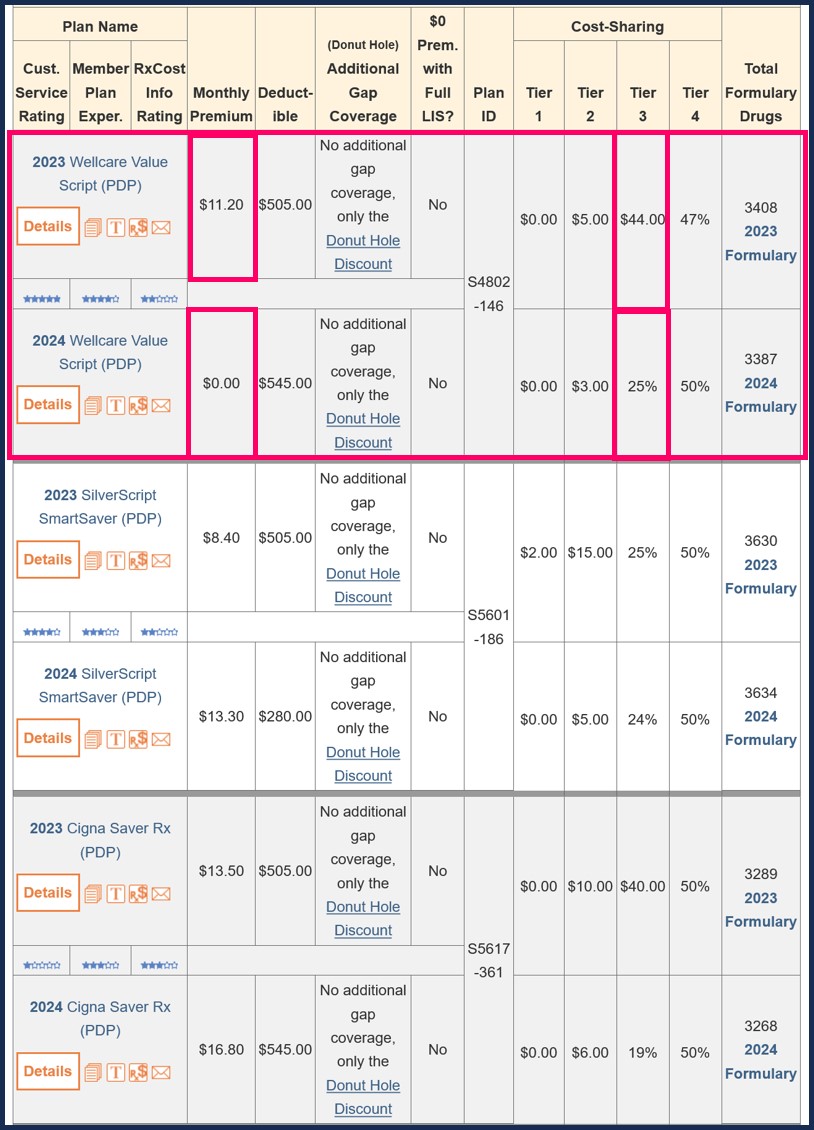
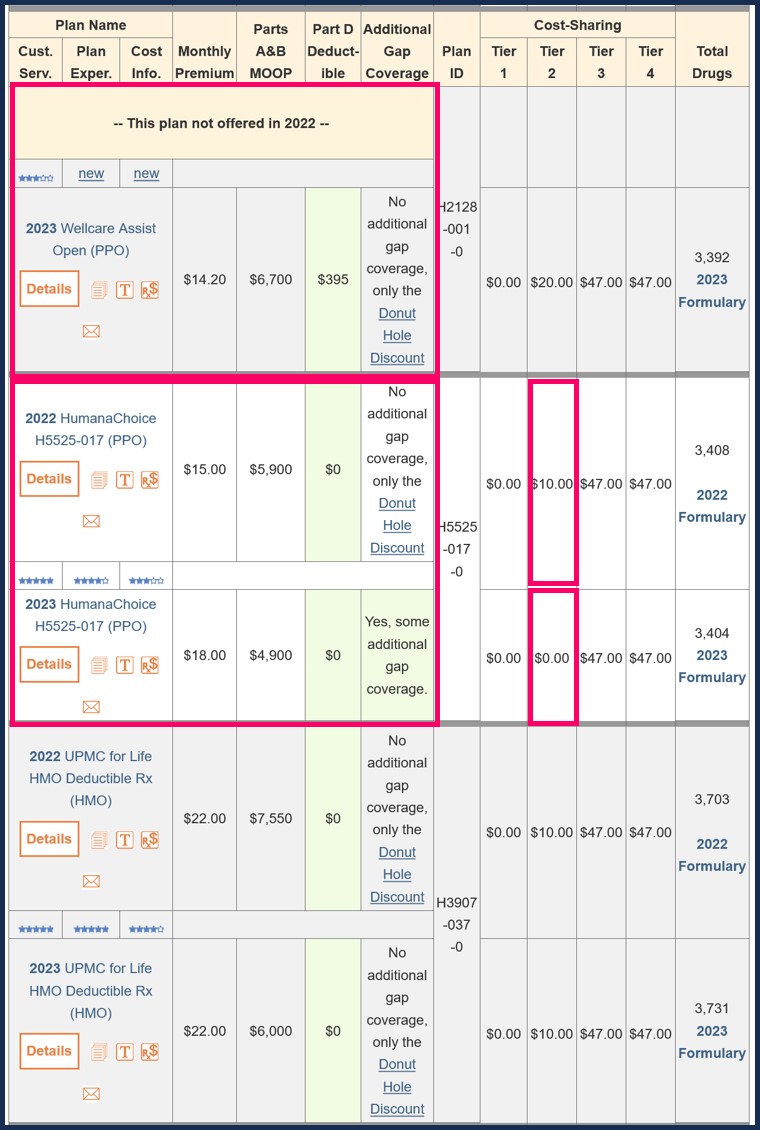
Our PDP-Compare.com and MA-Compare.com tools allow you to compare changes in all stand-alone Medicare Part D prescription drug plans (PDPs) or Medicare Advantage plans (MAs or MAPDs) across the country.
Our comparison tools show changes in monthly premiums and plan designs, as well as changes in copayments or coinsurance rates for different drug tiers.
Both the PDP-Compare and MA-Compare tools also show the Medicare Part D plans or Medicare Advantage plans that will be discontinued or added next year. The MA-Compare tool includes links to the health coverage details of all Medicare Advantage plans.
Example of PDP-Compare.com - Showing how stand-alone Medicare Part D plans can change year-to-year.
Example of MA-Compare.com - showing how Medicare Advantage plans can change year-to-year.
- Browse Medicare Part D prescription drug plans
- Browse Medicare Advantage plans (MAPD)
- Sign-up for our Medicare Part D Newsletter.
- Still have a question? Click here to let us know.