Not exactly. You will enter the Donut Hole based on the retail value of your formulary drug purchases - not just your co-payment (although a portion (or maybe all) of your co-payment will make up the retail drug cost).
So if your Tier 3 medication has a negotiated retail cost of $350 and your Medicare Part D plan has a $47 co-pay for the Tier 3 drug, the $350 counts toward entering the Donut Hole or reaching your Initial Coverage Limit ($5,030 in 2024) and the $47 co-payment you pay counts toward TrOOP threshold which is $8,000 in 2024.
However, if your Tier 3 medication
has a negotiated retail cost of $34 and your Medicare Part D plan has a
$47 co-pay for the Tier 3 drug, you will pay the "lessor of" the plan's co-pay or the drug's retail price. And since you never pay more than the drug's retail price, you will pay $34 for the drug (not the $47 co-pay) and the $34 you spend counts toward reaching your Initial Coverage Limit and entering the Donut Hole - and the $34 you spend also counts toward meeting your total out-of-pocket costs.
When you exceed your TrOOP threshold, you exit your Medicare Part D plan’s Coverage Gap or Donut Hole, and enter the Catastrophic Coverage phase and starting in 2024, the Inflation Reduction Act (IRA) eliminated beneficiary cost-sharing in the Catastrophic Coverage phase. This means, if you exit the 2024 Donut Hole and enter the Catastrophic Coverage phase, you will pay nothing more (cost-sharing will be $0) for all formulary Medicare Part D drugs through the remainder of the year.
Reader Comment: Wasn't the Donut Hole eliminated?
Not yet, but it will be in 2025: Although we say that the Donut Hole "closed" in 2020 since you receive a 75% discount on all formulary drugs, you will still leave your Initial Coverage Phase once your retail drug costs exceed the Initial Coverage Limit. And when you leave your Initial Coverage Phase, you will enter the Coverage Gap (Donut Hole) where the cost of your formulary medications can increase, decrease, or stay the same - depending on your Medicare plan, your Initial Coverage Phase cost-sharing, and the drug's retail price.
Using the first example above, your drug costs will almost double when you reach the Donut Hole. In the Donut Hole, you will pay 25% of the $350 retail drug price - or $87.50 instead of your previous $47 co-pay. Using the second example, your drug costs decrease when you enter the Donut Hole as you would pay 25% of the $34 retail drug price or $8.50 instead of $34.
2024 is the last year for the Coverage Gap or Donut Hole.
Starting in 2025, the Inflation Reduction Act (IRA) eliminates the Coverage Gap (Donut Hole). In 2025 and beyond, Medicare Part D beneficiaries will stay in the Initial Coverage phase until their out-of-pocket spending for Part D formulary drugs (TrOOP) reaches the maximum out-of-pocket spending limit for Part D formulary drugs (RxMOOP) - which is set at $2,000 for 2025. After reaching RxMOOP, Medicare Part D beneficiaries will enter Catastrophic Coverage and have a $0 copay (no additional costs) for all formulary Medicare Part D drugs through the remainder of the year.
2025 Medicare Part D coverage
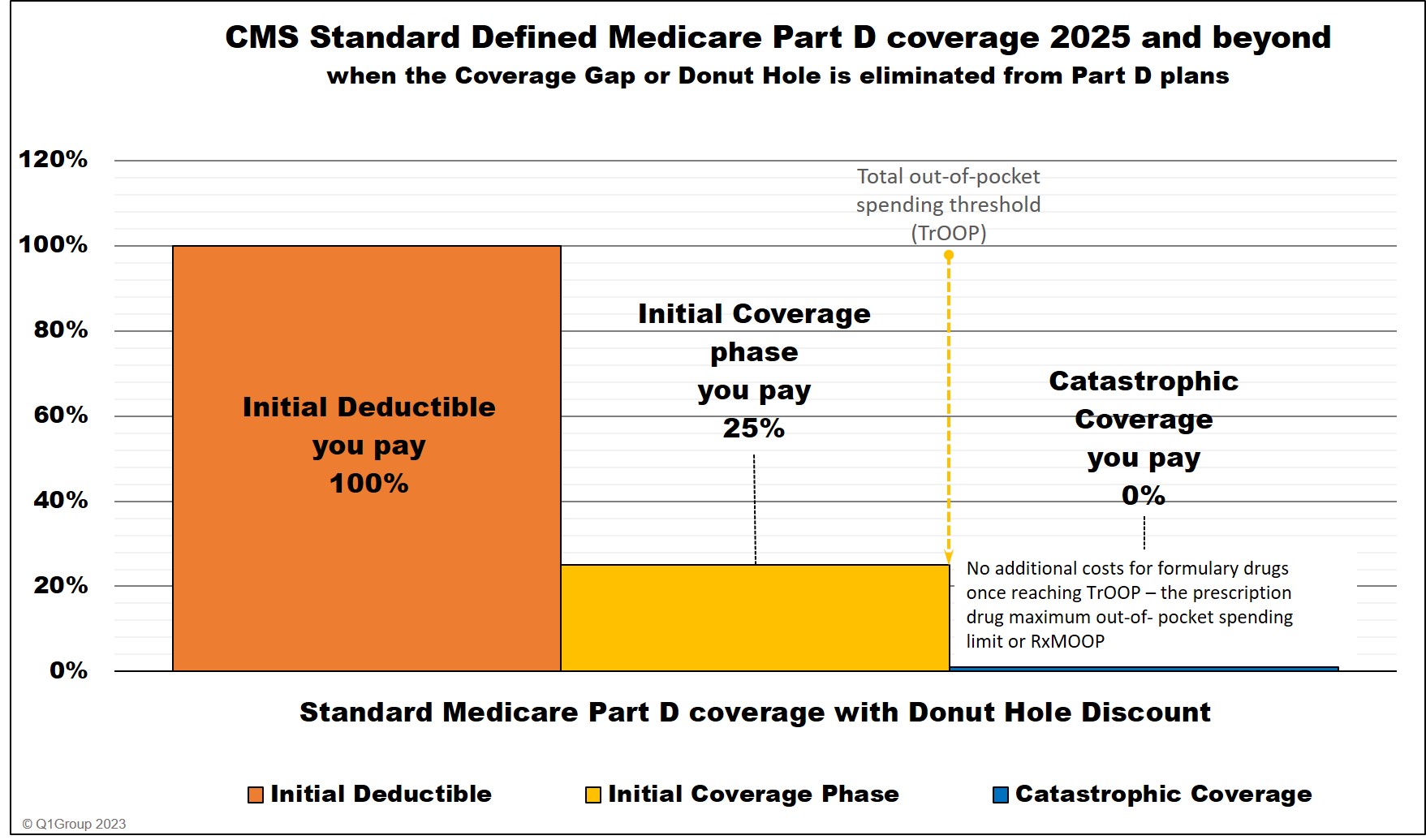
- You will leave your Initial Coverage Phase and enter your
Medicare Part D plan's Donut Hole or Coverage Gap when your retail
medication costs reach your Medicare Part D plan's Initial Coverage
Limit (ICL - not just the amount of what you paid, but the your plan's negotiated retail value of the medications you purchased).
- Your Medicare drug plan's Initial Coverage Limit can change each year. In 2014, the Donut Hole entry point was when
a person's total retail drug costs totaled $2,850 - in 2019,
the Initial Coverage Limit or Donut Hole entry point is $3,820 - and in
2024 the ICL is $5,030.
- One large drug purchase (or multiple month drug purchase)
can actually move you from the Initial Deductible through the Initial Coverage Phase and into the Donut Hole,
so the only way to know exactly when you will enter or leave the Donut Hole
is by watching your monthly Medicare Part D plan's Explanation of Benefits statement carefully (you received this printed form in the mail) or
you can contact your Medicare Part D plan and ask the Member Services
representative where you are relative to the plan's Coverage Gap.
- Once you are in the Donut Hole or Coverage Gap, you will automatically receive a discount
on your brand-name and generic drug purchases. The brand-name Donut
Hole discount is 75% (you pay 25% of retail) and the generic Donut Hole
discount is also 75% (you pay 25% of retail).
- You will stay in the Donut Hole phase until your true
out-of-pocket costs (also called TrOOP or total drug spend) reaches a
certain level. TrOOP is made up of what you
pay during the initial deductible (if you have one) plus what you personally
pay in the initial coverage phase, before the Donut Hole, plus
what you pay
in the Donut Hole (and you get credit for the 70% brand-name
discount paid by the drug manufacturer in the
donut hole) - for instance, if you buy a brand-name drug with a
$100 retail value, you will pay $25, but get credit for $95 toward TrOOP
).
- TrOOP can change every year. For example, the TrOOP in 2014 was $4,550 - TrOOP in 2019 wass $5,100 - and TrOOP in 2024 is $8,000.
- Once you exceed your TrOOP limit, you enter the Catastrophic Coverage portion of your Medicare Part D plan - and starting in 2024, there is no cost for any formulary Medicare Part D drugs once reaching Catastrophic Coverage.
- The Donut Hole will be eliminated in 2025 and a person who reaches the 2025 out-of-pocket spending limit of $2,000 will enter Catastrophic Coverage with no cost-sharing for formulary Part D drugs through the remainder of the year.
- No matter where you are at the end of the year, your Medicare Part D plan coverage ends on December 31st and the whole process begins again from the start on January 1st of the next year.