Reminder about the Donut Hole "closing"...
Although we say that the Donut Hole "closed" in 2020 since you receive a 75% discount on all formulary drugs purchased in the Donut Hole, the Coverage Gap will remain the third phase of your 2024 Medicare Part D coverage. So, if will leave your Medicare Part D plan's Second Phase or Initial Coverage Phase, you will enter the Coverage Gap (Donut Hole) where the cost of your formulary medications can actually increase, decrease, or stay the same - depending on your Medicare plan, your cost-sharing, and the drug's retail price (see the examples below for more information).
Important Update: 2024 is the last year for the Coverage Gap or Donut Hole.
Starting in 2025, the Inflation Reduction Act (IRA) eliminates the Coverage Gap (Donut Hole). In 2025 and beyond, Medicare Part D beneficiaries will stay in the Initial Coverage phase until their out-of-pocket spending for Part D formulary drugs (TrOOP) reaches the maximum out-of-pocket spending limit for Part D formulary drugs (RxMOOP) - which is set at $2,000 for 2025. After reaching RxMOOP, Medicare Part D beneficiaries will enter Catastrophic Coverage and have a $0 copay (no additional costs) for all formulary Medicare Part D drugs through the remainder of the year.
Tip 1. You can calculate when, or if, you enter the Donut Hole
You can use a little simple math and calculate when (or if) you enter this year's Donut Hole or Coverage Gap. All you need to do is divide your Initial Coverage Limit of $5,030 in 2024 by the average monthly retail value of your prescription drugs (this number is usually found on your EOB letter (see Tip #5 below) or your pharmacy receipt).
For example, if you use medications with a monthly retail value (not what you paid, but the retail drug value) of $420, you can figure that you will enter the 2024 Donut Hole in early December ($5,030 / $420 = month 11.97). If you would like to skip the math, here is a link to our article and chart showing when you can expect to enter the 2024 Donut Hole based on your average monthly retail drug prices: "Will you enter the 2024 Medicare Part D Coverage Gap or Donut Hole?".
Bonus Tip 6. (below) will also show you how our 2024 Donut Hole Calculator can help you with the math.
Tip 2. Call Member Services.
You can always call your Medicare Part D prescription drug plan and ask a Member Services representative to determine your Donut Hole or Coverage Gap status. The toll-free telephone number for your plan's Member Services is on the back of your Medicare plan's membership card or Member ID card or most of your plan's printed information that you have received.
Tip 3. Look on your pharmacy receipt.
Many pharmacies include this information right on your prescription drug receipt given to you when you purchase your Medicare Part D medications. On the receipt, you may see a yearly total of drug spending or where you are with respect to reaching your Medicare Part D plan's Donut Hole or Coverage Gap.
Tip 4. Use your plan's online system.
Most Medicare Part D prescription drug plans offer online access to your coverage benefit profile. However, you will need to set-up online access. Begin by going to your Medicare plan's website. Register to use the Medicare plan site and then you will receive your login credentials (usually by email). Once you login into the site, your Medicare plan should provide an online tool that lists all of your prescription drug purchases for the time period selected. If you want an annual overview, change the "start date" to January 01 and you should see a list of all of your purchases for the year.
Most online plan tools will automatically tell you how close you are to the Donut Hole portion of your drug plan - or, if necessary, you may need to add together how much your plan has paid - plus how much you have paid out of pocket - this should then total your annual retail drug cost. Remember, you will enter the Donut Hole and begin receiving the Donut Hole discounts, when the combined total (or total retail drug cost) exceeds your plan’s Initial Coverage Limit. Please click here to find your plan’s Initial Coverage Limit.
For more information, you can click here to read: What exactly is my Medicare drug plan's Initial Coverage Limit and why is it important?
Tip 5. Review your Explanation of Benefits.
Your Medicare Part D plan will send you a monthly Explanation of Benefits (EOB) statement. And in Section 2 of this EOB document you can see your current coverage stage (for instance, "Initial Deductible Phase" or "Initial Coverage Stage"). In your EOBs “What Happens Next?” section, your EOB tells you exactly how much more money you will need to spend (or prescriptions you will need to buy) before moving to your plan's next coverage stage. So if you are in the Initial Coverage phase, the "What Happens Next" section will tell you exactly how far you are from your Coverage Gap or Donut Hole. If you would like to read more and see examples, you can click on the following link: EOB Section 2: Which ’drug payment stage’ are you in?
So if you are only in the Initial Deductible stage of your coverage (where you still pay 100%), you will need to look in Section 3 of your EOB letter. Section 3 of your EOB provides a summary of your monthly and year-to-date spending for your Medicare Part D covered drugs. When your yearly total drug costs (column 2) goes above the Initial Coverage Limit (for example $4,660 in 2023 and $5,030 in 2024), you will enter the Coverage Gap or Donut Hole. Please click on the following link to read more and see examples: EOB Section 3: Your "out-of-pocket costs" and "total drug costs". The following example shows what your Explanation of Benefits (EOB) might look like if you are in the Initial Coverage Phase of your Medicare Part D coverage. This phase can include, payments from plan, from Extra Help, and from other organizations on your behalf.
| CHART 1. Your Prescriptions for covered Part D drugs September 202x. |
Plan paid | You paid | Other payments (made by programs or organizations; see Section 3) |
| {name of first drug} inj 100 u/ml 09/01/2x, ABC Pharmacy Rx# 106663421555, 15 day supply |
$107.11 | $21.42 | $14.28 (paid by "Extra Help") |
| {name of second drug} 240 mg caps 09/01/2x, ABC Pharmacy Rx# 106663421555, 30 day supply NOTE: Effective January 1, 202x, this drug will be removed from our drug list. See Section 4 for details. |
$6.60 | $1.32 | $2.26 (paid by "Extra Help") |
| {name of third drug} 150 mg tabs 09/01/2x, ABC Pharmacy Rx# 106663421555, 30 day supply |
$326.90 | $10.00 | $43.59 (paid by "Extra Help") $65.38 (paid by Worker’s Compensation) |
| {name of fourth drug} 50 mg tabs 09/01/2x, ABC Pharmacy Rx# 106663421555, 30 day supply NOTE: Effective January 1, 202x, this drug will be moved from cost-sharing tier 2 to a higher cost-sharing tier (tier 3). See Section 4 for details. |
$60.17 | $12.03 | $8.02 (paid by "Extra Help") |
| {name of fifth drug} 09/14/2x, ABC Pharmacy Rx# 106663421555, 15 day supply |
$107.11 | $21.42 | $14.28 (paid by "Extra Help") |
| TOTALS for the month of September 202x: Your "out-of-pocket costs" amount is $148.62. (This is the amount you paid this month ($66.19) plus the amount of "other payments" made this month that count toward your "out-of-pocket costs" ($82.43). see definitions in Section 3. Your "total drug costs" amount is $821.89. (This is the total for this month of all payments made for your drugs by the plan ($607.89) and you ($66.19) plus "other payments" ($147.81).) |
$607.89 (total for the month) |
$66.19 (total for the month) |
$147.81 (total for the month) (Of this amount, $82.43 counts toward your "out-of pocket" costs. See definitions in Section 3.) |
| Year-to-date totals | Plan paid | You paid | Other payments (made by programs or organizations; see Section 3) |
| Your year-to-date amount for "out-of-pocket costs" is $690.80. Your year-to-date amount for "total drug costs" is $2,136.26. For more about "out-of-pocket costs" and "total drug costs," see Section 3. |
$1,314.70 (year-to-date total) |
$445.20 (year-to-date total) |
$376.36 (year-to-date total) (Of this amount, $245.60 counts toward your "out-of pocket costs." See definitions in Section 3.) |
You can let us do the math and use our Donut Hole Calculator or PDP-Planner to get an idea of when you will enter the Donut Hole.
The following link is for an example for a person with retail brand-name drug costs totaling $800 per month: PDP-Planner.com/2024/ex1 (as noted below, you can adjust the example and drug mix to estimate your actual out-of-pocket costs).
Spoiler Alert: If your average retail drug cost are $800 per month, and you use only brand-name drugs, you enter the 2024 Donut Hole in June, and do not exit into Catastrophic Coverage. Your out-of-pocket drug costs would be about $2,809 for the year.
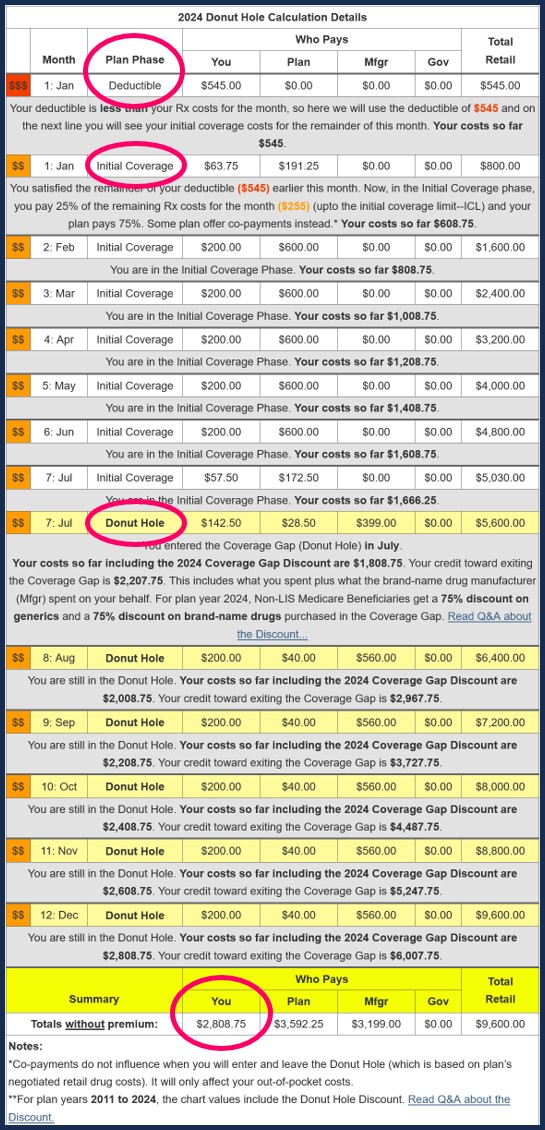
You can change the $800 value in our example to your own prescription spending - change the deductible - and choose your mix of generic or brand-name drugs) to see a preview of your own 2024 Medicare Part D drug coverage.