In short, higher retail drug prices mean you may pay more for your drug coverage and move faster through the phases of your Medicare drug coverage.
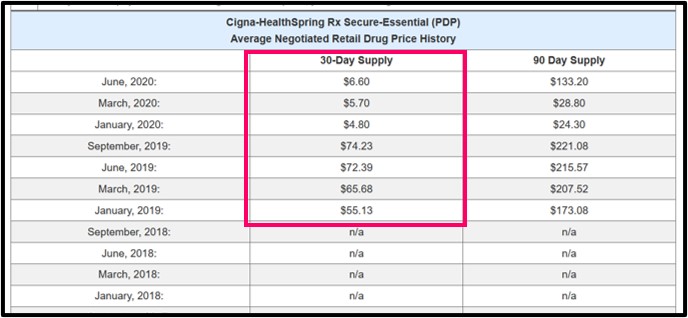
And yes, retail prices for your formulary drugs can change throughout the plan year (usually increasing) - and can vary pharmacy-to-pharmacy.
And the bad news: As retail prices increase for your drugs, your Part D coverage and out-of-pocket costs can change from what you predicted when you chose your Medicare Part D drug plan last November or December - meaning, with mid-year drug price increases, you may no longer be enrolled in the most economical Medicare prescription drug plan.
More about Retail Drug Prices:
- Retail drug prices determine how much time you spend in the Initial Deductible.
If your Medicare prescription drug plan has an initial deductible, retail drug prices will affect how long you stay in the deductible. You will stay in the initial deductible until you have paid, out-of-pocket, your plan's deductible amount.
- Retail drug costs can determine what you pay in the Initial Coverage phase.
If your Medicare prescription drug plan uses coinsurance cost-sharing, you will pay a percentage of the retail drug cost for your formulary drug.
For example, if you pay a 25% coinsurance for a medication that has a negotiated retail drug price of $100, your cost-sharing is $25. If the retail drug price for your medication increases to $200 during the plan year, you will pay $50 for the same medication - even though the cost-sharing was $25 for the same drug back when you enrolled in the plan.
- 2024 and beyond - No cost for formulary drugs in Catastrophic Coverage
2023 was the last year that Medicare Part D beneficiaries paid cost-sharing in the Catastrophic Coverage phase (the last phase of coverage). Starting with plan year 2024, the Inflation Reduction Act (IRA) eliminated beneficiary cost-sharing in the Catastrophic Coverage phase, so plan members have no out-of-pocket costs for formulary drugs after reaching the plan's total out-of-pocket threshold (TrOOP). Therefore, starting with plan year 2024, TrOOP became the RxMOOP (maximum out-of-pocket spending limit for formulary drugs).
(Back in 2023, you paid the greater of $4.15 or 5% of your plan’s negotiated retail drug price for generics or the higher of $10.35 or 5% of the retail cost of your brand-name drugs while in Catastrophic Coverage.)
- 2025 and beyond - Elimination of the Coverage Gap
2024 was the last year that there was a Donut Hole. Starting with plan year 2025, the Inflation Reduction Act (IRA) eliminated the Coverage Gap phase, so in 2025 and beyond, plan members move right from the Initial Coverage phase to the Catastrophic Coverage phase and have no out-of-pocket costs for formulary drugs after reaching the plan's annual maximum out-of-pocket Part D formulary drug spending limit (RxMOOP) of $2,000 (in 2025). Please note, RxMOOP may increase each year - RxMOOP will be $2,100 in 2026.
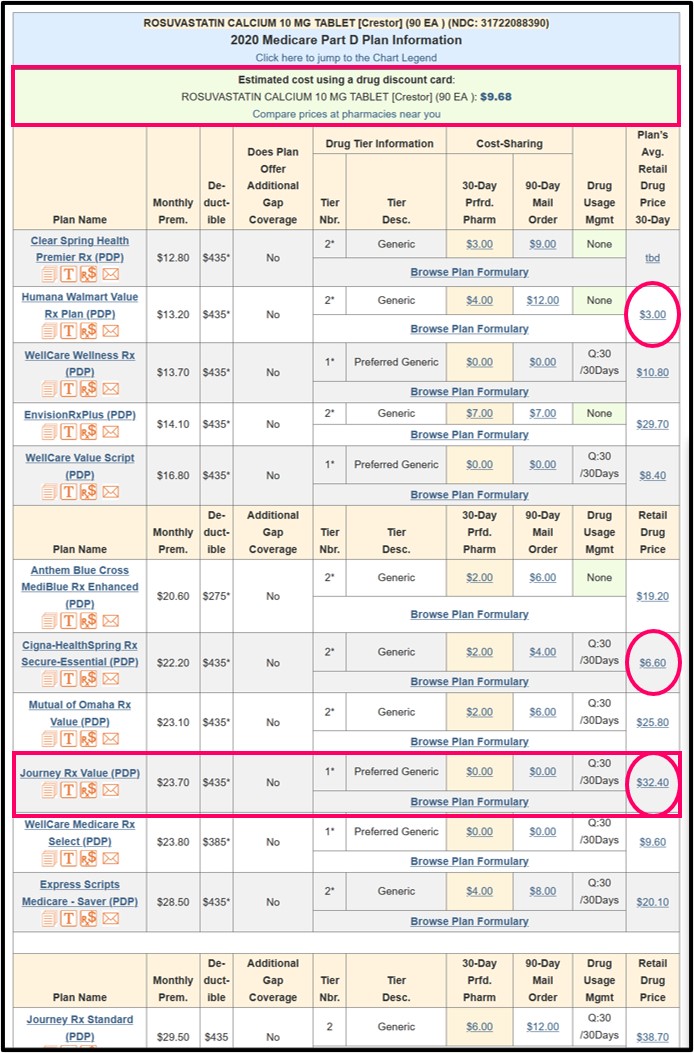
To give you an overview of pricing, we show the average negotiated retail drug price in the far right column of our the drug finder Drug Finder comparison chart. Again, these average negotiated retail drug prices can vary pharmacy-to-pharmacy (so CVS retail prices may not be the same as prices at WalMart or Walgreens) and prices can change week-to-week. Also, please note that the average negotiated retail drug price can vary state-to-state as you travel with your Medicare Part D plan.
Here is an example of our on this site Drug Finder showing how the retail price of a popular generic medication can vary between Medicare Part D plans (the estimated cost using a Drug Discount Card is shown at the top of the the drug finder table).