2024 Medicare Part D benefit changes and improvements:
1. No cost-sharing in the 2024 Catastrophic Coverage phase.
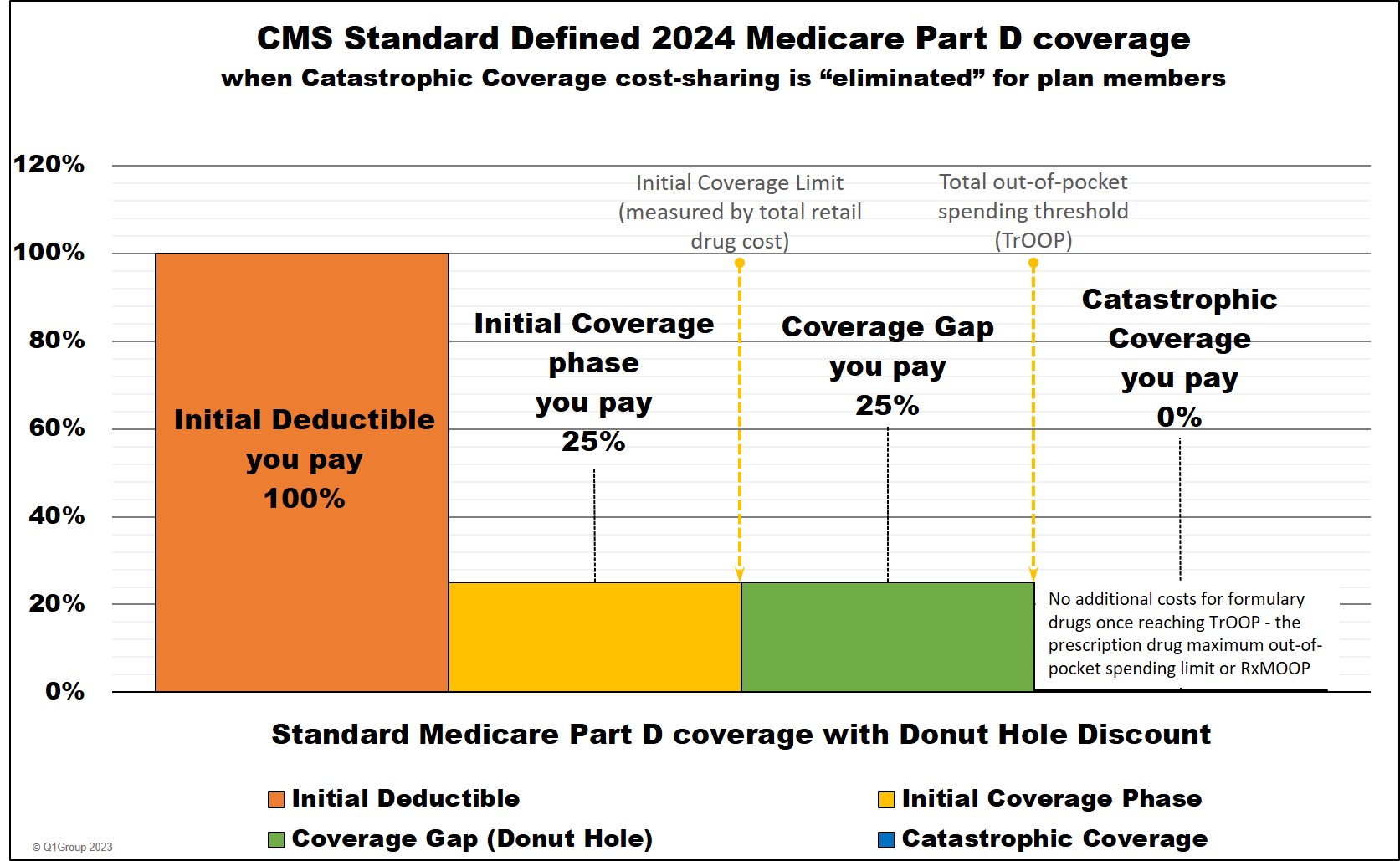
The most important 2024 change may be that a person with high prescription drug costs will not have any additional cost-sharing for formulary drugs once the $8,000 out-of-pocket spending threshold (TrOOP) is exceeded. In effect, the TrOOP threshold becomes the maximum limit or cap on Part D out-of-pocket drug spending (RxMOOP), similar to the Medicare Advantage plan Part A and Part B out-of-pocket spending threshold (MOOP).
2024 Medicare Part D coverage
Question: Does this mean a person has to actually spend $8,000 before they have no additional costs for the remainder of the year?
Not in all cases. The actual amount you spend will depend on your mix of generic and brand-name drugs. For example, if you purchase all brand-name drugs, your actual costs should be around $3,333. If you use the CMS estimated mix of generics and brand-name drugs, your actual costs should be around $3,429 (92.59% brand drugs and 7.41% generic drugs). And, if you purchase all generic drugs, your actual costs should be the full $8,000 out-of-pocket.
Important: Be certain that your 2024 Medicare drug plan covers all of your generic and brand-name medications. During the annual Open Enrollment Period (staring October 15th) be sure to choose a 2024 plan with the most economical drug coverage for all of your medications. If you need more information about 2024 coverage, you can speak with a Medicare representative at 1-800-633-4227. Starting October 15th, a Medicare representative can also help choose and join any Medicare drug plan that is available in your area.
Question: Is the Catastrophic Coverage phase eliminated in 2024?
No. The fourth part of your Medicare Part D coverage remains the Catastrophic Coverage phase. However, you will have no additional costs for formulary drugs if you reach Catastrophic Coverage. Instead, the cost of any drugs purchased for the remainder of the year will be shifted to your Medicare drug plan (paying 20% of the drug cost) and the federal government (paying 80%).
2. Medicare Part D Extra Help benefits expanded.
In 2024, qualifications for full Low-Income Subsidy (LIS) or Extra Help benefits were expanded from 135% of the Federal Poverty Level (FPL) to 150% of FPL (financial resource limits will also apply). In essence, people who would otherwise only qualify for partial Extra Help will qualify for full Extra Help benefits in 2024 and the partial LIS benefit level will be eliminated.
3. Annual increases in the Base Medicare Part D premium will be capped at 6%.
The Part D Base Beneficiary Premium is calculated every year by CMS using, in part, the Part D national average monthly premium bid weighted by plan enrollment. In practice, since 2006, the Part D Base premium has only once exceeded a 6% annual increase. You can click here to read more about the base beneficiary premium and changes to the base premium since 2007.
4. Maximum $35 copay for Insulin.
Insulin products covered by your 2024 Medicare drug plan will remain at a $35 (or less) copay for a 30-day supply throughout all phases of your Part D coverage.
5. $0 copay for approved vaccines.
Adult vaccines recommended by the Advisory Committee on Immunization Practices (ACIP) will continue to be available at no cost throughout all phases of your Part D coverage. Increases in all 2024 Medicare Part D parameters:
Each year, Medicare releases the Medicare Part D parameters for the "Defined Standard Benefit" plan and Medicare Part D plans use this information to determine drug plan coverage for the next year. Actual 2024 plan options and benefit details will be available for your review no later than October 1, 2023. A chart comparing the standard benefit parameters from 2020 through 2024 is available at on this site. And you can click here to see how the parameters have changed since 2006.
What this means to you.
You can use these CMS parameters as a preview of how your Medicare Part D prescription drug plan coverage may change in January 2024 (for example, if you currently pay a $505 deductible, your deductible in 2024 may be $545).
• The standard 2024 Initial Deductible will increase almost 8%.
The 2024 standard initial deductible will increase $40 to $545 from the current standard deductible of $505.
What this means to you.
If you enroll in a Medicare Part D prescription drug plan with a standard initial deductible, you will pay slightly more out-of-pocket in 2024 before you and your drug plan begin sharing your drug costs. However, as we have seen in 2023, many popular Medicare Part D plans exclude lower-costing Tier 1 and Tier 2 drugs from the plan’s deductible, providing you with coverage for some lower-costing medications before meeting your deductible. As mentioned above, insulin products and approved vaccines are excluded from the deductible on all Medicare Part D plans.
• The Initial Coverage Limit will increase $370.
The 2024 Initial Coverage Limit (ICL) will increase 8% to $5,030 from the current ICL of $4,660. The Initial Coverage Limit marks the point where you enter the Donut Hole or Coverage Gap and is based on the total negotiated retail value of your prescription drug purchases. For example, if you purchase a formulary medication in 2024 with a retail cost of $100, and you pay a $20 copay, the $100 retail drug value counts toward reaching your plan's $5,030 Initial Coverage Limit.
What this means to you.
You may find that you will purchase slightly more formulary medications before reaching the 2024 Donut Hole (assuming that the retail price of your medications does not increase over time). If you purchase medications with an average retail value of over $419 per month, then you will enter the 2024 Donut Hole at some point during the year.
• The 2024 Donut Hole discount for all formulary drugs remains at 75%.
If you reach your Medicare Part D plan’s 2024, you will pay only 25% of your plan's negotiated retail price for your formulary drug purchases. If you purchase a generic drug, you receive the 25% you paid toward meeting your 2024 out-of-pocket spending limit – or Donut Hole exit point. If you purchase a brand-name drug, you get credit for 95% of the retail price (the 25% you pay plus the 70% drug manufacturer discount).
What this means to you.
If you are in the 2024 Donut Hole and your formulary medication has a retail cost of $100, you will pay only $25 for your prescription. If you medication is a generic, the $25 you spend for the formulary drug will count toward your 2024 out-of-pocket spending limit (TrOOP) of $8,000.
If your Donut Hole purchase is a brand-name drug, you still pay $25 for the prescription, but get $95 credit ($25 paid by you plus $70 paid by the drug manufacturer) toward meeting your 2024 out-of-pocket spending limit.
For more information about how your formulary drug purchases affect your Medicare Part D drug costs, please see our 2024 PDP-Planner to estimate your costs and if (or when) you will enter (or exit) the Donut Hole: PDP-Planner.com/2024.
• The amount you need to spend to exit the 2024 Donut Hole (TrOOP) will increase $600.
The 2024 total out-of-pocket spending (TrOOP) threshold will increase to $8,000 from the current 2023 TrOOP limit of $7,400. TrOOP is the actual dollar figure you must spend (or someone else spends on your behalf) to get out of the Donut Hole (Coverage Gap) - and as mentioned above, once you leave the Donut Hole, you have no additional costs for formulary drugs for the remainder of 2024.
As noted above, the actual amount you will spend depends on your mix of generic and brand-name drugs purchased and will range anywhere from around $3,333 if you buy all brand-name drugs, to $8,000 if you purchase all generic drugs.
What this means to you.
2024 will bring big savings for anyone purchasing brand-name formulary drugs with a total monthly retail value of over $1,004. Please use our 2024 Donut Hole Calculator or PDP-Planner to see how the 2024 Medicare Part D plan changes will affect your spending.
Question: Will all 2024 Medicare Part D prescription drug plans follow these new plan limits?
No. The Medicare Part D defined standard benefit parameters only set minimum standards for next year’s Medicare Part D prescription drug plan coverage. However, Medicare Part D plans are allowed to deviate from the defined standard benefits and offer Part D drug plans with more enhanced features such as: a lower or $0 initial deductible, fixed copays for different drug tiers, lower Initial Coverage Limits, or supplemental drug coverage in the Coverage Gap (in addition to the Donut Hole discount).