A little background on retail drug pricing
Medicare Part D plans (or their pharmaceutical benefit manager, PBM) set the retail prices for your formulary drugs at each standard and preferred network pharmacy.
So the Medicare Part D retail drug prices can vary plan-to-plan, week-to-week, between preferred and standard pharmacies, between preferred network pharmacies, and between standard network pharmacies - and certainly at non-network pharmacies.
A note about the average retail drug price shown on this site: In our the drug finder® Drug Finder ( on this site), we show all Medicare Part D plans or Medicare Advantage plans in a Service Area (state or ZIP code area) that provide coverage for a particular formulary drug, and when available, we also show the Medicare plan's "average negotiated retail drug price" and this "average" price means that the retail drug prices are the average retail drug price across all network pharmacies (standard and preferred) in the plan’s Service Area. In many cases, we find that the average negotiated retail price we show in our Drug Finder accurately reflects what you may find at your chosen network pharmacy.
However, even though we update this drug pricing data on a regular basis, your "actual" retail drug price depends on how your Medicare prescription drug plan (PDP or MAPD) has negotiated with the standard and preferred network pharmacies in your area - and how that retail price has changed over the past weeks or even past days.
Question: Why should we care about retail drug pricing?
Your formulary drug's retail price may determine how fast you move through your Medicare drug plan coverage and what you may pay for your prescriptions along the way. Retail drug prices are used to determine:
-- how much time you spend in the Initial Deductible (if your plan has a deductible) and
-- what you may pay in the Initial Coverage phase and if/when you enter the Catastrophic Coverage phase (if your plan charges coinsurance – that is, you pay a percentage of the retail cost). (Remember, the Medicare Part D Coverage Gap was eliminated in 2025.)
Example of how retail drug prices can even vary between Medicare drug plan's offered by the same company.
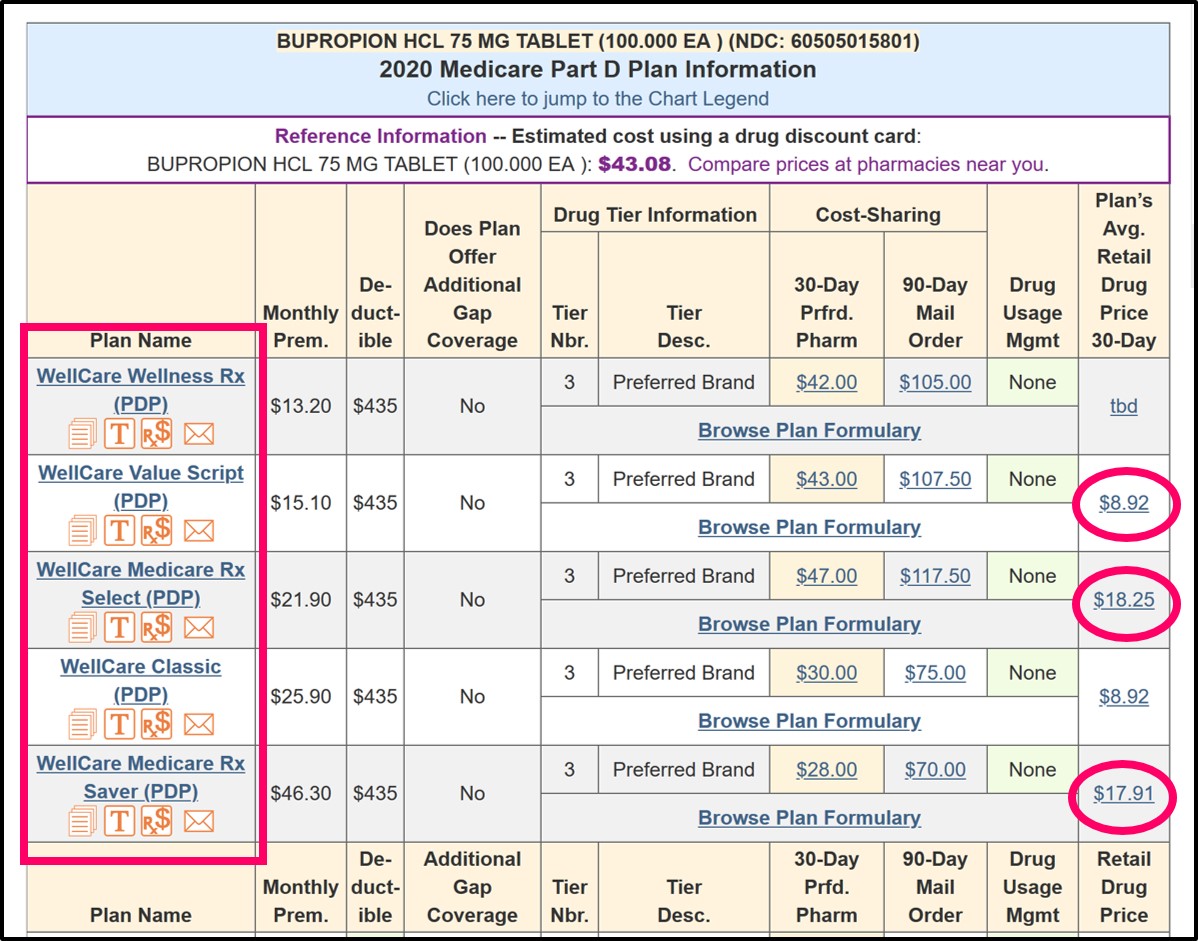
From the chart below, you can see an older example where several Medicare Part D plans offered by the same company have different negotiated retail drug prices for the same drug (BUPROPION HCL 75 MG TABLET (100.000 EA) (NDC: 60505015801)).
Remember that each Medicare drug plan offered by a company can also establish cost-sharing at standard and preferred network pharmacies based on the drug's formulary tier. In this same example you can see the different Tier 3 Preferred Brand copays of: $42, $43, $47, $30, $28 - all of which are more than the retail drug price - and, as noted below, since you never pay more than retail, you will not pay the copays, but instead the plan's retail drug price.
Question: What happens when the drug's retail cost is less than the plans coverage costs?
You always pay the lower cost - either retail cost or the plan's cost-sharing. So, in the examples above, you would not pay a $43 copay for a drug that has a retail cost of $8.92. Instead, you would pay the lower retail price of $8.92, even though this is a generic drug organized as a Tier 3 Preferred Brand. This is called the "lessor of" rule (you pay the plan's retail price or your plan's copay, whichever is less) and you can read more about this rule in our Frequently Asked Question on this site.
Question: How does the quantity of my prescription affect my coverage cost?
It depends. The quantity of your prescription may impact your coverage cost (coinsurance).
So if your Medicare Part D provides a specific Quantity Limit (say, 30 pills for 30 days) for your formulary drug, and your Medicare Part D plan grants you a Formulary Exception for 120 pills for 30 days - the Medicare.gov Plan Finder shows no impact of Quantity Limits on cost-sharing - however, you will note that the retail cost of the prescription drug is affected by the quantity of the prescription. (2019 version of Medicare.gov Plan Finder)
For example, the retail cost for a quantity of 120 tablets is approximately 4x the retail cost of the 30 tablet prescription. And since you enter the Coverage Gap or Donut Hole based on the retail value of your formulary drug purchases, you should move more quickly toward the Donut Hole when you increase the quantity of your prescription.
The actual retail drug price data and cost-sharing calculations were compiled from the official Medicare.gov Plan Finder (12/07/2018).
- Example 1 - Higher retail cost at preferred pharmacy. But, a higher drug copay at standard pharmacy
This actual example shows that you can have a higher negotiated retail price at a preferred pharmacy. But, you will pay a significantly higher copay at a standard pharmacy, but you never pay more than retail when your higher copay is more than your plan's retail drug price, the plan's Quantity Limit (QL) for this drug affects the total retail drug cost - but not your copay.
Update: Starting in 2025, retail drug prices have less of an affect on your Medicare plan coverage as we no longer have the Coverage Gap or Donut Hole and a person will move directly from the Initial Coverage phase to Catastrophic Coverage (where, since 2024, a person will have no additional cost-sharing for formulary Part D drugs through the remainder of the year). These examples are from 2018, and you can notice that the Catastrophic Coverage price is often the actual low retail drug price since the retail price is more than 5% of the retail price, but still less than the minimum $3.40 price for generics in the 2019 Catastrophic Coverage phase - and, again, you will not pay more than retail.
- Example 2 - Retail prices vary between preferred pharmacies
This example also shows that retail drug prices can even vary between two preferred network pharmacies, although the copays are consistent across all preferred pharmacies.
- Example 3 - Higher prescription quantities result in higher retail cost, but the same copay or cost-sharing
As noted above, without the Quantity Limit (QL) usage management restriction, the retail cost calculation provided by the 2019 Medicare.gov site (pre-2019 change) shows the same multiple of 4 x 30-day retail drug costs (as we saw with plans having a QL).
And, as expected, negotiated retail drug price can vary between standard network pharmacies, although fixed copays remain the same between standard pharmacies.
- Example 4 - How preferred pharmacy retail prices compare to much-higher non-network pharmacy prices
This last example shows pricing at a preferred network pharmacy as compared to the retail drug costs at an out-of-network pharmacy, although we doubt anyone would pay the prices showing in this example (over 10x the preferred pharmacy prices), but people would instead probably not use their Medicare Part D plan and simply pay the pharmacy's everyday low prices or use a Discount Drug Card prices for these low-costing generics.
Initial Deductible costs
All four of our chosen example 2019 Medicare Part D plans exclude low-costing Tier 1 and Tier 2 drugs from the ($415) 2019 initial deductible - so in all of the examples, the Medicare Part D prescription drug plan provides immediate coverage even before the standard initial deductible is met.
Update Starting in 2025: Your Medicare drug coverage will have no more than three phases: an initial deductible (if any), an initial coverage phase, and a final Catastrophic Coverage phase where, since 2025, you will have no additional costs for the remainder of the year. You will reach the 2025 Catastrophic Coverage phase when you have spent more than $2,000 out-of-pocket on formulary Part D drugs.
The chosen medication is a generic drug and will receive the 75% Donut Hole discount. The four example Medicare plans do not offer any additional coverage in the Donut Hole, so you would pay 25% of the retail drug cost.
Pre-2024 examples: Catastrophic Coverage costs
If you exited the 2019 Donut Hole or Coverage Gap, you would have paid the higher of either 5% of the drug's retail price or $3.40 for generic or preferred drug that is a multi-source drug and $8.50 for all other drugs (such as brand name drugs. In our examples, you can see that the Medicare.gov site shows Catastrophic Coverage costs for this generic as $3.40 - or the actual retail price is paid in Catastrophic Coverage when the actual retail price is less than the standard $3.40 copay for generics, but still greater than 5% of the retail drug price.
Reminder: 2023 was the last year that Medicare Part D beneficiaries paid cost-sharing in the Catastrophic Coverage phase. Starting in plan year 2024, the Inflation Reduction Act (IRA) eliminated beneficiary cost-sharing in the Catastrophic Coverage phase, so plan members will not have any out-of-pocket costs for formulary drugs after reaching the plan's 2024 $8,000 total out-of-pocket threshold (TrOOP). Therefore, starting in 2024, the TrOOP threshold becomes the RxMOOP (maximum out-of-pocket spending limit for formulary drugs).
Example 1 - higher retail cost at preferred pharmacy
Please notice that the retail drug price at the Preferred Network Pharmacy is actually higher than the retail drug price at the standard network pharmacy. However, the cost-sharing for this Tier 1 Preferred Generic is $1 at a preferred pharmacy and $10 at a standard network pharmacy. You can see that the retail cost at the standard retail pharmacy is significantly lower than the $10 copay, and since you never pay more than the negotiated retail price, you pay the retail price - and not the $10 copay.
This Medicare Part D plan also has the usage management restriction of a 30 tablet / 30 days Quantity Limit (QL). If the QL can be exceeded (for example, if the plan allows120 tablets / 30 days), the retail price increases by a factor of the QL, but the coverage cost, even for the excess amount of medication, does not change.
|
Comparison of Drug Cost-Sharing Across Quantities, Phases of Coverage, and Pharmacies
2019 Express Scripts Medicare - Saver (PDP) (S5660-227-0)with Quantity Limit (QL) of 30 tablets per 30 days |
||||||||||
| Walgreens #11481 - Standard Retail Cost Sharing | Walmart Pharmacy 10-2727 - Preferred Retail Cost Sharing | |||||||||
| Full Retail | Deduct- ible | Initial Coverage Phase | Cover-age Gap | Cata- strophic Coverage | Full Retail | Deduct- ible | Initial Coverage Phase | Cover- age Gap | Cata- strophic Coverage | |
| Atorvastatin Calcium TAB 10MG - 30 tablets | $2.44 | $2.44 | $2.44 | $0.90 | $2.44 | $2.93 | $1.00 | $1.00 | $1.08 | $2.93 |
| Atorvastatin Calcium TAB 10MG - 120 tablets | $8.08 | $8.08 | $8.08 | $2.99 | $3.40 | $8.57 | $1.00 | $1.00 | $3.17 | $3.40 |
| Atorvastatin Calcium TAB 20MG - 30 tablets | $5.65 | $5.65 | $5.65 | $2.09 | $3.40 | $6.14 | $1.00 | $1.00 | $2.27 | $3.40 |
| Atorvastatin Calcium TAB 20MG - 120 tablets | $20.92 | $10.00 | $10.00 | $7.74 | $3.40 | $21.41 | $1.00 | $1.00 | $7.92 | $3.40 |
Example 2 - different retail prices at different preferred pharmacies
In this example, we see that two preferred network pharmacies can also have different retail drug prices, although the cost-sharing for this Tier 2 (Generic) is the same at all preferred pharmacies.
|
Comparison of Drug Cost-Sharing Across Quantities, Phases of Coverage, and Pharmacies
Cigna-HealthSpring Rx Secure-Essential (PDP) (S5617-290-0)with Quantity Limit of 30 tablets per 30 days |
||||||||||
| Walgreens #11481 - Preferred Retail Cost Sharing | Walmart Pharmacy 10-2727 - Preferred Retail Cost Sharing | |||||||||
| Full Retail | Deduct- ible | Initial Coverage Phase | Cover-age Gap | Cata- strophic Coverage | Full Retail | Deduct- ible | Initial Coverage Phase | Cover- age Gap | Cata- strophic Coverage | |
| Atorvastatin Calcium TAB 10MG - 30 tablets | $3.38 | $3.00 | $3.00 | $1.25 | $3.38 | $3.00 | $3.00 | $3.00 | $1.11 | $3.00 |
| Atorvastatin Calcium TAB 10MG - 120 tablets | $11.53 | $3.00 | $3.00 | $4.27 | $3.40 | $8.55 | $3.00 | $3.00 | $3.16 | $3.40 |
| Atorvastatin Calcium TAB 20MG - 30 tablets | $3.00 | $3.00 | $3.00 | $1.11 | $3.00 | $3.00 | $3.00 | $3.00 | $1.11 | $3.00 |
| Atorvastatin Calcium TAB 20MG - 120 tablets | $9.99 | $3.00 | $3.00 | $3.70 | $3.40 | $8.55 | $3.00 | $3.00 | $3.16 | $3.40 |
Example 3 - retail drug prices vary between standard (non-preferred) network pharmacies
In this example, we do not have the usage management restriction of a Quantity Limit. So the plan member with a larger prescription (120 tablets / 30 days) would not need to file a formulary exception to receive this additional amount. The retail cost calculation provided by Medicare.gov shows the same multiple of 4 x 30-day costs.
|
Comparison of Drug Cost-Sharing Across Quantities, Phases of Coverage, and Pharmacies
WellCare Value Script (PDP) (S4802-146-0)with No Quantity Limit |
||||||||||
| Walgreens #11481 - Standard Retail Cost Sharing | Walmart Pharmacy 10-2727 - Standard Retail Cost Sharing | |||||||||
| Full Retail | Deduct- ible | Initial Coverage Phase | Cover-age Gap | Cata- strophic Coverage | Full Retail | Deduct- ible | Initial Coverage Phase | Cover- age Gap | Cata- strophic Coverage | |
| Atorvastatin Calcium TAB 10MG - 30 tablets | $4.61 | $3.00 | $3.00 | $1.71 | $3.40 | $6.60 | $3.00 | $3.00 | $2.44 | $3.40 |
| Atorvastatin Calcium TAB 10MG - 120 tablets | $16.93 | $3.00 | $3.00 | $6.26 | $3.40 | $24.90 | $3.00 | $3.00 | $9.21 | $3.40 |
| Atorvastatin Calcium TAB 20MG - 30 tablets | $6.46 | $3.00 | $3.00 | $2.39 | $3.40 | $9.36 | $3.00 | $3.00 | $3.46 | $3.40 |
| Atorvastatin Calcium TAB 20MG - 120 tablets | $24.63 | $3.00 | $3.00 | $9.01 | $3.40 | $35.92 | $3.00 | $3.00 | $13.29 | $3.40 |
Example 4 - higher retail prices at a preferred pharmacy, but much less than non-network pharmacies
In this example, you can see that at the preferred network pharmacy, there is a higher retail drug price, even when compared to standard pharmacies in our other examples. We also can see that the out-of-network pharmacy retail costs are over 10x (10 times) the preferred pharmacy prices.
In most cases, people would not pay such high prices, and would instead pay the pharmacies "everyday low prices" without using their Medicare Part D coverage - or people could use a pharmacy Drug Discount card at this non-network pharmacy.
Please note that the 2018 Medicare.gov site showed no coverage at a non-network pharmacy, except for the 37% Donut Hole discount. (This may be assuming the requirement that "Part D sponsors shall provide the applicable discount for out-of-network paper claims submitted by Part D enrollees." So only people who used a non-network pharmacy and then submitted their formulary drug-purchase receipts to their Medicare drug plan would receive the 2018 Donut Hole Discount - Reminder: No Donut Hole discount exists beyond 2024).
|
Comparison of Drug Cost-Sharing Across Quantities, Phases of Coverage, and Pharmacies
AARP MedicareRx Walgreens (PDP) (S5921-383-0)with Quantity Limit of 30 tablets per 30 days |
||||||||||
| Walgreens #11481 - Preferred Retail Cost Sharing | Walmart Pharmacy 10-2727 - Out-of-Network Pharmacy Retail Cost Sharing | |||||||||
| Full Retail | Deduct- ible | Initial Coverage Phase | Cover-age Gap | Cata- strophic Coverage | Full Retail | Deduct- ible | Initial Coverage Phase | Cover- age Gap | Cata- strophic Coverage | |
| Atorvastatin Calcium TAB 10MG - 30 tablets | $9.57 | $0.00 | $0.00 | $3.54 | $3.40 | $106.40 | $106.40 | $106.40 | $39.37 | $106.40 |
| Atorvastatin Calcium TAB 10MG - 120 tablets | $34.67 | $0.00 | $0.00 | $12.83 | $3.40 | $425.59 | $425.59 | $425.59 | $157.47 | $425.59 |
| Atorvastatin Calcium TAB 20MG - 30 tablets | $13.86 | $0.00 | $0.00 | $5.13 | $3.40 | $152.30 | $152.30 | $152.30 | $56.35 | $152.30 |
| Atorvastatin Calcium TAB 20MG - 120 tablets | $51.85 | $0.00 | $0.00 | $19.18 | $3.40 | $609.20 | $609.20 | $609.20 | $225.40 | $609.20 |