In many cases, the average negotiated retail price shown in the the drug finder Drug Finder accurately reflects what you may find at your chosen network pharmacy.
But remember, retail drug prices can change regularly, even changing on a weekly-basis - and prices can vary pharmacy-to-pharmacy - and drug prices can vary between your plan's standard and preferred network pharmacies - and retail drug prices can even vary between your plan's preferred network pharmacies.
In addition, retail drug pricing data is updated on a regular basis, and your actual retail drug price depends on how your Medicare prescription drug plan (PDP or MAPD) has negotiated with the standard and preferred network pharmacies in your area - and how that retail price has changed over the past weeks.
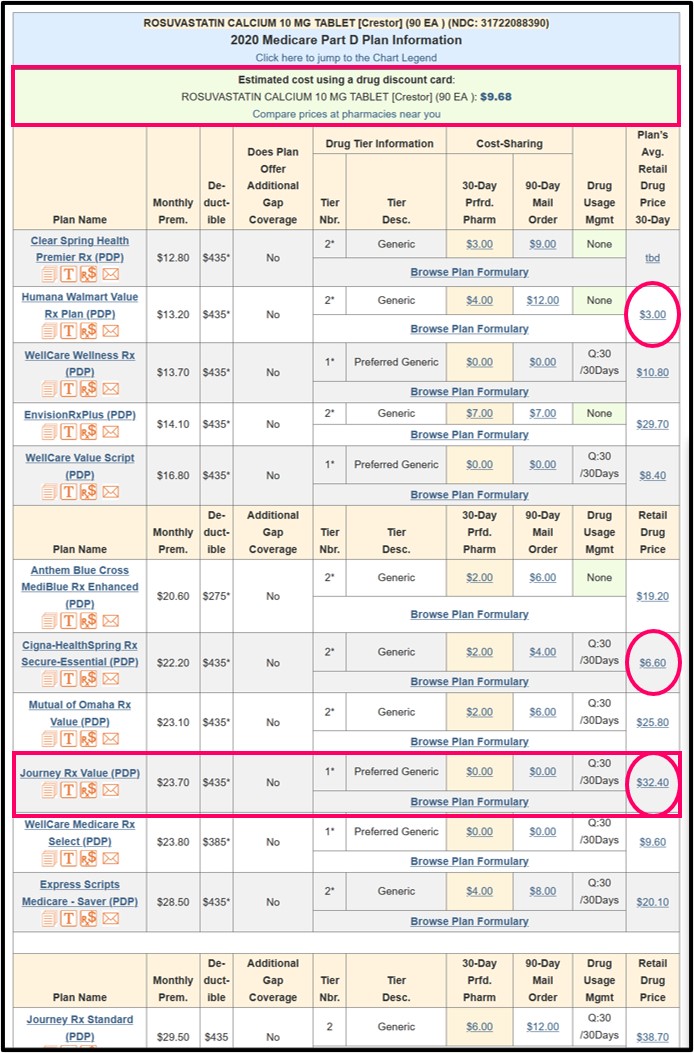
Here is an older example of the the drug finder Drug Finder showing how the retail price of a popular (usually low-cost) generic medication "Rosuvastatin 10mg" varied between 2020 Medicare Part D plans. In this example, the retail drug price for this common generic (back in 2020) varied from $3 to $38.70.
(Note about what you will be paying for this low-cost generic:
Looking at this 2020 the drug finder example, you can see that the Medicare Part D plan with the $3.00 average retail drug price also shows a plan copay of $4.00. However, since you will not pay more for the drug than your retail cost, you would actually pay the $3.00 retail cost, not the plan's $4.00 copay.)
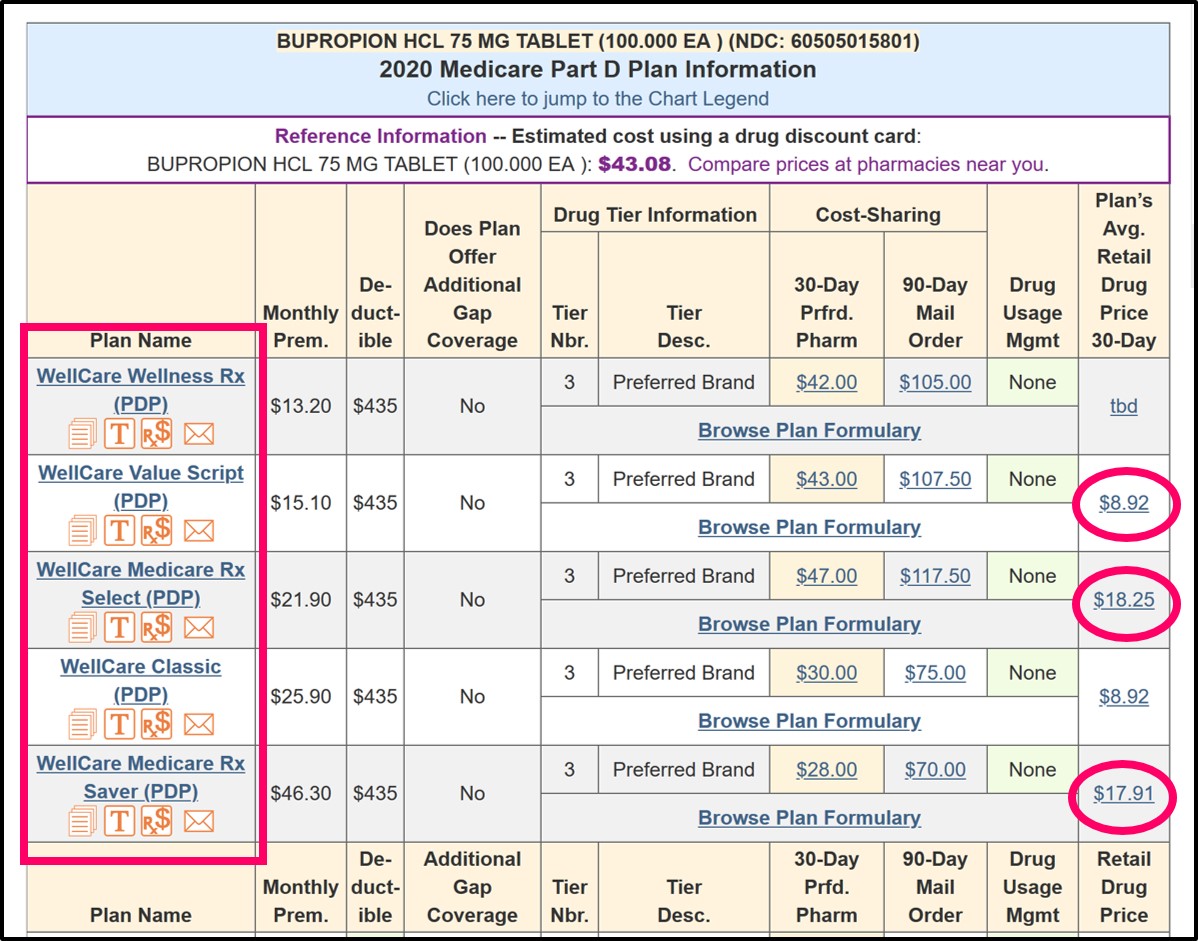
As an update, you can see in this 2025 example that retail drug prices for this same common generic drug now varies from $1.49 to $26.99.
(Note: Again, you can see that the Medicare Part D plan with the $4.28 average retail drug price shows a copay of $17.00. You will not pay more for the drug than your retail cost, so in this example, you would pay $4.28 not the $17.00 copay.)

Important: The "average drug price" may not take into account wide retail pricing variations between different pharmacies.
By definition the "average price" can be very close to the actual
retail price you find at a pharmacy - or the variation in pricing can be pretty broad - depending on a
Medicare Part D prescription drug plan's pricing strategy.
In the table below we show "Example Drug ABCD" and how four
different Medicare Part D plans can all have an average negotiated
retail price of $50, but the actual retail drug prices found at the
three different example pharmacies can vary widely from $7 to $95.
In our example, if you saw a retail drug price of $50 "average retail
drug price" - this price would be close to the actual pharmacy pricing
found on Drug Plan 1 and Drug Plan 4 (with the lowest variation between Pharmacies #1, #2, and #3).
But the $50 "average drug pricing" would not closely represent actual pricing at all three pharmacies for Drug Plan 2 and Drug Plan 3 - the three example pharmacies have wide variations in retail price depending on the plan - but the average price is still $50.
| "Example Drug ABCD" |
Pharmacy #1 |
Pharmacy
#2 |
Pharmacy #3 |
"Average" Price |
| Drug Plan 1 | $50 | $50 | $50 | $50 |
| Drug Plan 2 | $7 | $60 | $83 | $50 |
| Drug Plan 3 | $15 | $40 | $95 | $50 |
| Drug Plan 4 | $45 | $50 | $55 | $50 |
Bottom Line: Average pricing may not always equal actual drug prices.
So what can we learn about average retail drug pricing?
- You might find that your actual retail drug prices will vary
depending on the pharmacy you use as drug prices can vary
pharmacy-to-pharmacy - and retail prices can even vary between preferred
network pharmacies.
- And naturally, "standard" network pharmacy pricing may not be the same as "preferred" pharmacy pricing.
- Retail drug prices change all the time - and can even change on
a weekly-basis - your drug plan should have the most accurate retail
drug price information, but often this information is not updated
regularly on the plan's website).
- During the annual Open Enrollment Period (AEP that starts
October 15th and continues through December 7th) our retail drug pricing
data is for the time period through September - but, we often find that
some Medicare prescription drug plans have already changed their retail
drug prices for the following year (for example, a medication may have a
2020 retail price of $7, but can have a 2021 retail price of $47 - same
drug, same plan, same pharmacy).
- So, if you are choosing a Medicare plan during the AEP, contact the Medicare Part D prescription drug plan or Medicare (1-800-Medicare) for more specific pricing at your chosen pharmacy - then check the retail drug prices again before the December 7th close of the annual Open Enrollment Period to ensure that the retail prices have remained stable and that your chosen Medicare plan is still providing the most economic coverage.