[Updated March 17, 2025] Your Medicare Part D drug plan coverage can be separated into three different parts and you cross between these parts or phases of your drug coverage based on your total out-of-pocket spending. Typically, when you purchase a formulary drug, you pay some portion of the drug's retail cost based on your phase of coverage (except when you reach Catastrophic Coverage and have $0 cost-sharing).
However, a Straddle Claim can occur when a single formulary drug purchase crosses over different phases of your Medicare Part D prescription drug plan coverage - this means that what you pay for your drug purchase must be considered in more than one phase of your Part D coverage.
And more importantly, some people are confused as the cost of their formulary drugs appear to vary unpredictably throughout the year as they cross or straddle two (or more) phases of their Part D drug coverage. For example, instead of paying a fixed $35 copay for a Tier 4 drug, a person may pay much more for their drug as they leave the Initial Deductible or pay less at the pharmacy as they move into Catastrophic Coverage.
Common Types of Straddle Claims

Depending on your Medicare Part D prescription drug plan benefit design (that is, whether your Medicare Part D prescription drug plan has an Initial Deductible), Straddle Claims usually occur in three situations - when prescription drug purchase claims cross:
(1) From the Initial Deductible phase into the Initial Coverage phase where coinsurance applies or the Initial Coverage phase where a copayment percentage structure applies (see As seen in Examples #1 and Example #2 below). In this first case, you will pay the portion of the retail purchase price that satisfies the Initial Deductible and then the remainder of the retail cost will be charged some portion of cost-sharing in the Initial Coverage phase - where the total of the two charges does not exceed the drug's retail price.
(2) From the Initial Coverage phase during which a copayment or coinsurance applies to the purchase of a formulary Part D drug and when the maximum out-of-pocket spending limit or RxMOOP is reached, into the Catastrophic Coverage phase in which no ($0) copayment or coinsurance will apply (starting in 2024, there is no longer cost-sharing for formulary drugs once reaching Catastrophic Coverage).
(3) Finally, with expensive drug purchase, it is possible to straddle more than one part of your Part D coverage with a single, expensive drug purchase.
Straddle Claim Example #1: Your Medicare drug plan has a $590 deductible and your first drug purchase of the year is a $670 Tier 3 drug with a $47 copay. Your purchases will straddle from your Initial Deductible into your Initial Coverage Phase.
Result: You will pay a total of $637 for the $670 Tier 3 drug.
Here are our assumptions:
Your total cost for the $660 drug would be $590 + $47 = $637.

Important: Straddle Claims and "Lessor-of Logic" - Your out-of-pocket drug cost is never more than the retail drug price.
The cost of a drug purchase that crosses two or more parts of your Medicare Part D plan coverage is calculated using a combination of retail drug cost and copayments - but no matter what the calculation, you will never pay more than your plan's negotiated retail drug price (you will pay the "less-of" of the retail drug cost or the cost-sharing).
However, a Straddle Claim can occur when a single formulary drug purchase crosses over different phases of your Medicare Part D prescription drug plan coverage - this means that what you pay for your drug purchase must be considered in more than one phase of your Part D coverage.
And more importantly, some people are confused as the cost of their formulary drugs appear to vary unpredictably throughout the year as they cross or straddle two (or more) phases of their Part D drug coverage. For example, instead of paying a fixed $35 copay for a Tier 4 drug, a person may pay much more for their drug as they leave the Initial Deductible or pay less at the pharmacy as they move into Catastrophic Coverage.
Common Types of Straddle Claims
Depending on your Medicare Part D prescription drug plan benefit design (that is, whether your Medicare Part D prescription drug plan has an Initial Deductible), Straddle Claims usually occur in three situations - when prescription drug purchase claims cross:
(1) From the Initial Deductible phase into the Initial Coverage phase where coinsurance applies or the Initial Coverage phase where a copayment percentage structure applies (see As seen in Examples #1 and Example #2 below). In this first case, you will pay the portion of the retail purchase price that satisfies the Initial Deductible and then the remainder of the retail cost will be charged some portion of cost-sharing in the Initial Coverage phase - where the total of the two charges does not exceed the drug's retail price.
(2) From the Initial Coverage phase during which a copayment or coinsurance applies to the purchase of a formulary Part D drug and when the maximum out-of-pocket spending limit or RxMOOP is reached, into the Catastrophic Coverage phase in which no ($0) copayment or coinsurance will apply (starting in 2024, there is no longer cost-sharing for formulary drugs once reaching Catastrophic Coverage).
(3) Finally, with expensive drug purchase, it is possible to straddle more than one part of your Part D coverage with a single, expensive drug purchase.
Review: A quick overview of your Medicare Part D plan coverage (2025 and beyond)
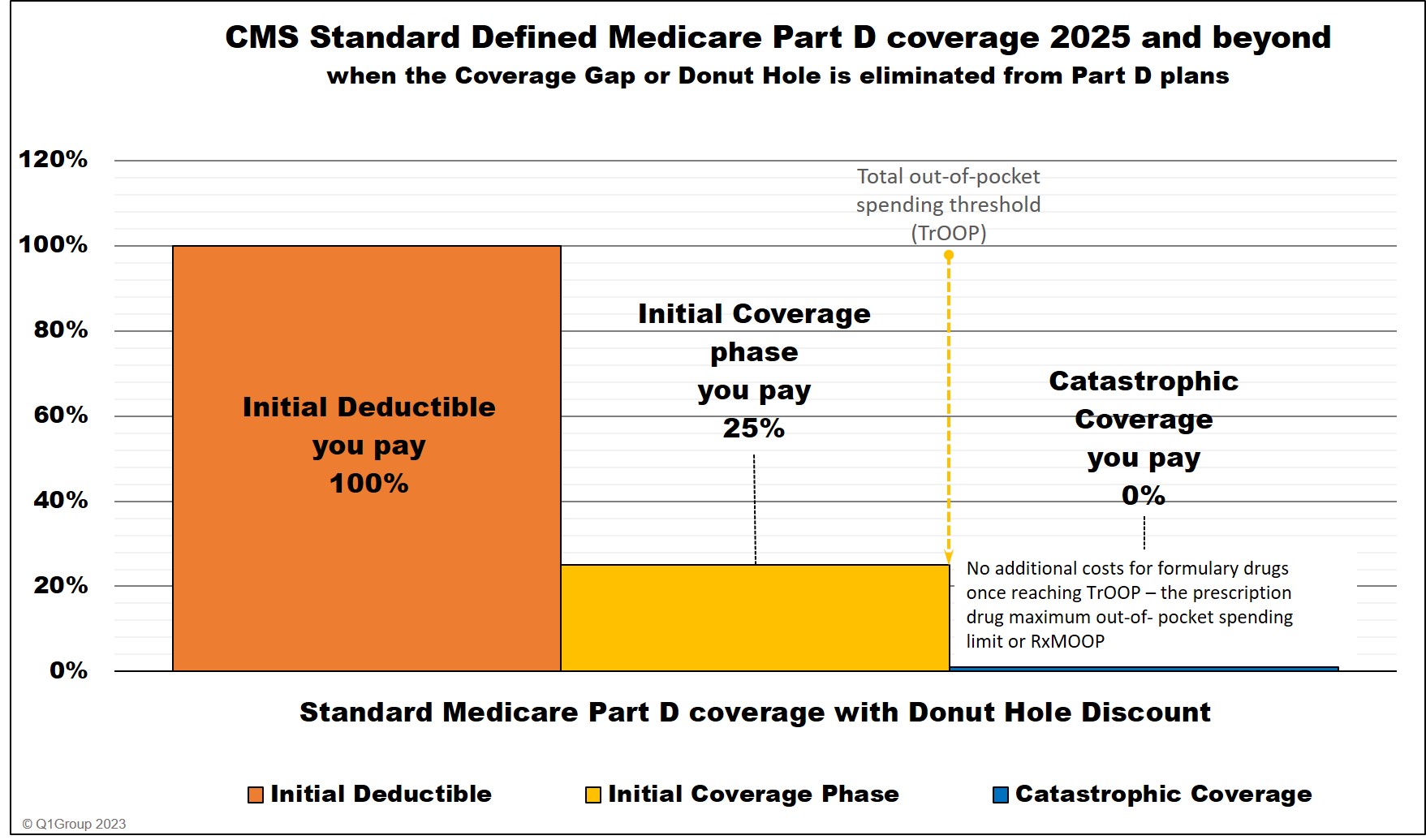
Remember that, starting in 2025, your Medicare prescription drug plan has three (3) phases or parts, just like other insurance:
- (1) Initial Deductible phase - you pay 100% of your prescription purchases (unless you are enrolled in a Medicare plan with a $0 deductible, then you begin in the next part of coverage - or if your Medicare Part D plan excludes Tier 1 and Tier 2 drugs from the deductible, your deductible would only be applied to all other drugs). The standard Initial Deductible can change every year and the 2025 standard deductible (adopted by many Medicare Part D plans) is $590.
- (2) Initial Coverage phase - you share the negotiated retail cost of your prescription purchases with your plan either as a coinsurance percentage (for instance, you pay 25% of retail) or as a fixed copayment (for instance, you pay a $30 copay for your Tier 3 formulary medication). In 2025, when you have spent (or others have spent on your behalf) $2,000 on formulary Part D drugs you will reach the annual maximum out-of-pocket spending limit (RxMOOP), leave the Initial Coverage phase and enter Catastrophic Coverage - the last phase of Part D drug coverage.
- (3) Catastrophic Coverage phase - after spending a certain amount out-of-pocket for your medications ($2,000 in 2025), you enter the Catastrophic Coverage phase and will have no additional costs for formulary Part D drugs through the remainder of the year.
2025 Medicare Part D coverage
Straddle Claim Example #1: Your Medicare drug plan has a $590 deductible and your first drug purchase of the year is a $670 Tier 3 drug with a $47 copay. Your purchases will straddle from your Initial Deductible into your Initial Coverage Phase.
Result: You will pay a total of $637 for the $670 Tier 3 drug.
Here are our assumptions:
- Your Medicare Part D plan's initial deductible was: $590 (still unchanged)
- Your plan's Tier 3 drug copay: $47
- Your Tier 3 drug's retail price: $670
- After the Tier 3 drug purchase your Medicare Part D plan's initial deductible: $0 (you are now in into Initial Coverage Phase)
Your total cost for the $660 drug would be $590 + $47 = $637.
Important: Straddle Claims and "Lessor-of Logic" - Your out-of-pocket drug cost is never more than the retail drug price.
The cost of a drug purchase that crosses two or more parts of your Medicare Part D plan coverage is calculated using a combination of retail drug cost and copayments - but no matter what the calculation, you will never pay more than your plan's negotiated retail drug price (you will pay the "less-of" of the retail drug cost or the cost-sharing).
Example #2: Your Medicare drug plan has a $590 deductible and your first drug purchase of the year is a $620 Tier 3 drug with a $47 copay. Your purchases will cross from your Initial Deductible into your Initial Coverage Phase.
Result: You will pay a total of $620 (the full retail drug price) for the $620 Tier 3 drug.
Here are our assumptions:
- Your Medicare Part D plan's initial deductible was: $590 (still unchanged)
- Your plan's Tier 3 drug copay: $47
- Your Tier 3 drug's retail price: $620
- After the Tier 3 drug purchase your Medicare Part D plan's initial deductible: $0 (you are now in into Initial Coverage Phase)
Example #3: Your Medicare drug plan has a $590 deductible and your first drug purchase of the year is a $12,100 Tier 5 specialty drug with 25% cost-sharing. Your purchases will cross from your Initial Deductible through your Initial Coverage Phase and into Catastrophic Coverage.
Result: You will pay a total of no more than $2,000 for the $12,100 Tier 5 drug.
Here are our assumptions:
- Your Medicare Part D plan's initial deductible was: $590 (still unchanged)
-
Your plan's Tier 5 drug cost-sharing: 25% of retail
- Your Tier 5 drug's retail price: $12,100
- After the Tier 5 drug purchase your Medicare Part D plan's initial deductible: $0
- Again, once reaching the Catastrophic Coverage phase, you will have
no cost-sharing ($0) for all formulary drug purchases through the end
of the year.
$590 in the initial deductible phase - the remaining $11,510 falls in the Initial Coverage phase.
+ $1,410 in the Initial Coverage phase -- you reach your RxMOOP, the remaining $5,870 moves to the Catastrophic Coverage phase.
+ $0 in the Catastrophic Coverage phase.
= $2,000 Total cost-sharing for this purchase.

New for 2025:
When you make such a large initial purchase as in Example #3, your local pharmacist or your Medicare Part D plan may remind you that you have the option of joining your drug plan’s “Medicare prescription payment plan” (MPPP or M3P). The M3P spreads your $2,000 out-of-pocket drug cost to a monthly basis over the remainder of the year. The M3P may help to lessen the impact of high-cost Part D medications - or the M3P can smooth highly-fluctuating drug costs.
If you elected to join your plan’s M3P, you would pay the monthly cost of $166.67 instead of the single $2,000 payment.
Important: You may pay much less than $2,000 before reaching the $2,000 RxMOOP.
It is possible, depending on your plan design, that you will never pay the full $2,000 out of pocket cost for your formulary drugs. See our article: “Medicare Part D Math 2025: Spending $329 on $12,000 worth of Part D drugs will meet the $2,000 annual maximum out-of-pocket spending limit.”
Tip: Let us help you visualize how your drug spending can change over the year: To help you estimate your own out-of-pocket drug costs, you can use our 2025 PDP-Planner or out-of-pocket spending calculator – following this $12,100 example, you can enter a $590 deductible and this will show you the costs in each Part D plan phase throughout the year.

Sources include:
The Center for Medicare and Medicaid Services, with clarifications, examples, and emphasis added)
https://www.cms.gov/Medicare/Prescription-Drug-Coverage/PrescriptionDrugCovContra/ Downloads/Final-Straddle-Claims-QA-4-26-07.pdf
- Browse Medicare Part D prescription drug plans
- Browse Medicare Advantage plans (MAPD)
- Sign-up for our Medicare Part D Newsletter.
- Still have a question? Click here to let us know.