The Inflation Reduction Act
establishes a maximum out-of-pocket prescription drug spending limit - or RxMOOP - this is the most a person pays out-of-pocket for the year for Medicare Part D prescription drugs covered by their Part D drug plan (either a stand-alone Medicare
Part D prescription drug plan, PDP or Medicare Advantage plan that includes drug coverage, MAPD).
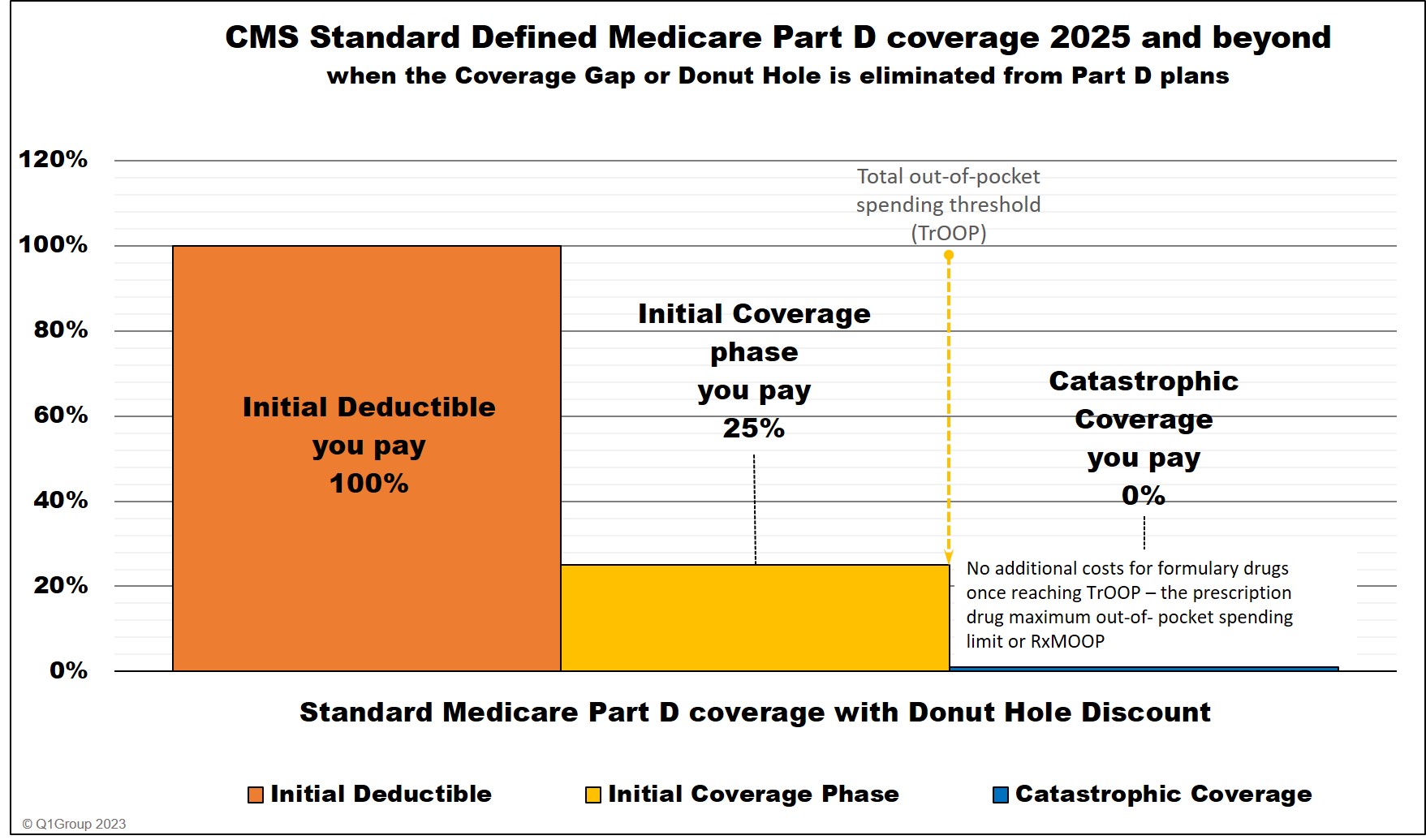
When a person exceeds the RxMOOP, they enter the Catastrophic Coverage phase and pay no additional cost sharing for Part D drugs covered by their Medicare drug plan through the remainder of the year.
Question: What counts toward your annual Part D prescription drug maximum out-of-pocket spending limit (RxMOOP)?
RxMOOP includes what you personally spend out-of-pocket (and in some cases, what other organizations spend) for Medicare Part D drugs that are included on your Medicare drug plan's formulary (drug list).
For example, as in the past, some third party arrangements that help pay for your Part D drugs count in your true out-of-pocket (TrOOP) spending and therefore help you reach the RxMOOP faster, such as:
Question: How did RxMOOP change from 2024 to 2025?
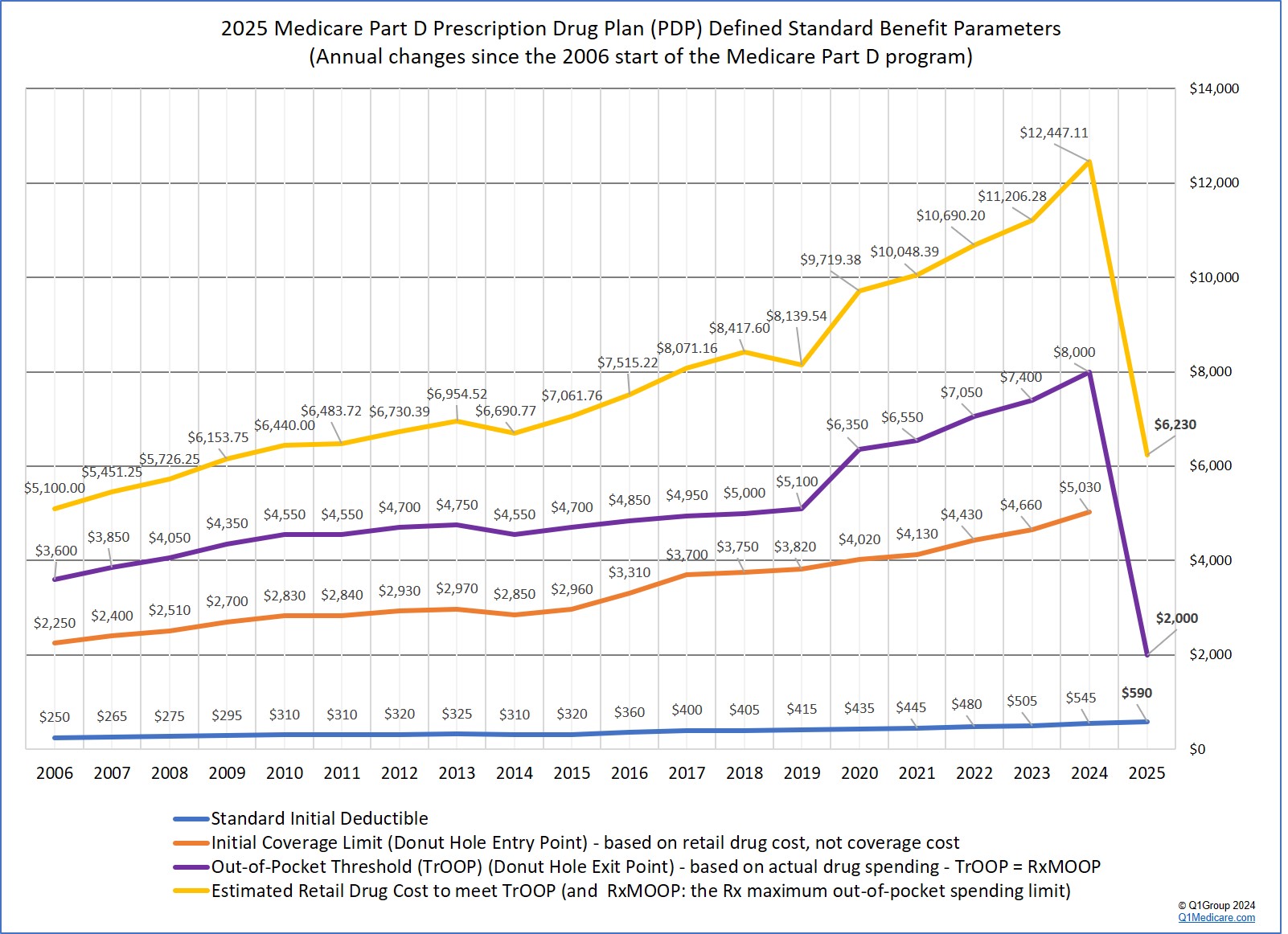
The Medicare Part D RxMOOP was introduced in 2024 and was equivalent to the 2024 Medicare Part D total out-of-pocket spending (TrOOP) threshold of $8,000.
In 2025, the annual maximum out-of-pocket spending limit for formulary drugs (RxMOOP) was reduced to $2,000 and is equivalent to both the 2025 TrOOP threshold (replacing what was the Medicare Part D Initial Coverage Limit (ICL)) and is the entry point to Catastrophic Coverage.
Each year thereafter, the RxMOOP will be adjusted (increase or decrease) based on inflation or economic changes. The RxMOOP will increase to $2,100 in 2026. After reaching the RxMOOP, a person will not have additional costs for Part D drugs covered by their Medicare Part D plan. Also beginning in 2025 drug plan members have the option of spreading their prescription drug spending over the entire year to assist with the stabilization of the person's monthly budgeting.
In addition, in 2025, what counts toward out-of-pocket spending will change.
The Centers for Medicare and Medicaid Services (CMS) notes:
So, what counts toward the $2,000 in 2025?
As was true in 2024, in 2025, what you actually spend out-of-pocket on Medicare Part D drugs found on your plan’s formulary (plus, in some cases, what other organizations spend) will count toward the annual $2,000 maximum prescription drug out-of-pocket spending limit (RxMOOP) - plus what Enhanced Alternative Medicare Part D plans with supplemental benefits pay toward Part D drugs up to the amount that a Defined Standard Part D plan ($590 standard deductible and 25% of retail cost sharing) would have paid.
The simplest RxMOOP example using the 2025 Defined Standard Medicare Part D plan.
In this example, assume your 2025 Medicare Part D drug plan has a standard $590 deductible and then 25% cost-sharing after the deductible for all formulary Part D drugs (following the Defined Standard (DS) Part D plan) – and we will also assume your first purchase of the year is a $1,000 Tier 3 drug with 25% cost-sharing.
Your $1,000 drug purchase is calculated in two parts. First, you spend $590 to meet the 2025 standard deductible, and in addition, you pay 25% of the remaining retail drug price balance (($1,000 - $590) * 25% = $102.50). In the end, after this first $1,000 drug purchase your 2025 out-of-pocket spending would be $590 + $102.50 = $692.50.
You then have $2,000 - $692.50 = $1,307.50 remaining to spend before reaching your annual $2,000 RxMOOP spending limit.
If you use the same $1,000 Tier 3 drug each month you will only pay the 25% coinsurance or $250 a month (since you met the $590 deductible with your first purchase). This means that in just over 6 months, you will meet the $2,000 RxMOOP and have no additional costs for Part D formulary drugs through the remainder of the year.
Important: You may spend much less than $2,000 to meet your 2025 RxMOOP - depending on your 2025 Part D plan.
There are actually four different types of Medicare Part D drug plans that vary depending on how close the drug plan coverage is to the annual Medicare Defined Standard benefit plan (having a $590 deductible and 25% cost-sharing for all formulary tiers in 2025). The four types of drug plans you can join are:
A more complicated RxMOOP example using a 2025 Enhanced Alternative Medicare Part D plan.
Around 75% to 90% of all Part D plan members who are non-LIS eligible are enrolled in an Enhanced Alternative Part D drug plan that has richer benefits than a Defined Standard drug plan. An Enhanced Alternative drug plan may have a $0 or low deductible and copays for many formulary tiers that are less than the 25% cost-sharing in a Defined Standard plan.
And, if you are enrolled in an Enhanced Alternative (EA) Medicare Part D plan (that is a drug plan, that exceeds the Defined Standard benefit), you get credit for what you spend on Part D formulary drugs plus what the EA Medicare plan spends on your Part D drugs, up to the amount you would have spent if you were covered by a Defined Standard Part D plan.
For example, if you enroll into a Medicare Part D plan with a $0 deductible (instead of the standard 2025 deductible of $590) and your plan has a Tier 3 fixed copay of $30 (instead of the standard 25% of retail cost-sharing) - and your first purchase of the year is a $200 Tier 3 drug, you would pay a $30 copay and get TrOOP credit for the $200 retail price.
This is calculated by first determining what the person would have paid if this was a Defined Standard (DS) plan where the $590 deductible was not met (since this is the first purchase of the year). In the case of a DS plan, the person would pay the full $200 (toward the standard $590 deductible).
Next, the Part D beneficiary is granted the greater of the Enhanced Alternative plan cost or the Defined Standard plan cost as TrOOP credit: The Enhanced Alternative drug plan copay cost is $30 as compared to Defined Standard drug plan cost of $200. So, in this case, the TrOOP credit is $200 - even though the person only spent $30 out-of-pocket.
You then have $2,000 - $200 = $1,800 remaining to spend before reaching your annual $2,000 RxMOOP spending limit (although you actually only spent $30 for the first drug purchase).
What does not count toward your $2,000 RxMOOP?
RxMOOP does not include your monthly Medicare plan premiums - or your spending on non-formulary Part D drugs - or medications not covered by the Medicare Part D program (although your Medicare drug plan may cover these prescriptions as "bonus drugs").
For example, if you spend $2,000 out-of-pocket on formulary Part D drugs and reach your 2025 RxMOOP - and then purchase an expensive drug (such as Wegovy®, the new-released weight loss drug that retails for about $1,300 a month) - and this drug is not cover by your Medicare drug plan (and you have not received coverage of this drug under a formulary exception) - your RxMOOP will not apply to this non-formulary drug purchase, and you will pay the $1,300 retail drug price yourself.
In summary:
2025 RxMOOP = $2,000 = 2025 TrOOP threshold
Beginning in 2025, a new Medicare Part D plan design is established where Medicare Part D plans have only three phases or parts: (1) the initial deductible (if the plan includes a deductible), (2) an Initial Coverage phase that continues until the end of the plan year (December 31st) or until the Medicare Part D beneficiary reaches the $2,000 maximum cap on out-of-pocket prescription drug spending (RxMOOP) ($2,100 in 2026) and (3) the Catastrophic Coverage phase where, after exceeding the RxMOOP (also known as the TrOOP threshold), the plan member has no additional costs for formulary drugs for the remainder of the year.
In Addition, starting in 2025, TrOOP can also include supplemental benefits provided by Enhanced Alternative Part D sponsors and Employer Group Waiver Plans (EGWPs) that extend beyond Defined Standard Part D plan coverage.
(3) 2026 and beyond RxMOOP can be more - or less - than $2,000*
Like other Medicare Part D plan parameters, the annual $2,000 RxMOOP can (and probably will) change every year*. Currently, the out-of-pocket threshold (or RxMOOP) is predicted as:
*Section 1860D-2(b)(6) of the Social Security Act notes:
Question: What would be the retail value of the formulary prescriptions needed to reach the 2025 RxMOOP?
The total retail value of formulary drugs that you can purchase before you no longer have any 2025 formulary drug costs will vary depending on your Medicare drug plan's initial deductible and here are two possibilities:
(1) Retail value of 2025 formulary medications of about $6,230 when the Defined Standard drug plan has an standard deductible of $590.
The 2025 Medicare Part D deductible is $590 and a Medicare Part D plan member would need to purchase medication with a retail value of around $6,230 before reaching the $2,000 RxMOOP (assuming a standard 25% coinsurance cost-sharing for all formulary drugs). So, a person with a standard $590 deductible using Part D formulary medications with a retail value of over $520 per month would reach the RxMOOP at some time during 2025 and have no additional costs for Part D formulary drugs for the remainder of 2025.
(2) Retail value of 2025 formulary medications of about $8,000 for drug plans with a $0 deductible.
If a 2025 Medicare Part D plan (PDP or MAPD) has a $0 deductible and standard 25% coinsurance, a Medicare Part D plan member would need to purchase medication with a retail value of around $8,000 before reaching the annual $2,000 RxMOOP. So, a person with a $0 Rx deductible using Part D formulary medications with a retail value of over $667 per month would reach the annual RxMOOP at some time during 2025 and have no additional costs for Part D formulary drugs for the remainder of 2025.
When a person exceeds the RxMOOP, they enter the Catastrophic Coverage phase and pay no additional cost sharing for Part D drugs covered by their Medicare drug plan through the remainder of the year.
Question: What counts toward your annual Part D prescription drug maximum out-of-pocket spending limit (RxMOOP)?
RxMOOP includes what you personally spend out-of-pocket (and in some cases, what other organizations spend) for Medicare Part D drugs that are included on your Medicare drug plan's formulary (drug list).
For example, as in the past, some third party arrangements that help pay for your Part D drugs count in your true out-of-pocket (TrOOP) spending and therefore help you reach the RxMOOP faster, such as:
- Supplemental commercial health insurance
- Qualified State Pharmacy Assistance Programs (SPAPs)
- Indian Health Service and certain other Native American organizations;
- AIDS Drug Assistance Programs; and
- Legitimate charities
Question: How did RxMOOP change from 2024 to 2025?
The Medicare Part D RxMOOP was introduced in 2024 and was equivalent to the 2024 Medicare Part D total out-of-pocket spending (TrOOP) threshold of $8,000.
In 2025, the annual maximum out-of-pocket spending limit for formulary drugs (RxMOOP) was reduced to $2,000 and is equivalent to both the 2025 TrOOP threshold (replacing what was the Medicare Part D Initial Coverage Limit (ICL)) and is the entry point to Catastrophic Coverage.
Each year thereafter, the RxMOOP will be adjusted (increase or decrease) based on inflation or economic changes. The RxMOOP will increase to $2,100 in 2026. After reaching the RxMOOP, a person will not have additional costs for Part D drugs covered by their Medicare Part D plan. Also beginning in 2025 drug plan members have the option of spreading their prescription drug spending over the entire year to assist with the stabilization of the person's monthly budgeting.
In addition, in 2025, what counts toward out-of-pocket spending will change.
The Centers for Medicare and Medicaid Services (CMS) notes:
"[True Out-of-Pocket Costs (TrOOP)] is the portion of spending on covered Part D drugs made by the beneficiary or on their behalf by certain third parties. The [Inflation Reduction Act (IRA)] updates which categories of payments count toward TrOOP spending. TrOOP is the spending that determines when a beneficiary enters the initial coverage phase, becomes an applicable beneficiary for the [2025] Discount Program, reaches the annual OOP threshold [RxMOOP], and subsequently enters the catastrophic coverage phase. In addition to the third-party arrangements that already count toward TrOOP, the IRA specifically amends the definition of incurred costs that count toward TrOOP for [contract year] 2025 to include payments for previously excluded supplemental benefits provided by Part D sponsors and Employer Group Waiver Plans (EGWPs) and exclude payments under the new [2025] Discount Program." [emphasis added]
So, what counts toward the $2,000 in 2025?
As was true in 2024, in 2025, what you actually spend out-of-pocket on Medicare Part D drugs found on your plan’s formulary (plus, in some cases, what other organizations spend) will count toward the annual $2,000 maximum prescription drug out-of-pocket spending limit (RxMOOP) - plus what Enhanced Alternative Medicare Part D plans with supplemental benefits pay toward Part D drugs up to the amount that a Defined Standard Part D plan ($590 standard deductible and 25% of retail cost sharing) would have paid.
The simplest RxMOOP example using the 2025 Defined Standard Medicare Part D plan.
In this example, assume your 2025 Medicare Part D drug plan has a standard $590 deductible and then 25% cost-sharing after the deductible for all formulary Part D drugs (following the Defined Standard (DS) Part D plan) – and we will also assume your first purchase of the year is a $1,000 Tier 3 drug with 25% cost-sharing.
Your $1,000 drug purchase is calculated in two parts. First, you spend $590 to meet the 2025 standard deductible, and in addition, you pay 25% of the remaining retail drug price balance (($1,000 - $590) * 25% = $102.50). In the end, after this first $1,000 drug purchase your 2025 out-of-pocket spending would be $590 + $102.50 = $692.50.
You then have $2,000 - $692.50 = $1,307.50 remaining to spend before reaching your annual $2,000 RxMOOP spending limit.
If you use the same $1,000 Tier 3 drug each month you will only pay the 25% coinsurance or $250 a month (since you met the $590 deductible with your first purchase). This means that in just over 6 months, you will meet the $2,000 RxMOOP and have no additional costs for Part D formulary drugs through the remainder of the year.
Important: You may spend much less than $2,000 to meet your 2025 RxMOOP - depending on your 2025 Part D plan.
There are actually four different types of Medicare Part D drug plans that vary depending on how close the drug plan coverage is to the annual Medicare Defined Standard benefit plan (having a $590 deductible and 25% cost-sharing for all formulary tiers in 2025). The four types of drug plans you can join are:
- Defined Standard (DS) - used in the simple example above,
- Basic Alternative (BA),
- Actuarial Equivalent (AE), and
- Enhanced Alternative (EA) - used in the more complex example below.
A more complicated RxMOOP example using a 2025 Enhanced Alternative Medicare Part D plan.
Around 75% to 90% of all Part D plan members who are non-LIS eligible are enrolled in an Enhanced Alternative Part D drug plan that has richer benefits than a Defined Standard drug plan. An Enhanced Alternative drug plan may have a $0 or low deductible and copays for many formulary tiers that are less than the 25% cost-sharing in a Defined Standard plan.
And, if you are enrolled in an Enhanced Alternative (EA) Medicare Part D plan (that is a drug plan, that exceeds the Defined Standard benefit), you get credit for what you spend on Part D formulary drugs plus what the EA Medicare plan spends on your Part D drugs, up to the amount you would have spent if you were covered by a Defined Standard Part D plan.
For example, if you enroll into a Medicare Part D plan with a $0 deductible (instead of the standard 2025 deductible of $590) and your plan has a Tier 3 fixed copay of $30 (instead of the standard 25% of retail cost-sharing) - and your first purchase of the year is a $200 Tier 3 drug, you would pay a $30 copay and get TrOOP credit for the $200 retail price.
This is calculated by first determining what the person would have paid if this was a Defined Standard (DS) plan where the $590 deductible was not met (since this is the first purchase of the year). In the case of a DS plan, the person would pay the full $200 (toward the standard $590 deductible).
Next, the Part D beneficiary is granted the greater of the Enhanced Alternative plan cost or the Defined Standard plan cost as TrOOP credit: The Enhanced Alternative drug plan copay cost is $30 as compared to Defined Standard drug plan cost of $200. So, in this case, the TrOOP credit is $200 - even though the person only spent $30 out-of-pocket.
You then have $2,000 - $200 = $1,800 remaining to spend before reaching your annual $2,000 RxMOOP spending limit (although you actually only spent $30 for the first drug purchase).
What does not count toward your $2,000 RxMOOP?
RxMOOP does not include your monthly Medicare plan premiums - or your spending on non-formulary Part D drugs - or medications not covered by the Medicare Part D program (although your Medicare drug plan may cover these prescriptions as "bonus drugs").
For example, if you spend $2,000 out-of-pocket on formulary Part D drugs and reach your 2025 RxMOOP - and then purchase an expensive drug (such as Wegovy®, the new-released weight loss drug that retails for about $1,300 a month) - and this drug is not cover by your Medicare drug plan (and you have not received coverage of this drug under a formulary exception) - your RxMOOP will not apply to this non-formulary drug purchase, and you will pay the $1,300 retail drug price yourself.
In summary:
2025 RxMOOP = $2,000 = 2025 TrOOP threshold
Beginning in 2025, a new Medicare Part D plan design is established where Medicare Part D plans have only three phases or parts: (1) the initial deductible (if the plan includes a deductible), (2) an Initial Coverage phase that continues until the end of the plan year (December 31st) or until the Medicare Part D beneficiary reaches the $2,000 maximum cap on out-of-pocket prescription drug spending (RxMOOP) ($2,100 in 2026) and (3) the Catastrophic Coverage phase where, after exceeding the RxMOOP (also known as the TrOOP threshold), the plan member has no additional costs for formulary drugs for the remainder of the year.
In Addition, starting in 2025, TrOOP can also include supplemental benefits provided by Enhanced Alternative Part D sponsors and Employer Group Waiver Plans (EGWPs) that extend beyond Defined Standard Part D plan coverage.
(3) 2026 and beyond RxMOOP can be more - or less - than $2,000*
Like other Medicare Part D plan parameters, the annual $2,000 RxMOOP can (and probably will) change every year*. Currently, the out-of-pocket threshold (or RxMOOP) is predicted as:
| Year | Out-Of-Pocket threshold (RxMOOP = TrOOP threshold) |
| 2024 | $8,000 |
| 2025 | $2,000 |
| 2026 | $2,100 |
| 2027 | $2,050 |
| 2028 | $2,000 |
| 2029 | $1,950 |
*Section 1860D-2(b)(6) of the Social Security Act notes:
"Annual percentage increase - The annual percentage increase [for Medicare Part D plan parameters] specified in this paragraph for a year is equal to the annual percentage increase in average per capita aggregate expenditures for covered part D drugs in the United States for part D eligible individuals, as determined by the Secretary for the 12-month period ending in July of the previous year using such methods as the [HHS] Secretary shall specify."And the 2023 Annual Report of the Boards of Trustees of the Federal Hospital Insurance and Federal Supplementary Medical Insurance Trust Funds, predicts that the Catastrophic Coverage threshold (or RxMOOP) will decline starting 2027 and notes:
"As required by the provisions of the Inflation Reduction Act 2022 (IRA), the initial benefit limit will end at the catastrophic threshold beginning in 2025, and the catastrophic threshold will be reduced to $2,000 in that year. Thereafter, the catastrophic threshold will be indexed by program growth."
Question: What would be the retail value of the formulary prescriptions needed to reach the 2025 RxMOOP?
The total retail value of formulary drugs that you can purchase before you no longer have any 2025 formulary drug costs will vary depending on your Medicare drug plan's initial deductible and here are two possibilities:
(1) Retail value of 2025 formulary medications of about $6,230 when the Defined Standard drug plan has an standard deductible of $590.
The 2025 Medicare Part D deductible is $590 and a Medicare Part D plan member would need to purchase medication with a retail value of around $6,230 before reaching the $2,000 RxMOOP (assuming a standard 25% coinsurance cost-sharing for all formulary drugs). So, a person with a standard $590 deductible using Part D formulary medications with a retail value of over $520 per month would reach the RxMOOP at some time during 2025 and have no additional costs for Part D formulary drugs for the remainder of 2025.
(2) Retail value of 2025 formulary medications of about $8,000 for drug plans with a $0 deductible.
If a 2025 Medicare Part D plan (PDP or MAPD) has a $0 deductible and standard 25% coinsurance, a Medicare Part D plan member would need to purchase medication with a retail value of around $8,000 before reaching the annual $2,000 RxMOOP. So, a person with a $0 Rx deductible using Part D formulary medications with a retail value of over $667 per month would reach the annual RxMOOP at some time during 2025 and have no additional costs for Part D formulary drugs for the remainder of 2025.
Question: Who pays formulary drug costs in 2025?
In 2025, the IRA eliminated the Coverage Gap (Donut Hole) and extends the Initial Coverage phase until a person has spent $2,000 out-of-pocket for Part D formulary drugs.
The $2,000 represents the prescription drug maximum out-of-pocket spending limit (RxMOOP). When a person reaches the RxMOOP (that can change each year, see below), the plan member will not have any additional costs for Part D formulary drugs for the remainder of the year.
At this same time, the IRA also changes the percentage of the drug costs allocated to the brand-name drug manufacturer, Medicare Part D plan, and the federal government.
| Beginning January 1, 2025 When you purchase a Part D formulary medication with a $100 retail cost |
||||||
| Brand-name Drug Retail Cost |
You Pay | Your Medicare drug plan pays |
Pharma Mfgr. pays |
Federal Govern. pays |
Amount counted toward your RxMOOP Threshold |
|
| Initial Deductible (if any) |
$100 | $100 | $0 | $0 | $0 | $100 |
| Initial Coverage phase - brand-drugs * | $100 | $25 | $65 | $10** | $0 | $25 |
| Initial Coverage phase - generic-drugs * | $100 | $25 | $75 | $0 | $0 | $25 |
| Catastrophic Coverage (brand drug) **** | $100 | $0 | $60 | $20 | $20 | n/a |
| Catastrophic Coverage (generic drug) **** | $100 | $0 | $60 | $0 | $40 | n/a |
* 25% coinsurance until you reach the $2,000 RxMOOP, then your Part D formulary drug costs are $0 for the remainder of the year.
** The 10% brand-name drug manufacturer discount applied in the 2025 Initial Coverage phase (after the standard deductible) does not apply toward the $2,000 TrOOP threshold (https://www.cms.gov/files/document/manufacturer-discount-program-final-guidance.pdf).
**** Starting in 2025, the Coverage Gap (or Donut Hole) no longer exists for plan members. A plan member stays in the Initial Coverage phase until exceeding the plan's $2,000 out-of-pocket spending threshold (RxMOOP) and enters the Catastrophic Coverage phase where, for the remainder of the year, the person has no out-of-pocket costs for formulary drug purchases. As noted above, the $2,000 out-of-pocket threshold or RxMOOP can change every year.
_____________________________________
References include:
https://www.cms.gov/newsroom/fact-sheets/final-cy-2025-part-d- redesign-program-instructions-fact-sheet
https://www.democrats.senate.gov/imo/media/doc/inflation_reduction_act_of_2022.pdf
https://www.congress.gov/bill/117th-congress/house-bill/5376/text
https://www.cms.gov/files/document/2026-advance-notice.pdf
https://www.cms.gov/oact/tr/2024https://www.cms.gov/files/document/2026-advance-notice.pdf
** https://www.cms.gov/files/document/manufacturer-discount-program-final-guidance.pdf
https://www.cms.gov/newsroom/fact-sheets/final-cy-2025-part-d-redesign-program-instructions-fact-sheet
https://www.cms.gov/files/document/final-cy-2025-part-d-redesign-program-instructions.pdf
https://www.hhs.gov/guidance/sites/default/files/hhs-guidance-documents/PDE_Record_Reporting_ Instructions_for_the_Implementation_of_the_IRA_for_Contract_Year_2025_508_G.pdf
- Browse Medicare Part D prescription drug plans
- Browse Medicare Advantage plans (MAPD)
- Sign-up for our Medicare Part D Newsletter.
- Still have a question? Click here to let us know.