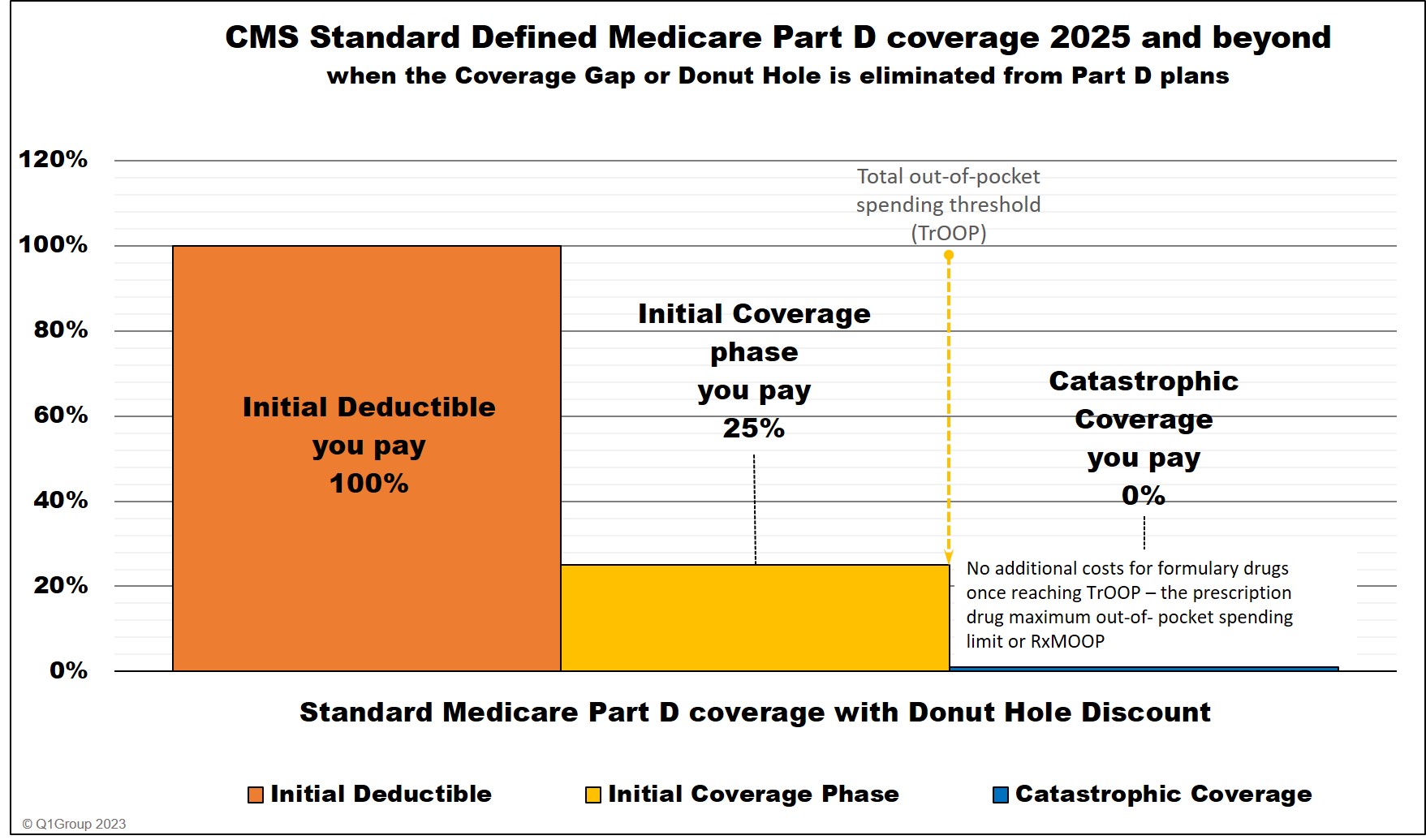
In 2025, the Inflation Reduction Act (IRA) eliminated the Coverage Gap and extended the Initial Coverage phase until a person has spent $2,000 out-of-pocket for Part D formulary drugs. The $2,000 represents the prescription drug maximum out-of-pocket spending limit (RxMOOP). And as stated above, when a person reaches the RxMOOP ($2,100 in 2026), the plan member enters Catastrophic Coverage and will not have any additional costs for Part D formulary drugs for the remainder of the year.
Also in 2025, the IRA changed the percentage of the drug costs allocated to the brand-name drug manufacturer, Medicare Part D plan, and the federal government, see example table below.
| Beginning January 1, 2025 When you purchase a Part D formulary medication with a $100 retail cost |
||||||
| Brand-name Drug Retail Cost |
You Pay | Your Medicare drug plan pays |
Pharma Mfgr. pays |
Federal Govern. pays |
Amount counted toward your RxMOOP Threshold |
|
| Initial Deductible (if any) |
$100 | $100 | $0 | $0 | $0 | $100 |
| Initial Coverage phase - brand-drugs * | $100 | $25 | $65 | $10** | $0 | $25 |
| Initial Coverage phase - generic-drugs * | $100 | $25 | $75 | $0 | $0 | $25 |
| Catastrophic Coverage (brand drug) **** | $100 | $0 | $60 | $20 | $20 | n/a |
| Catastrophic Coverage (generic drug) **** | $100 | $0 | $60 | $0 | $40 | n/a |
* 25% coinsurance or cost-sharing until you reach the $2,000 RxMOOP, then your Part D formulary drug costs are $0 for the remainder of the year.
** The 10% brand-name drug manufacturer portion paid in the 2025 Initial Coverage phase (after the standard deductible) does not apply toward the $2,000 TrOOP threshold (https://www.cms.gov/files/document/manufacturer-discount-program-final-guidance.pdf).
**** Starting in 2025, the Coverage Gap (or Donut Hole) no longer exists for plan members. A plan member will stay in the Initial Coverage phase until exceeding the plan's $2,000 out-of-pocket spending threshold and then enter Catastrophic Coverage where for the remainder of the year, the person will have no out-of-pocket costs for formulary drugs. As noted below, the $2,000 out-of-pocket threshold or RxMOOP can change every year.
Medicare Part D coverage 2025 and beyond
Question: Can the $2,000 RxMOOP change every year?
Yes. Like other Medicare Part D plan parameters, the annual $2,000 RxMOOP can (and probably will) change every year. Currently, the Catastrophic Coverage threshold (or RxMOOP) is predicted to decrease over time.
| Year | Catastrophic threshold (RxMOOP) |
| 2024 |
$8,000 |
| 2025 |
$2,000 |
| 2026 | $2,100 |
| 2027 | $2,050 |
| 2028 | $2,000 |
| 2029 | $1,950 |
To help you visualize the phases of your Medicare Part D prescription drug plan coverage, we have a Out-of-Pocket Cost Calculator or PDP-Planner.com online illustrating the changes in your monthly estimated costs based on the established annual standard Medicare Part D plan limits mentioned above.
A bit of history...
Prior to plan year 2024, Medicare Part D plan members who had high medication costs would pay roughly 5% of the formulary drug's retail cost during the Catastrophic Coverage phase.
Of the remaining 95% of the total retail drug cost, 80% of the cost was paid by the federal government or Medicare’s reinsurance subsidy, 15% of the retail drug cost was
paid by the Medicare prescription drug plan (Medicare Part D plan or Medicare Advantage plan).
So, as illustrated in the example below, if you reached the 2023 Catastrophic Coverage phase and buy a brand-name formulary drug with a $300 retail cost, you paid $15 for the drug, the federal government paid $240, and the Medicare Part D prescription drug plan paid $45.
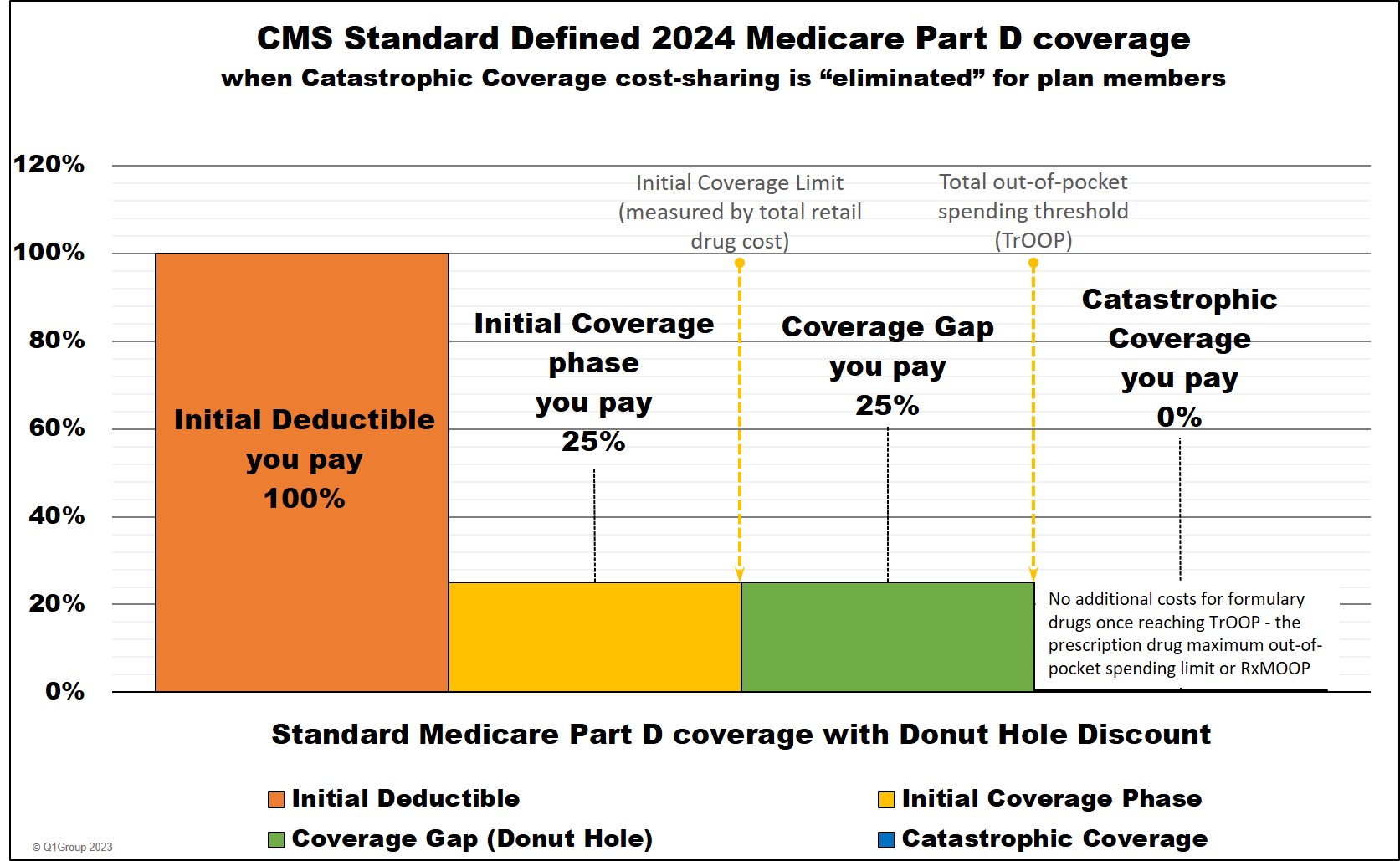
In 2024, the Inflation Reduction Act (IRA) eliminated beneficiary cost-sharing in the Catastrophic Coverage phase.
Below is a chart showing how example formulary drug purchases were paid throughout your Medicare Part D plan coverage -- using the CMS defined standard benefit Medicare Part D plan with a fixed 25% coinsurance for calculating cost-sharing.
|
Beginning January 1, 2024 When you purchase a Part D formulary medication with a $100 retail cost |
||||||
| Retail Cost | You Pay | Your Medicare drug plan pays |
Pharma Mfgr. pays |
Federal Govern. pays |
Amount counted toward your TrOOP Threshold |
|
| Initial Deductible | $100 | $100 | $0 | $0 | $0 | $100 |
| Initial Coverage phase * | $100 | $25 | $75 | $0 | $0 | $25 |
| Coverage Gap - brand-name ** | $100 | $25 | $5 | $70 | $0 | $95 |
| Coverage Gap - generic *** | $100 | $25 | $75 | $0 | $0 | $25 |
| Catastrophic Coverage (brand drug) **** | $100 | $0 | $20 | $0 | $80 | n/a |
| Catastrophic Coverage (generic drug) **** | $100 | $0 | $20 | $0 | $80 | n/a |
* 25% coinsurance or cost-sharing
** 75% Brand-name Donut Hole Discount
*** 75% Generic Donut Hole Discount
**** In 2024, the Catastrophic Coverage phase still existed, but plan members did not have any out-of-pocket costs for formulary drugs after reaching the plan's $8,000 total out-of-pocket threshold (TrOOP).
2024 Medicare Part D coverage
Question: How did the Catastrophic Coverage work prior to 2024?
Prior to 2024, in the Catastrophic Coverage phase, you paid either a flat copay fee (set annually) or 5% of the plan's negotiated retail drug cost (whichever was greater) for your formulary medications, depending on the type of drug -- generics or preferred brand drugs that are multi-source drugs vs. all other drugs.
For example, in 2023, you paid the higher of either 5% of the drug's retail price or $10.35 for brand name drugs or $4.15 for generic drugs in Catastrophic Coverage.
So in 2023, if you purchased a brand-name drug with a retail price of $100 in the Catastrophic Coverage phase, you paid $10.35 for the prescription fill since the fixed $10.35 brand-name drug copay is higher than 5% of the $100 retail drug price (or $5). But, if you purchased a brand-name formulary drug with a retail cost of $300, you paid $15 in the 2023 Catastrophic Coverage phase since 5% of $300 ($15) is more than the 2023 fixed copay of $10.35.
2023 Medicare Part D coverage

Here is how example formulary drug purchases are calculated throughout your 2023 Medicare Part D plan (using the CMS defined standard benefit Medicare Part D plan as a guide).
| When you purchase a formulary medication during your 2023 Medicare Part D prescription drug coverage - assuming a $100 retail drug cost (or $300 retail drug cost in our brand-name drug Catastrophic Coverage example) | ||||||
| Retail Cost | You Pay | Your Medicare drug plan pays |
Pharma Mfgr. pays |
Federal Govern. pays |
Amount counting toward your TrOOP Threshold |
|
| Initial Deductible | $100 | $100 | $0 | $0 | $0 | $100 |
| Initial Coverage phase * | $100 | $25 | $75 | $0 | $0 | $25 |
| Coverage Gap - brand-name ** | $100 | $25 | $5 | $70 | $0 | $95 |
| Coverage Gap - generic *** | $100 | $25 | $75 | $0 | $0 | $25 |
| Catastrophic Coverage (brand drug) **** | $300 | $15 | $45 | $0 | $240 | n/a |
| Catastrophic Coverage (generic drug) **** | $100 | $5 | $15 | $0 | $80 | n/a |
* 25% coinsurance or cost-sharing
** 75% Brand-name Donut Hole Discount
*** 75% Generic Donut Hole Discount
**** In 2023, you paid 5% of retail or $10.35 for brand drugs whatever is higher or 5% of retail or $4.15 for generic or multi-source drugs whatever is higher (80% paid by Medicare, 15% paid by Medicare plan, and around 5% by plan member)
See:
https://www.democrats.senate.gov/imo/media/doc/inflation_reduction_act_of_2022.pdf
https://www.cms.gov/files/document/2025-announcement-pdf.pdf
https://www.cms.gov/oact/tr/2025