Next Step: Living with your selected Medicare Part D plan.
Perhaps one of the greatest challenges facing a Medicare beneficiary after selecting the "optimal*" Medicare Part D plan (MAPD or PDP) - is understanding how to best use your plan and how to budget for your annual drug costs.A Medicare Part D drug plan works like any other type of insurance:
- You pay a monthly premium (although some drug plans have a $0 monthly premium and some Medicare Advantage plans even provide a Part B "giveback" feature.
- You may pay an initial deductible before the plan begins sharing your formulary drug costs; however, some Medicare drug plans have a $0 deductible or
exclude some low-costing drugs from the deductible.
- After meeting the deductible (if any), you will share the cost of your covered Part D drugs with your Medicare drug plan (although some covered prescriptions could have a $0 copay).
- After you meet your annual out-of-pocket spending limit, you will have no further costs for your formulary drug purchases for the remainder of the year.
Unlike other forms of insurance, you may already have experience with your prescription drug usage and can therefore estimate what you will spend each month throughout the year.
Some Medicare beneficiaries will want to develop a drug plan budget - allocating a certain amount of money each month for prescription costs. In fact, you may want to do some additional planning because your annual prescription costs may vary greatly from month-to-month, due to your chosen Medicare Part D plan and prescription drug usage.
Please note that every Medicare drug plan provides the voluntary Medicare Premium Payment Plan allowing you to better smooth your annual drug plan spending over the year.
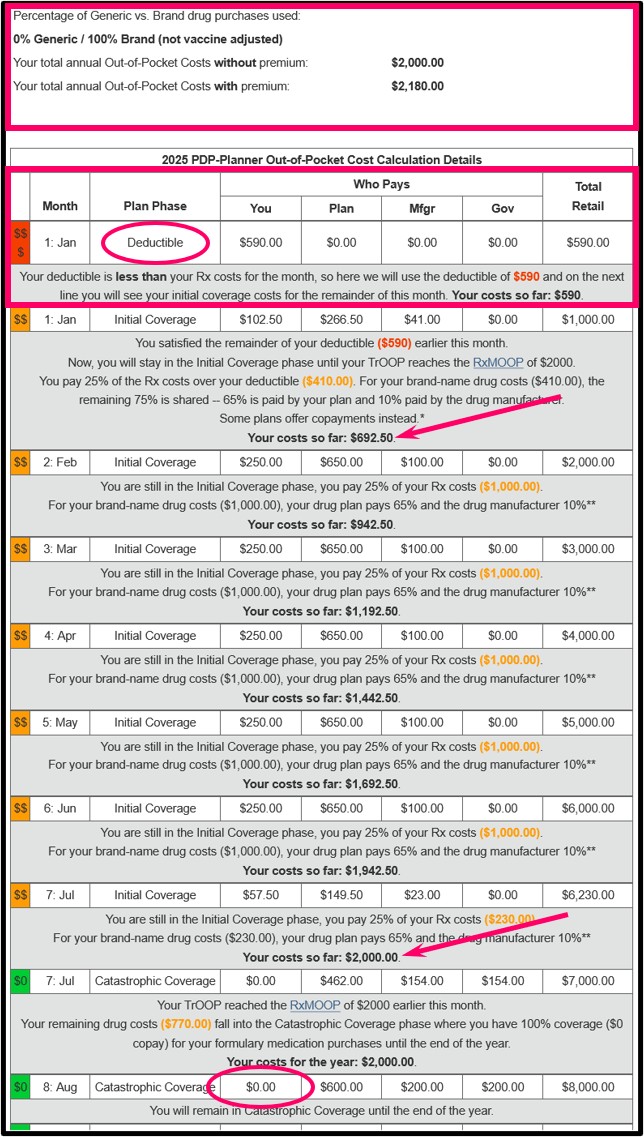
Assume that your chosen 2025 Medicare Part D plan has a $15 per month premium, a $590 annual deductible and 25% coinsurance (you pay 25% of the retail price of formulary drugs) and, based on your past experience, your average monthly retail cost of medications is about $1,000 (not what you pay, but the actual retail cost without insurance).
Your monthly Medicare Part D costs would be as follows:
Tip: Need some assistance understanding your monthly costs: try our PDP-Planner Out-of-Pocket Cost Calculator (PDP-Planner.com).
The this site Out-of-Pocket Cost Calculator helps you estimate when (or if) you will reach your annual out-of-pocket spending limit and provides an idea of your monthly and annual Medicare Part D prescription drug spending. You can begin by entering your estimated monthly retail drug costs and choose the variables that apply to your Medicare drug plan, you can then see an estimation of what you may spend as you move through the different phases of your Part D plan coverage.
*Your prescription and healthcare needs can change over time and "optimal" really means that you have selected the Medicare drug plan that most economically (and conveniently) covers your current and projected health and prescription needs. Unfortunately, the "optimal" Medicare drug plan you selected in October may not remain the "optimal" drug plan in June of the following year – and you may need to look for a Special Enrollment Period (SEP) that would allow you to change Medicare plans during the year, or plan on changing your Medicare drug coverage during the next annual Open Enrollment Period (AEP) - starting October 15th and continuing through December 7th.