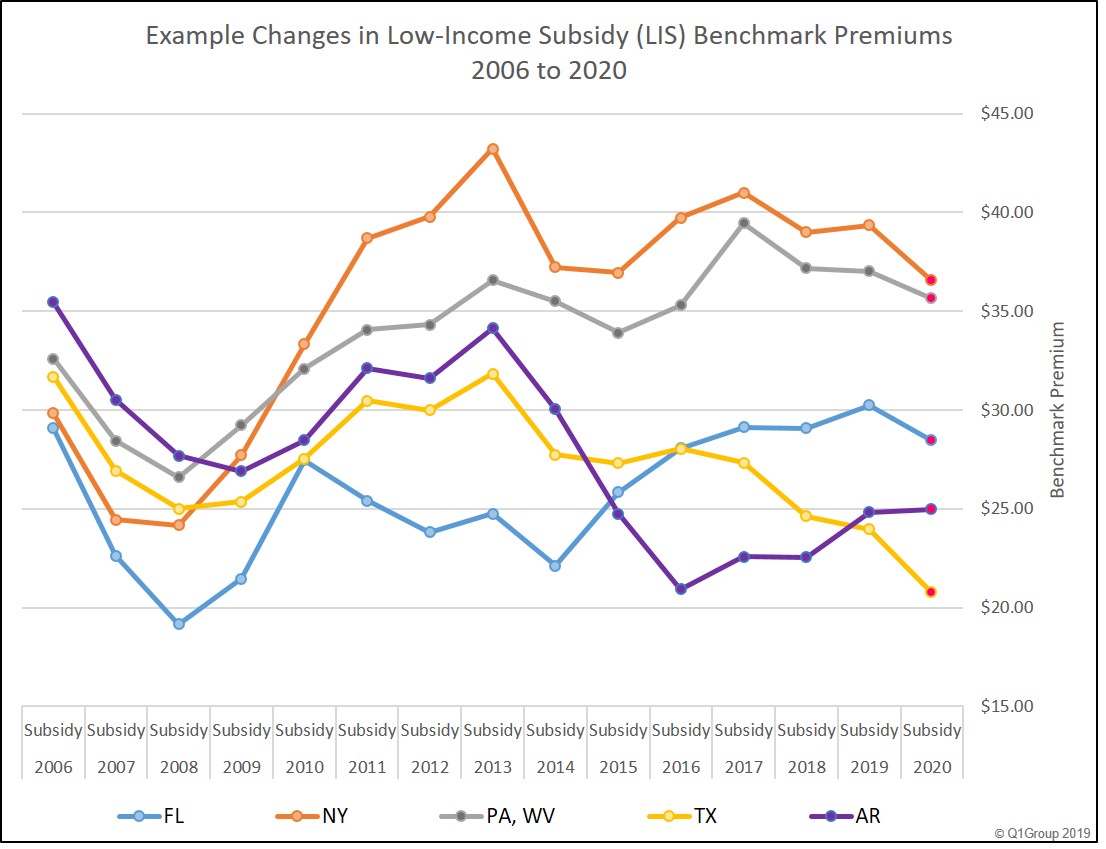
Here are a few state highlights of the 2020 LIS benchmarks:
- Ohio
will see the largest benchmark decrease with a 2020 LIS subsidy of
$28.54
as compared to
$32.92 in 2019.
Colorado
had the largest benchmark decrease last year.
- Arkansas
will have the only benchmark increase with a 2020 LIS benchmark
of $24.96
as compared to
$24.81
in 2019.
Arkansas
also had the largest benchmark increase in 2019.
- Wisconsin
will continue to have the highest benchmark premium of all CMS PDP
regions at $39.91.
Last year,
Wisconsin
also had the highest benchmark premium at $40.80.
- Texas will continue to have the lowest benchmark premium at $20.78. Texas also had the lowest benchmark in 2019.
What is the LIS Benchmark Premium?
As a reminder, the benchmark premium is the maximum monthly Medicare Part D plan premium that will be paid by CMS for
persons qualifying for the low-income subsidy (LIS) or the Medicare Part D "
Extra Help"
program.
If a person receiving the
low-income subsidy
enrolls in a Medicare Part D plan that has a premium higher than the subsidy amount listed below for
their state, the beneficiary is responsible for paying the difference in premiums (unless the difference between the benchmark premium and the plan premium are relatively small, please see the
explanation of the de minimis premium policy below*).
Below is a chart showing how the annual Medicare Part D LIS Benchmark premiums have fluctuated since 2006. The example states were chosen due to their relatively large population of seniors.
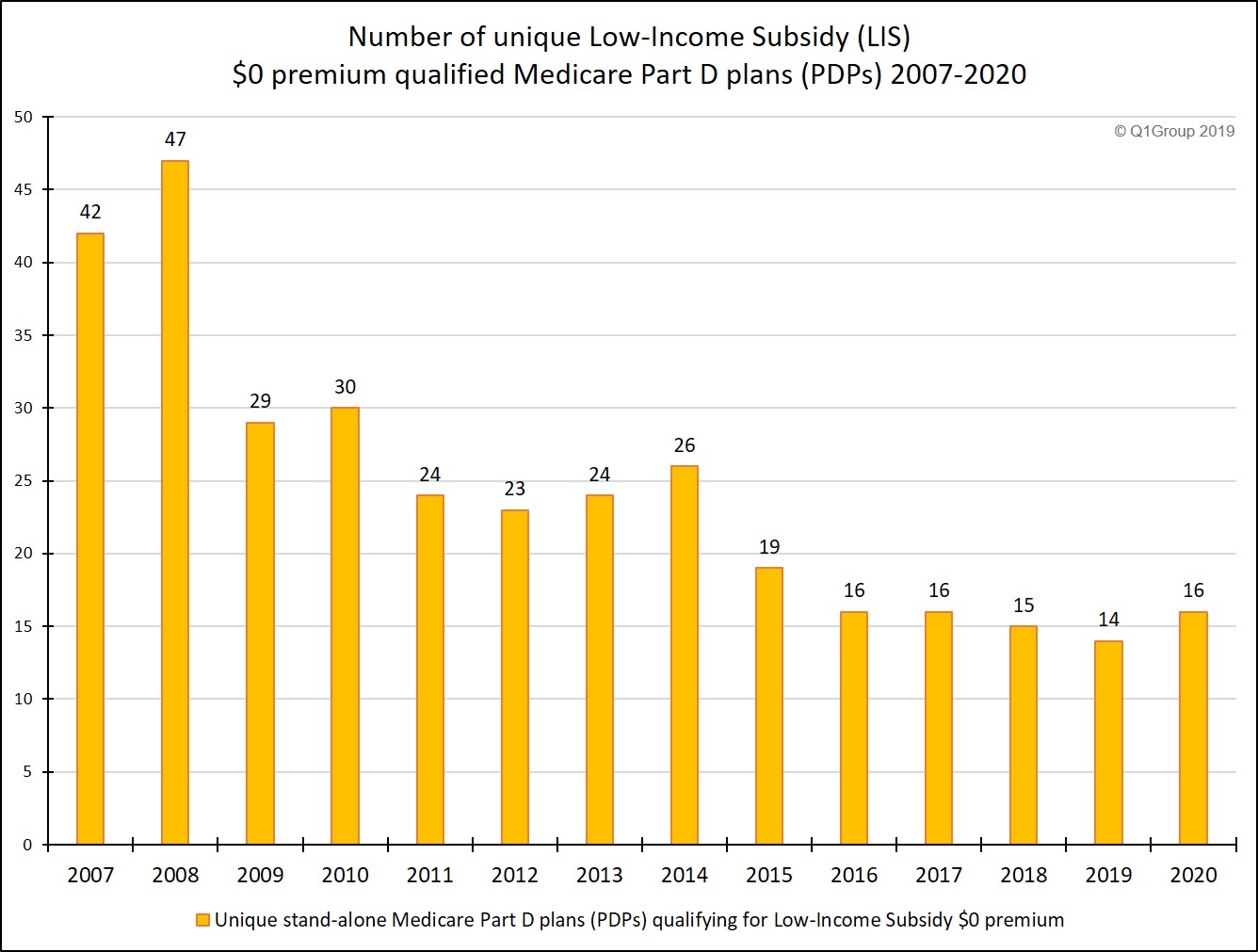
You can click on the premium subsidy in the table below to see the stand-alone Medicare Part D prescription drug plans (PDPs) for the selected year that qualify for the $0 LIS premium (the 2020 Medicare Part D plan information will be available starting October 1, 2019).
Changes in the number of stand-alone Medicare Part D plans qualifying for the $0 LIS premium (2006-2019).
*Note: Under the CMS de minimis premium policy, "Part D plans are required to charge full-premium subsidy eligible beneficiaries a monthly Part D beneficiary premium equal to the applicable low-income premium subsidy amount, if the plan’s beneficiary premium for basic prescription drug coverage exceeds the low-income premium subsidy amount by $2 or less."
"Under the Affordable Care Act (ACA) §3303(a), a prescription drug plan (PDP) or Medicare Advantage plan with prescription drug coverage (MA-PD) may volunteer to waive the portion of the monthly adjusted basic beneficiary premium that is a de minimis amount above the low-income subsidy (LIS) benchmark for a subsidy eligible individual. The law prohibits CMS from reassigning LIS members from plans who volunteered to waive the de minimis amount. The de minimis amount for 2020 will be $2. The de minimis amount for 2020 for a plan participating in the Part D Payment Modernization Model will also be $2."
**Note: The 2009 low-income benchmark premium amount calculated for region 29 is $19.68. The low-income premium subsidy amount of $20.20 is the lowest monthly beneficiary premium for a PDP that offers basic coverage in region 29. Section 1860D-14(b)(3) of the Social Security Act states that the low-income premium subsidy amount is the greater of the lowest monthly beneficiary premium for a PDP that offers basic coverage and the low-income benchmark premium amount.