As a departure from past years, CMS based the 2024 Part D premium prediction on the "Average Total" Part D premium taking into consideration both "Basic" Part D premiums and additional Part D "Supplemental" premiums weighted by June 2023 Part D plan enrollment. Since 2006, CMS has been using the estimated "basic" Medicare Part D premium to predict upcoming premium changes.
In the Fact Sheet accompanying the government's press release, CMS reasoned that the "average total" Part D premium was "the most accurate current projection of what people will pay in 2024 for Part D premiums" since approximately 75% of Medicare beneficiaries are enrolled in an Enhanced Alternative Medicare Part D plan providing benefits beyond "basic" or standard Part D coverage (such as plans with a $0 deductible and formulary drug cost-sharing below the standard 25% of retail cost). And although the 2024 average "basic" Part D premium is projected to increase 7.5%, the reduction in the average 2024 "supplemental" premium offsets the estimated "basic" premium increase.
CMS also adds some clarification to different terminology when discussing the estimation of Medicare Part D plan premiums ultimately paid by Medicare Part D plan members:
- 2024 National Average Monthly Bid Amount: 85% increase
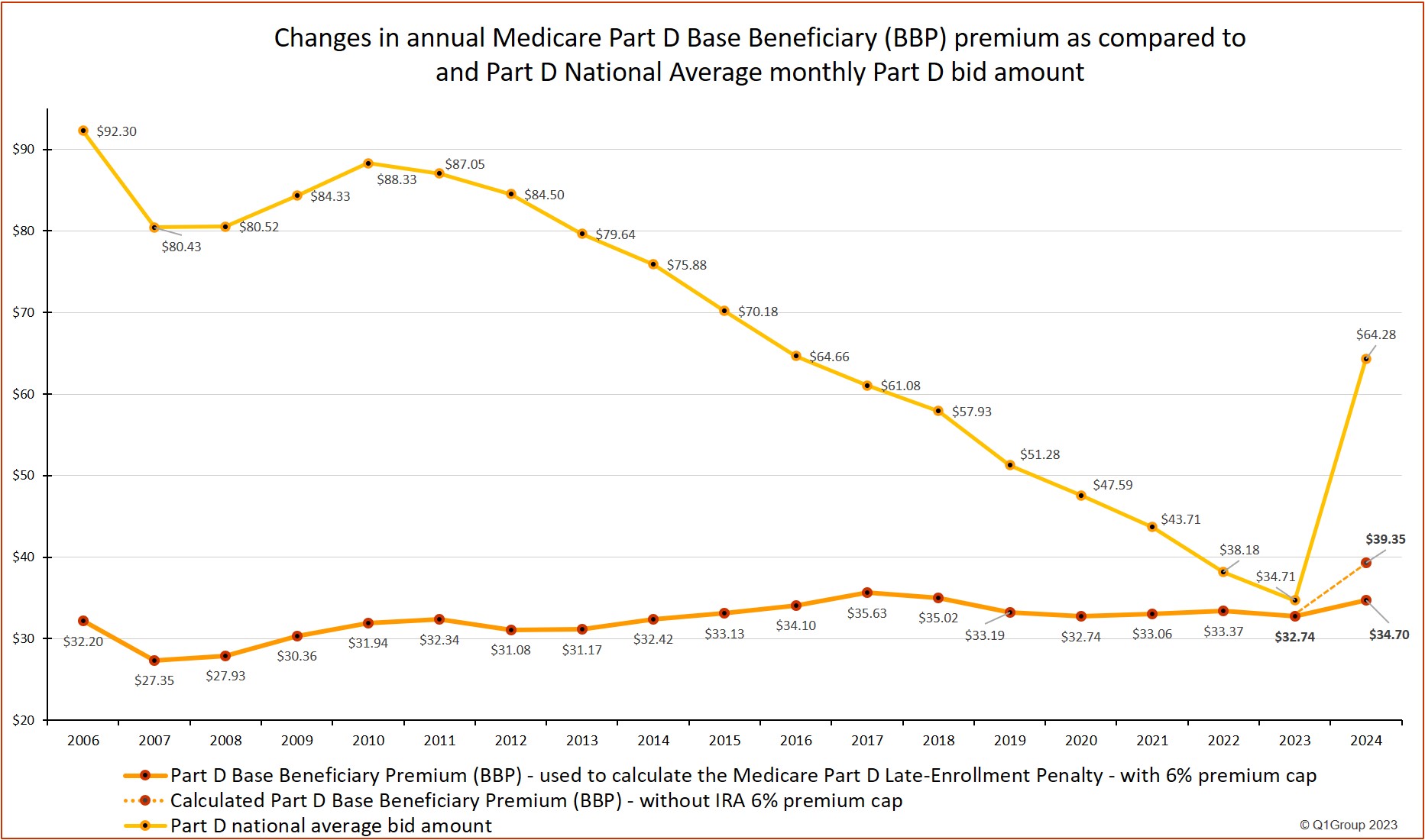
As noted by CMS, "[t]he national average monthly bid amount is [an enrollee] weighted average of the standardized bid amounts for each stand-alone prescription drug plan (PDP) and MA plan with prescription drug coverage (MA-PD)". The calculation excludes certain Medicare plans such as MSA plans, MA PFFS plans, and PACE plans. CMS calculated that the 2024 Part D "national average monthly bid amount" is $64.28 - an 85% increase over the 2023 average monthly bid $34.71.
- 2024 Part D Base Beneficiary Premium (BBP) - with IRA premium stabilization: 6% increase
The Part D Base Beneficiary Premium is calculated every year by CMS using, in part, the Part D national average monthly premium bid which is weighted by Medicare plan enrollment. With the increase in the national average bid, the increase in the 2024 BBP would have been $39.35, a 20% increase over the 2023 Base Beneficiary Premium of $32.74.
However, as noted by Medicare: "[b]eginning in [plan year] 2024, the annual growth in the Base Beneficiary Premium [BBP] will be capped at 6 percent. The Base Beneficiary Premium for Part D is limited to the lesser of a 6 percent annual increase, or the amount that would otherwise apply under the prior methodology had the [Inflation Reduction Act] not been enacted." Therefore, "the premium stabilization provision reduced the increase in the base beneficiary premium by 14 percentage points; the base beneficiary premium will increase by 6% in 2024 to $34.70".
The Part D Base Beneficiary Premium is also used each year to determine the amount of a person's Part D late-enrollment penalty. The annual late-enrollment penalty is calculated as 1% of the annual BBP multiplied by the number of months a person was without some form of creditable prescription drug coverage. (For example, if you waited 12 months to join a Part D drug plan after becoming eligible for Medicare, and did not have any other form of creditable drug coverage, your 2024 penalty would be 12 * $0.3470 or $4.20 per month paid in addition to your Part D drug plan premium (rounded to nearest $0.10).
The following chart shows how the National Average monthly Part D premium bid has changed in comparison with the Medicare Part D Base Beneficiary Premium and how the BBP would have increase in 2024 if the value was not capped at a 6% increase.
- 2024 estimated Part D average Basic Part D premium: 7.5% increase
The annual Part D Base Beneficiary Premium is then "used to calculate a plan-specific monthly premium for the basic benefit offered by each Part D plan, called the basic Part D premium".
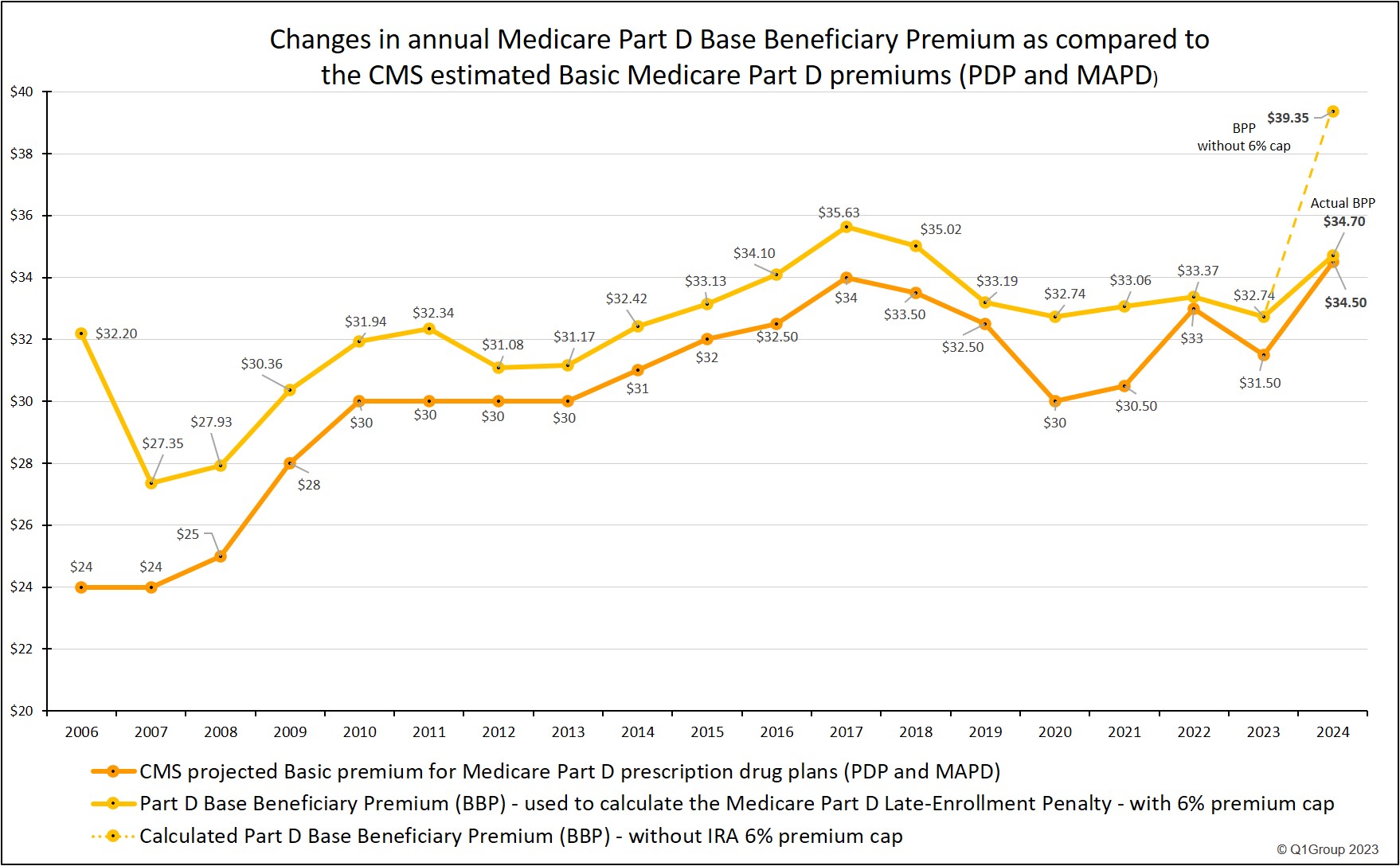
In 2024, the average basic Medicare Part D premium will increase 7.5% to $34.50 from the actual average 2023 Part D basic premium of $32.09 - accordingly, as per CMS estimates, approximately 25% of Medicare Part D beneficiaries are enrolled in a Medicare Part D plan offering basic or standard Part D coverage and may be affected by this 7.5% average premium increase.
Question: Does the Base Beneficiary Premium predict Part D plan-specific basic Medicare Part D plan premiums?
Not exactly. As noted by CMS, the "plan-specific basic premium can be higher or lower than the base beneficiary premium depending on if the plan’s bid is higher or lower than the national average bid." "[T]he plan-specific basic Part D premium is calculated as the sum of the base beneficiary premium and the difference between the plan’s monthly bid and the national average monthly bid amount. Thus, the plan-specific basic premium can be higher or lower than the base beneficiary premium, depending on if the plan’s bid is higher or lower than the national average monthly bid amount. These plan-specific basic premiums across all plans that submit bids are then averaged together to calculate the average basic Part D premium."
The following chart shows how the estimated monthly Basic Part D premium has changed in comparison with the Medicare Part D Base Beneficiary Premium and how the BBP would have increase in 2024 if the value was not capped at a 6% increase.
Question: How have projected average basic Medicare Part D premiums changed over time?
The following are Medicare's annual projected "basic" Medicare Part D premiums weighted by enrollment. The actual annual average basic Medicare Part D premium reported by Medicare may be slightly higher or lower than the projected premium depending on actual Medicare plan enrollment for the year.
For example, in 2022, the annual CMS press release entitled, "CMS Releases 2023 Projected Medicare Basic Part D Average Premium", noted that "the average basic monthly premium for standard [2023] Medicare Part D coverage is projected to be approximately $31.50.... This expected amount is a decrease of 1.8%" from the actual 2022 basic premium of $32.08. The calculated 2022 Basic Part D premium, based on June 2021 plan enrollment, was $33.
Below is a list of the past CMS' estimates of basic Medicare Part D premiums with links to a brief analysis of the annual prediction.
- 2024 estimated Supplemental D premium: 14% decrease
Medicare Part D plans can have either basic or standard Medicare Part D plan coverage (plans designated as (BA, DS, AE)) or the Part D plans can add coverage features beyond basic Part D coverage and these plans are called Enhanced Alternative Medicare Part D plans (or Part D plans designated as (EA)). To cover these additional coverage features ($0 deductible or cost-sharing less than paying 25% of retail drug prices) Enhanced Alternative Medicare Part D plans will have a Supplemental premium added to the plan's Basic Part D premium. According to CMS, the vast majority (75%) of Medicare Part D beneficiaries are currently enrolled in a Part D plan with enhanced features.
The past average Supplemental premiums provided by CMS are:
- 2020: $13.47
- 2021: $15.22
- 2022: $19.51
- 2023: $24.40
- 2024: $21.00
In the press release Fact Sheet, CMS reasoned that the decrease in the 2024 Supplemental Part D premium was "largely driven by the enhancements described below to the 2024 Part D basic benefit mandated by the IRA and CMS’ recent rulemaking on pharmacy price concessions. These basic benefit enhancements reduce the need for additional benefit enhancements traditionally offered by enhanced alternative [EA] Part D plans, resulting in a lower supplemental premium."
- 2024 estimated Average Total Part D premium: 1.8% decrease
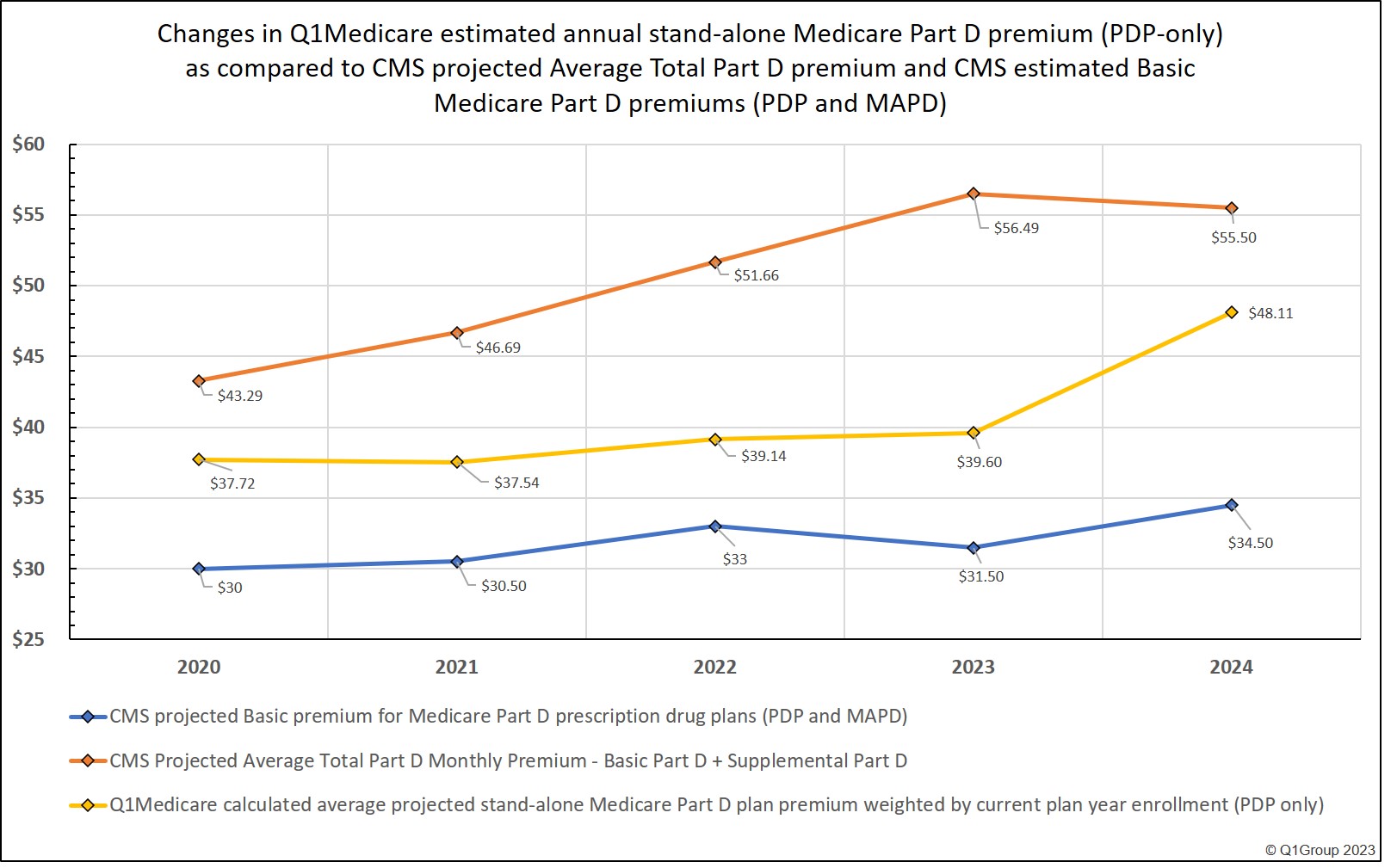
As noted, instead of using only the average "Basic" Part D premium as an estimate of 2024 Medicare Part D plan premium changes, CMS is instead using the Average Total Part D premium calculated as the sum of the average "Basic" premium and the average Supplemental premium for Medicare Part D plans.
In the end, CMS noted that, "the IRA’s [6%] premium stabilization provision has moderated the growth in the average basic premium, which, when taken with a lower average supplemental premium, results in a lower [estimated] average total [2024 Part D] premium."
The following chart shows how the estimated CMS monthly Basic Part D premium has changed in comparison to the CMS Average Total Part D Premium and how these two CMS estimates compare to the this site calculation of actual weighted average of stand-alone Medicare Part D plans (PDP-only - weighted by the current year's plan enrollment).
Question: Does the projected decrease in the CMS estimated Average Total Medicare Part D premium mean you will pay less for your 2024 Medicare Part D plan?
Not exactly. As noted by CMS, the average total monthly Medicare Part D premium released by CMS may not reflect the actual changes you see in your 2024 Medicare Part D prescription drug plan premiums - or overall coverage.
CMS noted that the "[Medicare Part D] plan-specific basic premium can be higher or lower than the base beneficiary premium depending on if the plan’s bid is higher or lower than the national average bid. Moreover, the base beneficiary premium is calculated across certain plans that submit bids, as specified by statute, while the average basic premium is calculated across all plans that submit bids."
In short, the CMS projected average total premium suggests that you should be able to shop around during the annual Open Enrollment Period (AEP) and find a stand-alone Medicare prescription drug plan (PDP) with about the same monthly premium as you currently have now - or you may want to consider changing enrollment to a low-premium (or $0 premium) Medicare Advantage plan that includes prescription drug coverage (MAPD) - or even an MAPD that offers a Part B premium Giveback feature (the MAPD plan rebates a portion of your Medicare Part B premium).
- 2024 this site annual calculation of average stand-alone Medicare Part D (PDP) premium: $48.11
Each year, this site calculates the average stand-alone Medicare Part D plan premiums (both weighted by the most-recent plan enrollment and unweighted) based on an analysis of CMS Medicare Part D prescription drug plan (PDP) landscape data and shown in the on this site PDP-Facts section.
Unlike CMS, the this site analysis does not include the premiums for Medicare Advantage plans offering prescription drug coverage (MAPDs) combined with stand-alone Medicare Part D plans (PDPs). Instead, the this site analysis only focuses on stand-alone Part D PDP plans for several reasons:
-
First, Medicare Part D plans (PDPs) are offered on a statewide (or multi-state regional)
basis and Medicare Advantage prescription drug plans (MAPDs) are
offered within much smaller service areas (ZIP code, partial-ZIP, or
county basis) - and more MAPDs are available in densely populated areas
where Medicare plans can easily establish healthcare networks as
compared to rural areas (for example, there are no 2024 Medicare Advantage plans offered in Alaska). So low-premium MAPDs may not be widely
available to all Medicare beneficiaries in a state.
- In addition, many popular MAPDs have a low or $0 premium and these low premiums tend to skew the average weighted monthly premium for prescription drug coverage toward lower values that are not reflective of the stand-alone Medicare Part D plan (PDP) landscape. In short, a national average of combined PDP and MAPD premiums weighted by enrollment may not reflect the actual stand-alone Medicare Part D plan premiums available to all seniors.
Question: So how does the CMS projected Medicare Part D premium actually compare to the stand-alone Medicare Part D (PDP) plan landscape?
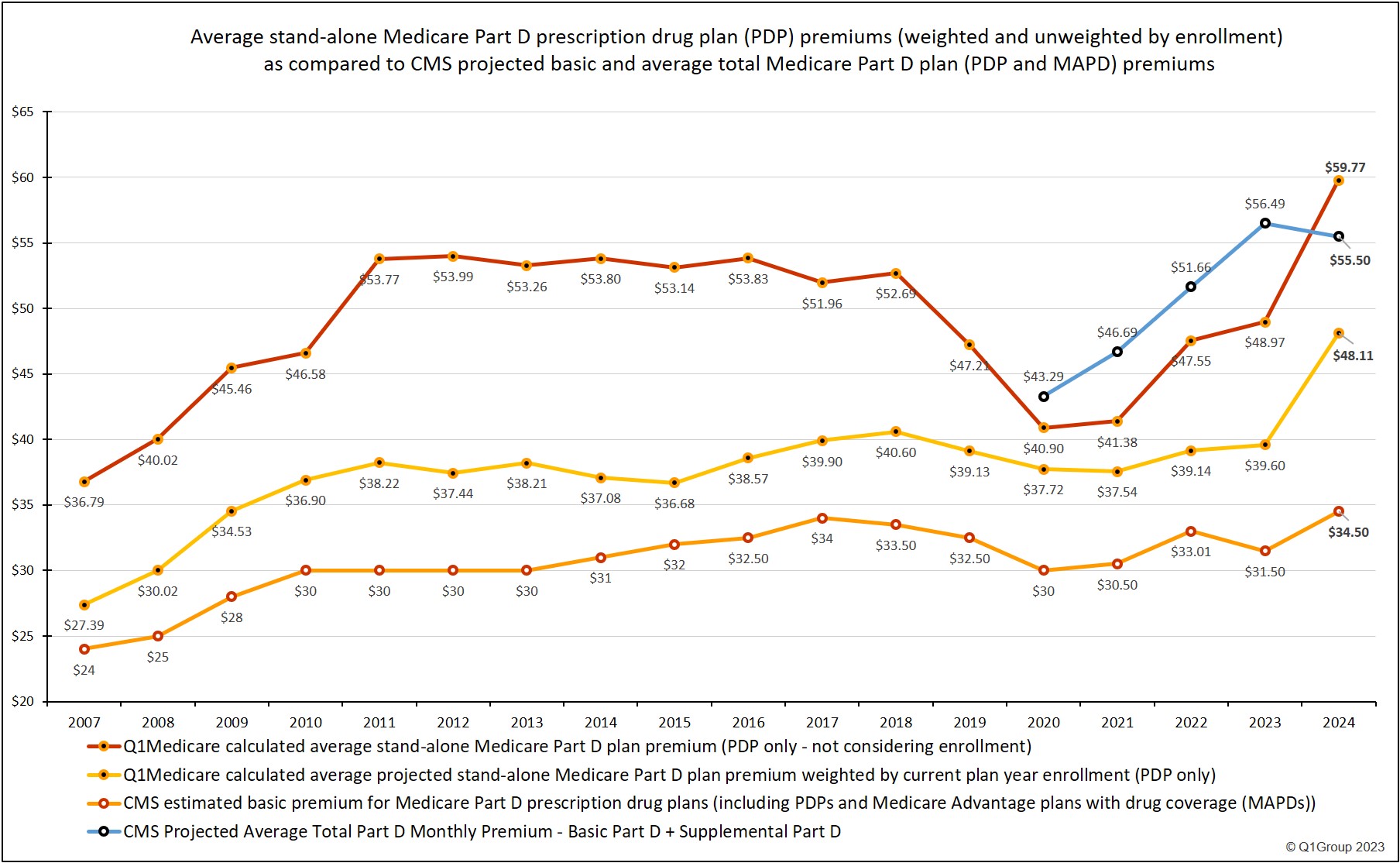
The following chart shows variations or trends in CMS projected average Basic Medicare Part D plan premiums (PDP and MAPD) and Average Total Medicare Part D premium as compared to our calculated average stand-alone Medicare Part D plan (PDP-only) premiums (weighted and unweighted by plan enrollment).
CMS estimated average basic and average total Medicare Part D premiums
vs. actual weighted (and unweighted) stand-alone Medicare Part D premiums
Average Premiums weighted by enrollment as compared to Average unweighted Premiums
Over time we have seen trends of increasing and then stabilizing of average stand-alone Medicare Part D (PDP) premiums - with PDP premiums weighted by plan enrollment remaining more consistent or stable - decreasing and - then increasing starting in 2022. From this chart, we might conclude that people are staying with moderately priced PDPs, even with premium increases - or, as noted by CMS, people are moving to Part D plans with richer, enhanced features having higher premiums.
Here is a summary of our average-weighted PDP premiums over the past years:
- We calculated the 2023 average and weighted average monthly premiums across all stand-alone Medicare Part D plans (not considering Medicare Advantage plans offering prescription drug coverage or MAPDs) to be $48.97 - or $42.62 when weighted by stand-alone Medicare Part D plan enrollment (updated 09/30/2022). You can find these values and others statistics at PDP-Facts.com/2023.
- We calculated the 2022 average and weighted average monthly premiums across all stand-alone Medicare Part D plans (PDPs) to be $47.55 - or $43.19 when weighted by stand-alone Medicare Part D plan enrollment (updated 09/30/2021). You can find these values and others statistics at PDP-Facts.com/2022.
- We calculated the 2021 average and weighted average monthly premiums across all stand-alone Medicare Part D plans (PDPs) to be $41.38 - or $40.70 when weighted by stand-alone Medicare Part D plan enrollment (updated 09/25/2020) (adjusted to $37.54 on 09/30/2021 due to enrollment changes). You can find these values and others statistics at PDP-Facts.com/2021.
- We calculated the 2020 average monthly premium across all stand-alone Medicare Part D plans (PDPs) to be $40.90 - or $41.40 (adjusted to $37.72 on 09/25/2020) when weighted by stand-alone Medicare Part D plan enrollment. (Updated 09/26/2019 and again on 09/25/2020)
Starting in October, people with Medicare Part D can begin to research their Medicare health and prescription plan options. During the annual Open Enrollment Period (AEP) that begins October 15th and ends December 7, 2023, beneficiaries can switch Medicare plans by enrolling in their newly selected plan. If you are not sure where to begin with the annual plan review process, you can start by calling a Medicare representative at 1-800-MEDICARE for more information.
Question: Will my 2023 Medicare Part D plan inform me about 2024 plan changes?
Yes. Everyone enrolled in a Medicare Part D or Medicare Advantage plan should review their Medicare plan's Annual Notice of Change letter (ANOC) that will be mailed in late-September. Even if your Medicare Part D plan premium remains stable (or decrease) – this does not mean that your 2024 Medicare plan’s drug coverage costs will decrease. Your Medicare drug plan's prescription coverage - which drugs are covered and at what cost - usually changes every year, even if your monthly Medicare plan premium remains the same or decreases slightly.
Finally, Medicare Part D plan members should review their Medicare plan's 2024 Evidence of Coverage (EOC) document mailed to them in early-October - or made available electronically for download. The EOC is a 200+ page document that includes detailed information about the Medicare plan's coverage.
Bottom Line: Medicare Part D plans change each year, so please be prepared to review your 2024 Medicare plan options starting in early October.
The full text of the July 31, 2023 CMS Press Release is included below:
July 31, 2023
The Centers for Medicare & Medicaid Services (CMS) today announced that the average total monthly premium for Medicare Part D coverage is projected to be approximately $55.50 in 2024. This expected amount is a decrease of 1.8% from $56.49 in 2023. Stable premiums for Medicare prescription drug coverage in 2024 are supported by improvements to the Part D program in the Inflation Reduction Act that allow people with Medicare to benefit from reduced costs.
CMS is releasing the projected average total monthly Part D premium—calculated based on plan bids submitted to CMS—to help individuals understand overall Part D premium trends before Medicare Open Enrollment when they can select from plan options for the upcoming benefit year.
The Medicare Part D program helps people with Medicare pay for both brand-name and generic prescription drugs. Part D remains one of Medicare’s most popular programs, with more than 51 million Medicare beneficiaries enrolled for prescription drug coverage. CMS continues to analyze changes to the Part D program carefully and engages with stakeholders to identify opportunities for improvements, particularly for reducing costs.
CMS is also releasing additional information—such as the Part D national average monthly bid amount—to help Part D plan sponsors finalize their premiums and prepare for Medicare Open Enrollment. Medicare Open Enrollment for coverage beginning January 1, 2024, will run from October 15 to December 7, 2023. CMS anticipates releasing the 2024 premium and cost-sharing information for 2024 Medicare Advantage and Part D plans in September 2023.
For more information on the Part D national average monthly bid amount, the Part D regional low-income premium subsidy amounts, the de minimis amount, the Medicare Advantage employer group waiver plan regional payment rates, and the Medicare Advantage regional preferred provider organization benchmarks, visit: www.cms.gov/medicare/health-plans/ medicareadvtgspecratestats/ratebooks-and-supporting-data/655541402/2024
References include:
https://www.cms.gov/newsroom/news-alert/cms-releases-2024-projected-medicare-part-d-premium-and-bid-information
Fact Sheet accompanying the CMS Press Release -
https://www.cms.gov/newsroom/fact-sheets/cms-releases-2024-projected-medicare-part-d-premium-and-bid-information
Annual Release of Part D National Average Monthly Bid Amount and Other Part C & D Bid Information -
https://www.cms.gov/files/document/july-31-2023-parts-c-d-announcement-pdf.pdf
2022 CMS Press Release -
https://www.cms.gov/newsroom/news-alert/cms-releases-2023-projected-medicare-basic-part-d-average-premium